
One Way to Use a Psych Ph.D.
As a student, this alum helped shut down UConn’s only primate testing lab. Now she’s training a new generation of animal advocates.
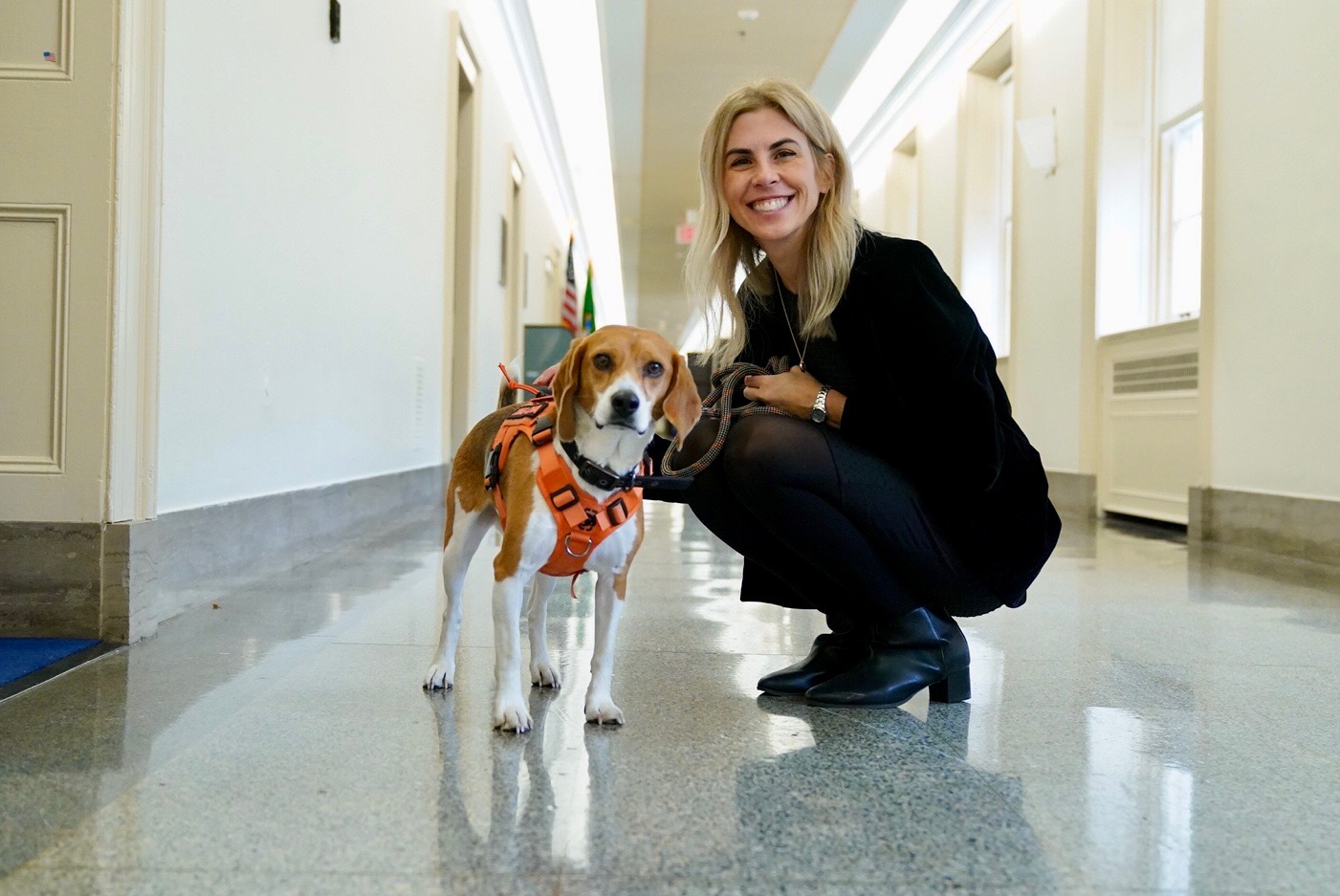
“These beagles make amazing companions. That’s why they’re used in laboratories, because of how docile they are and easy to handle. Those same traits that make them great companions make them vulnerable,” says Lopresti-Goodman.
After protesting for the closure of UConn’s only primate laboratory as students, Stacy Lopresti-Goodman ’09 Ph.D. and her husband, Justin Goodman ’05 (CLAS), ’08 MA, realized they wanted to devote their lives to animal protection.
A student group that the couple founded, the UConn Animal Rights Collective, tipped off the U.S. Department of Agriculture to animal welfare violations at a UConn Health lab, which ultimately led to the lab’s closure. “This was the first time that we had this concrete experience of, ‘Oh my God, we have power to effect change for animals,’” says Lopresti-Goodman.
Goodman went on to a leadership career at People for the Ethical Treatment of Animals and, now, the bipartisan government watchdog organization White Coat Waste Project.
Lopresti-Goodman has been using her experimental psychology doctorate to examine the psychological toll that animal testing takes on its subjects. She’s published in academic journals and commercial media, including The Hill, The Washington Post, and The New York Times; testified before lawmakers; lobbied for legislation; and served as an expert witness in animal cruelty trials. And after 17 years as a Marymount University professor teaching courses on primate psychology and animal advocacy alongside more traditional psych fare, she’s become director of animal law education and scholarship for the Animal Legal Defense Fund (ALDF), where she works with law school students, faculty, and staff to strengthen and expand animal law education across the country. We spoke with Lopresti-Goodman this spring as she began this latest endeavor.
How will you help ALDF train a new generation of animal advocates?
Right now I’m developing a template syllabus for an introductory animal law course to make it easier for faculty to offer these classes. Creating a new course can be a heavy lift, so this lowers that barrier. It also gives students a tool they can bring to faculty if they want to see animal law taught at their school.
The course introduces students to the legal frameworks that govern how humans use and interact with animals — everything from animal cruelty laws and dog fighting cases to custody disputes involving companion animals, wrongful death claims, endangered species protections, and federal regulation of animals used in research. The syllabus offers assignments and activities designed to get students actively engaged — not just reading about the law but also thinking about how it operates in practice.
I care deeply about teaching in a way that actually reaches students and has philosophy built into the course design.
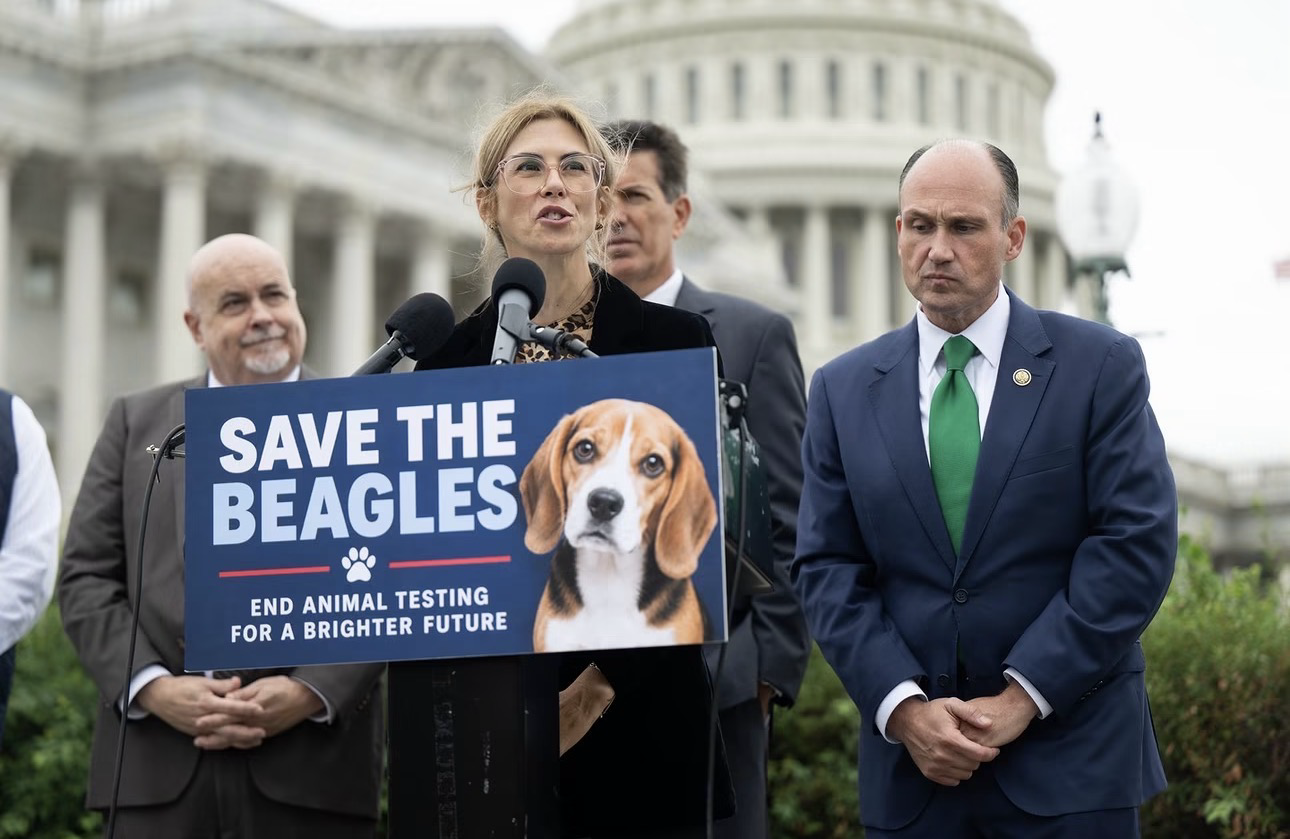
Lopresti-Goodman speaking at a Congressional Press Conference in September in support of a new bill that would prohibit funding for dog and cat research, and require their retirement into homes.
What issues do students who study animal law often end up working on IRL?
Animal law shows up in more places than people expect: custody disputes involving companion animals in divorce cases, trusts that provide for an animal’s care, housing policies that restrict pets, animal cruelty prosecutions. It is less a narrow specialty and more a set of issues that cuts across many areas of law.
How did you gain the legal background for this role?
I’ve worked within the legal system through public records requests, legislative advocacy, and policy efforts aimed at improving protections for animals. As students at UConn, my husband and I used the Freedom of Information Act to obtain records from a primate laboratory, which uncovered violations of the Animal Welfare Act, which in turn contributed to the lab shutting down. Then, as a professor at Marymount, I taught students how existing laws often fall short. That came up in courses like Primate Psychology, where we looked at the Animal Welfare and Endangered Species acts, and Food Ethics, which discussed the Humane Methods of Slaughter Act.
I also worked with students on advocacy efforts, including lobbying for legislation such as the Captive Primate Safety Act and Violet’s Law, which would require adoption options for animals used in nonlethal research. So while I’m new to ALDF, I’ve been working at the intersection of animal protection and the law for a long time.
Has your UConn dissertation on human perception and action informed your animal protection work at all?
In some ways, yes. Ecological psychology — what used to be called experimental psychology — emphasizes that similar processes underlie how all animals interact with their environments, which aligns with how I think about animal cognition and welfare. But more directly, my doctoral training shaped the skills I rely on most today. Research, writing, critical thinking, teaching, and public speaking have all been central to my work as an advocate.
I read that you were involved in the Ridglan Farm beagle case, the one that made national news this spring when the facility was shut down and 1,500 beagles raised for lab use were rescued and adopted out.
Yes, I submitted expert testimony in two lawsuits involving dogs confined at Ridglan. My role was to assess the behaviors visible in footage from inside the facility.
I observed stereotypic behaviors, such as repetitive circling and pacing, which are well-documented indicators of psychological distress. These behaviors are associated with barren environments, overcrowding, and lack of meaningful social interaction with other dogs and humans.
Are you seeing a move away from animal testing in this country?
There are still more than 100 million animals in U.S. laboratories, so we have a long way to go. Under the Animal Welfare Act, animals like dogs and primates can still be subjected to invasive and painful procedures. Amendments in the early 1990s acknowledged their social and psychological needs, but the regulations remain weak, and enforcement is limited. Primates can still be housed alone despite their complex social lives. Dogs may be kept in cages only slightly larger than their bodies, and minimal movement can count as exercise. So the law recognizes these animals’ needs on paper but does very little to protect them in practice. Stronger standards are needed, especially ones that address psychological well-being and create pathways for animals used in nonterminal studies to be retired to sanctuaries or adopted into loving homes.
But I am encouraged by the increasing shift at both the state and federal levels toward more ethical, human-relevant alternatives to animal testing.
Do you see other causes for optimism?
What keeps me going even when it is hard, is knowing that I’m documenting these experiences to show how closely they mirror human responses to trauma, which can inform both scientific understanding and advocacy efforts. When people understand that the way other animals experience the world and suffer is similar to the way we do, it helps build empathy, which I hope then turns into action to help animals.
The first time I visited the Save the Chimps sanctuary in 2011, I was brought to tears. The chimpanzees, all rescued from biomedical research, were living on large open islands, lounging in the sun, and grooming one another. Knowing where they had come from made the contrast incredibly powerful, especially seeing how resilient they were. I had a similar experience last year at Kindness Ranch Animal Sanctuary. I sat on the floor while a group of beagles rescued from testing climbed all over me, and I couldn’t help but cry. It was a mix of sadness for what they had endured and joy in knowing they were headed to loving homes. I guess I cry a lot!
What’s something you’d like people to understand about your work?
I think that we all have the power to improve the lives of animals just through our everyday actions. Deciding what products to buy, you know, were they tested on animals? If you hear about something that’s happening and you don’t agree with it, you can contact your representative about legislation that would either prohibit that or would support other ways to help animals. For example, there are a lot of statewide bills that require adoption as an option for animals who are used in nonlethal studies, like dogs coming out of labs. People can read about animal protection issues online, tweet, share, all the things — we really do have a lot of power to make small changes in our lives for animals. If people feel compelled to do so, I hope that they do.
By Siobhan Moynihan Murray