
A Coach’s Comeback
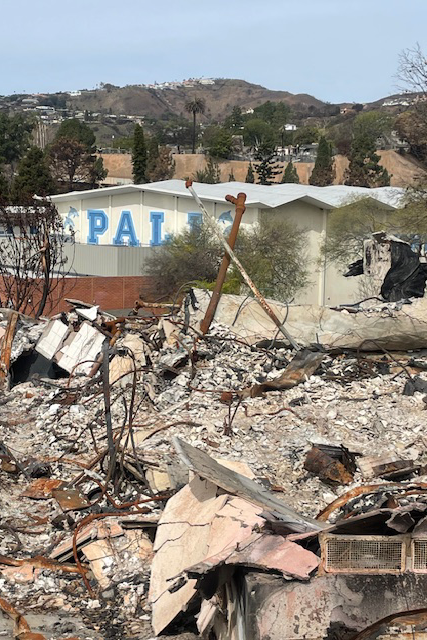
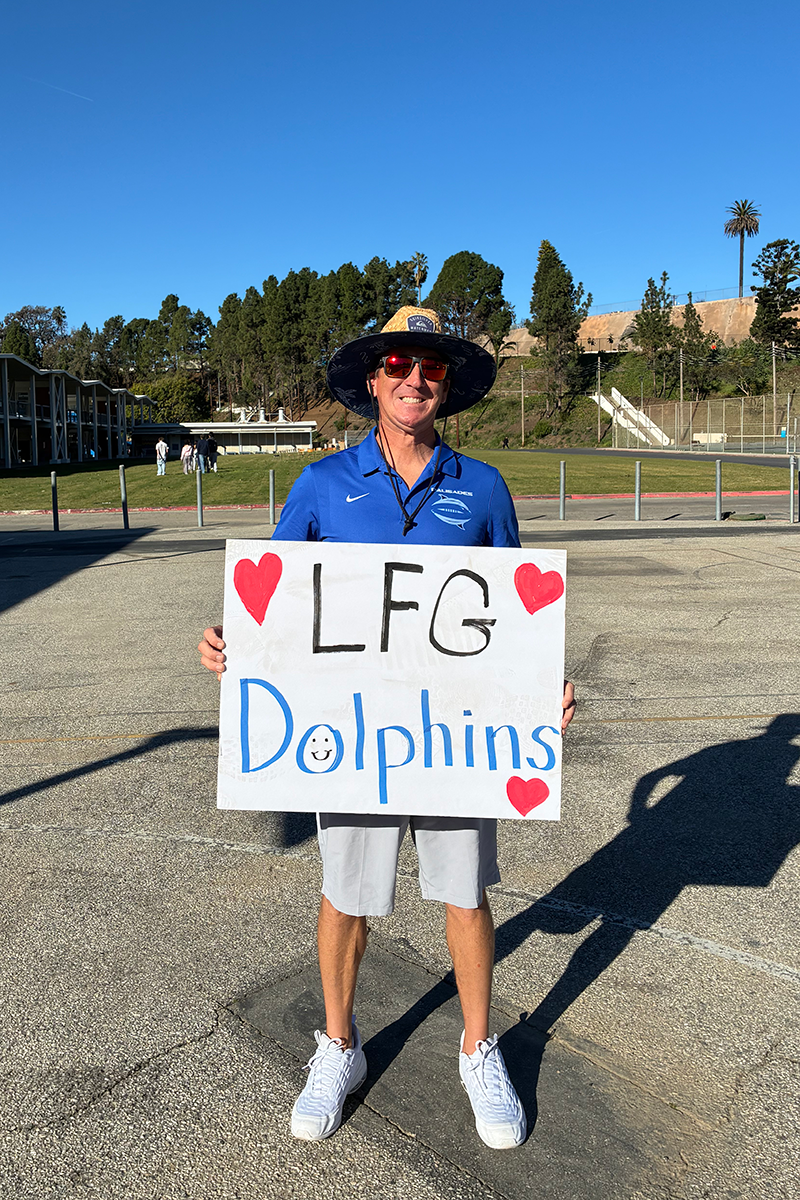
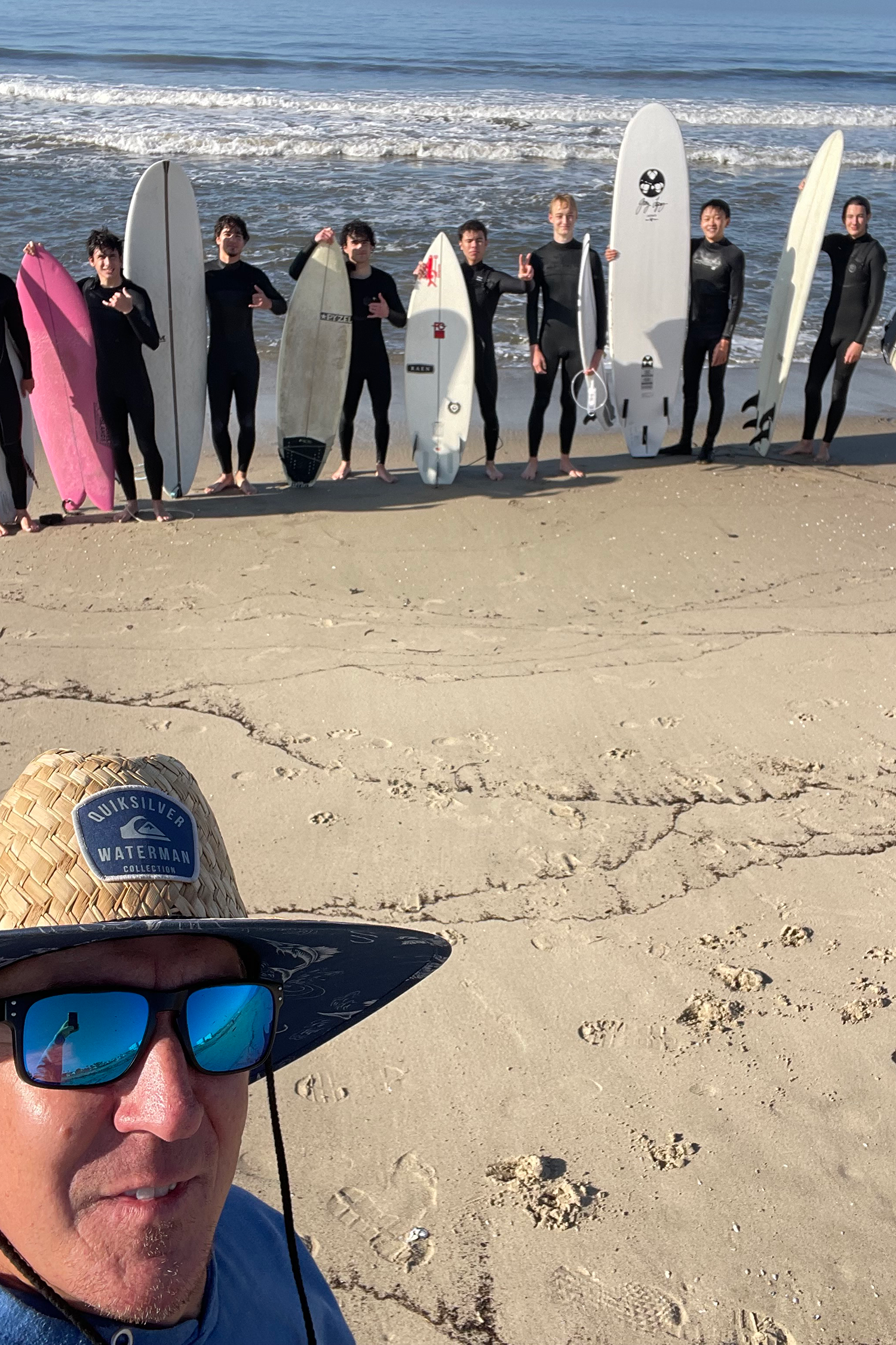
Palisades Charter High the day after the fire; Marsden over a year later on the first day of classes back on campus; the first day of lessons back at their normal surf break off Will Rogers Beach in Pacific Palisades.
On the morning of Jan. 7, 2025, Ray Marsden ’99 (ED), ’00 MA looked down a Los Angeles beach and saw a wall of smoke enveloping the coastline. That night, from his home nearby, he watched flames engulf the Pacific Palisades neighborhood where he’d worked for 17 years. By morning, he says, “The town was just gone. It was like an atom bomb went off.”
A third or more of the campus at Palisades Charter High School, where Marsden coaches and teaches physical education, was destroyed in the Palisades Fire. His office and numerous classrooms were reduced to wreckage. The football field was burned, the track melted, and the palm trees blackened at the once-picturesque campus that served as the backdrop for “Carrie,” “Teen Wolf,” “Freaky Friday,” and “Modern Family.” Some 1,000 Pali High students had lost their homes.
Two weeks later, says Marsden, “I turn on my Zoom, and there are 60 faces staring at me from all over LA. One’s crashing on an uncle’s couch in Florida. I had a kid who was in England. I had a kid on a houseboat. They were everywhere.” The Neag School of Education’s last-ever sports pedagogy (physical education) graduate found himself once again teaching online gym class. It was muscle memory from the pandemic.
That experiment had taught Marsden’s PE department a thing or two about remote teaching (read, asking students to keep up with live Zoom calisthenics will result in a glitchy mashup of moving limbs, playing out across 60 small windows on a screen). So he tried a different tack: daily pep talks. “My job when I talked to them each day was to convince them: Get up from your computer or couch, get out, get some sunlight on your face, get some fresh air, find some friends to play with — and just move, especially during this stressful time.” Students could do an online exercise class or explore a park in their temporary neighborhood, then show him their pedometers or fitness journals.
A couple months later, Pali High resumed in-person instruction at a once-abandoned Sears building. “It was emotional for everybody to see each other finally, for the first time since the fire. These are teenagers, and they need each other and — whether they admit it or not — their teachers and coaches as well.” In the four-story former department store, windowless classrooms were sectioned off by drywall, with shower curtains or cardboard for doors. Restrooms were trailers in the parking lot. “It was kind of like studying abroad,” Marsden says. “But the novelty wore off real fast.” Each day, Pali teams, including those Marsden coaches (offseason strength and conditioning for football, baseball, and softball), scoured Los Angeles for a school field, park, campus, or even a beach where they could practice or compete — sometimes ending up an hour away in LA traffic.
Marsden says the resilience he’s drawn on throughout this period and his entire teaching career comes from his time at UConn. “When you are doing your student teaching at UConn, they put you in multiple schools with different atmospheres. So you teach inner city, you teach rural, you teach suburban, you teach high school, elementary, middle school. I taught everything — and that was a really positive experience that’s helped me always be able to adapt.”
In late January, Pali High opened the remediated, industrially cleaned campus, where a full rebuilding effort is still underway.
“Spirits are high now that we’re back on campus,” Marsden said when we caught up with him in May. “You can’t see any real scars on our campus anymore. But the second we step off campus, all the destruction is still there. You just see home foundations. You see entire city blocks of just foundations.”
Around the same time, Marsden was able to resume teaching his quintessentially Californian surf class at the local break in the Palisades. After the fire, the area was ground zero for staging the firefighting effort, and the beach was too polluted from fire debris to use. Now, he and the students are back in the water. “We’re nowhere near back to the way it was,” he says, “but we’re on our way.”
By siobhan moynihan murray