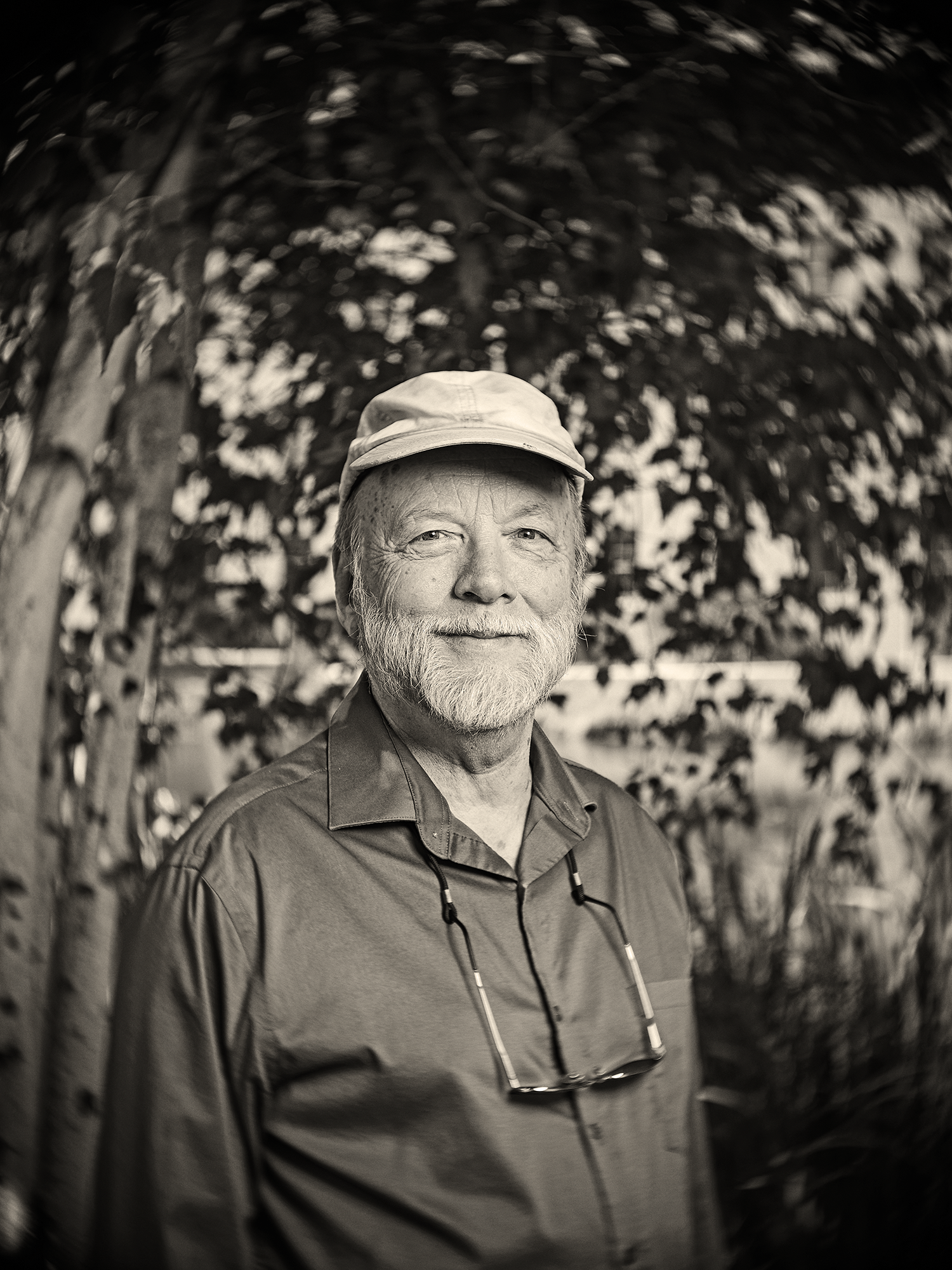
The Seven Wonders of Walden Pond
By Alexandra Kennedy
Portrait by Peter Morenus
Sandy Beach, Walden Pond, 1933; Thorson at UConn’s Swan Lake, 2026.

Please join us in Concord, Massachusetts, for an eye-opening trip around the kettle lake that Henry David Thoreau made famous more than 170 years ago.
Our tour guide today is Professor Robert M. Thorson — Thor, to his friends — professor of earth sciences at UConn since 1984. He is, specifically, a surficial geologist: “I’m interested in the origin of landscapes — what they’re made of and how they’re put together.”
Thorson has walked this beaten path around Walden Pond countless times, studying the lake and woods geologically, of course, but also as they relate to Thoreau’s two-year living experiment and his subsequent 1854 masterpiece “Walden; Or, Life in the Woods.” Thorson honed this public tour over the 15 years he led field trips here, a high point for his UConn honors students taking Walden and the American Landscape.
It’s been a big year for Thorson. Last fall he co-wrote “Why Concord?” about the geological origins of the American Revolution for The Atlantic’s special series “The Unfinished Revolution.” Last spring, he was a featured expert in the PBS documentary “Henry David Thoreau,” produced by Ken Burns. And “The Walden Experiments: The Science of Henry David Thoreau,” his fourth book on the topic, was released earlier this fall by Princeton University Press. Thorson’s important message throughout is still not widely recognized: By bridging the sciences and the humanities, Thoreau anticipated and documented, with uncanny insight, the environmental challenges of our day — climate change, ecological collapse, and the global stressors of agribusiness and technology. He was not a philosopher and writer dabbling at being a naturalist; he was a prophetic scientist who sought the divine in nature, then wrote about his experience.
If you’re feeling rusty on your literary history, let’s pause to get our bearings. In the mid-19th century, Thoreau’s hometown of Concord was a small New England community bursting with intellectual debate about spirituality, self-reliance, and the best ways to reform a society and economy built on slavery and the subjugation of women. Ralph Waldo Emerson, father of the transcendentalist movement, was Thoreau’s mentor, friend, and neighbor. Emerson’s groundbreaking 1836 essay “Nature,” which made the case for rejecting societal norms and instead seeking enlightenment in the natural world, made a profound impression on his young protégé.
In 1845 Thoreau built a simple house on Emerson’s woodlot overlooking the pond and lived there for two years: “I went to the woods because I wished to live deliberately, to front only the essential facts of life, and see if I could not learn what it had to teach, and not, when I came to die, discover that I had not lived.” He was no hermit, though: “I had more visitors while I lived in the woods than at any other period in my life.” His brainy circle of friends who visited included Bronson Alcott and his daughter Louisa May, revered author of “Little Women”; Nathaniel Hawthorne, who wrote “The Scarlet Letter”; and the women’s rights advocate and journalist Margaret Fuller. His family’s boardinghouse, which he visited regularly, was a 20-minute walk away.
It’s not surprising Thorson has found a kindred spirit in Thoreau. Growing up in different parts of the upper Midwest, he wasn’t much of a student — too much sitting around — but he loved experiential learning. He collected fossils, explored caves, and mapped his neighborhood with a self-built surveying transit. As a senior in high school, he was hoping to work on his uncle’s farm when a low draft number for Vietnam made him reassess. To defer induction, he enrolled at a local college. There, a science class he took to fulfill a Gen Ed requirement was a revelation. Those boyhood joys had been hiding in plain sight.
Walden — the book and the place — have provided great comfort to Thorson, who first encountered Thoreau in an English textbook his junior year of high school. “Thoreau’s insights, courage, humor, and caring kept me from spinning out of control during tumultuous times,” he writes in his new book. He hopes they will do the same for us. So, who better to saunter with, as Thoreau would put it, around Walden Pond?
This is Thor on Thoreau.
Terrace Edge
GPS coordinates
42°26'25.22"N, 71°20'04.93"W, 197 ft.
“Many have believed that Walden reached quite through to the other side of the globe.”
— Thoreau in “Walden”
Walden Pond is the deepest natural lake in Massachusetts. As we exit the visitor parking lot, Thorson asks us to pause and note that we’re leaving behind the plateau — an ancient delta plain — and descending into a massive sinkhole. Formed about 14,000 years ago when buried chunks of glacial ice melted, the giant depression eventually exposed groundwater, creating Walden Pond as we know it today. “It’s like a threshold. You walk into a sinkhole and you’re in a different world,” says Thorson. “That was very important for Thoreau, for solitude and for getting away.”
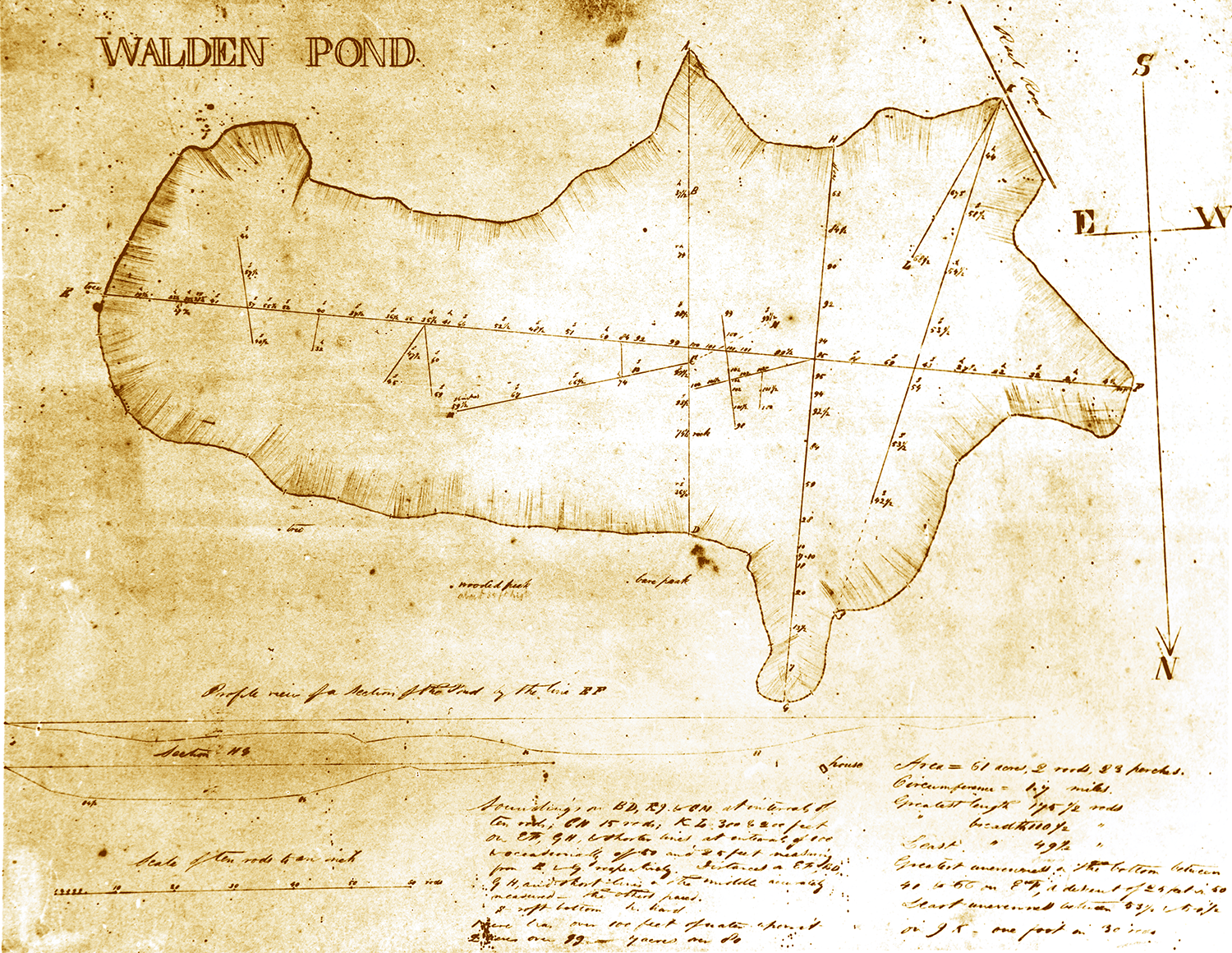
Concord locals were convinced the pond was bottomless. “Thoreau had a lot of time on his hands, and he was incensed by misinformation,” says Thorson. So in his first winter, he drilled more than a hundred holes in the ice, lowering a stone tied to a cod line to measure varying depths. “He used his survey to do triangulation,” says Thorson. “It was brilliant.” Did he get it right? Yup. Walden Pond is 102 feet deep.
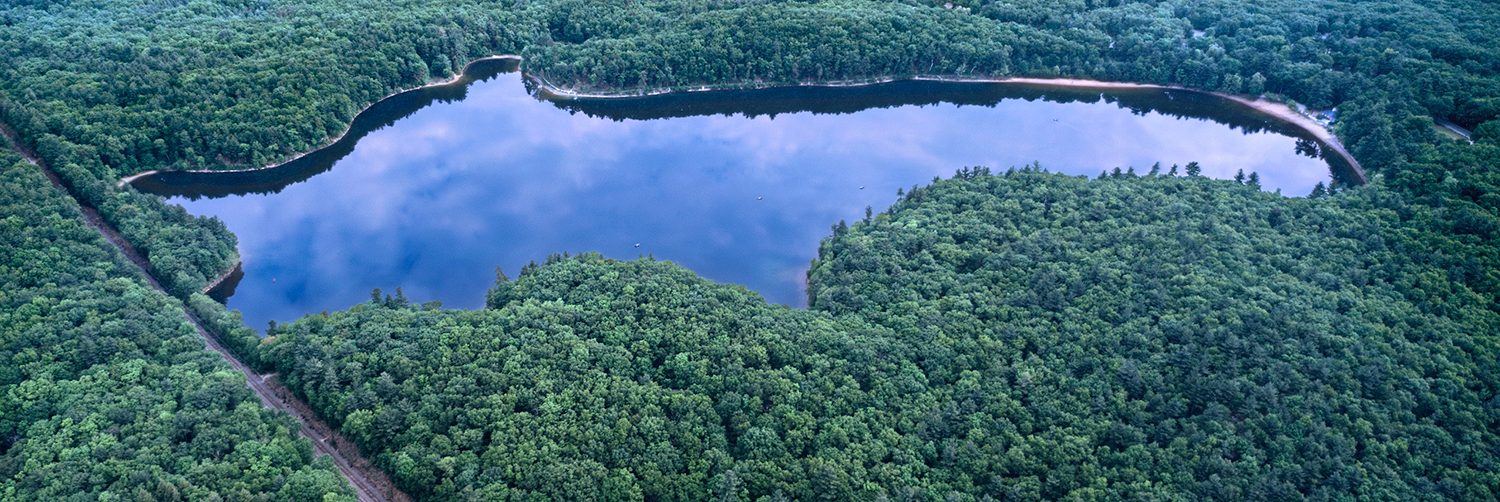
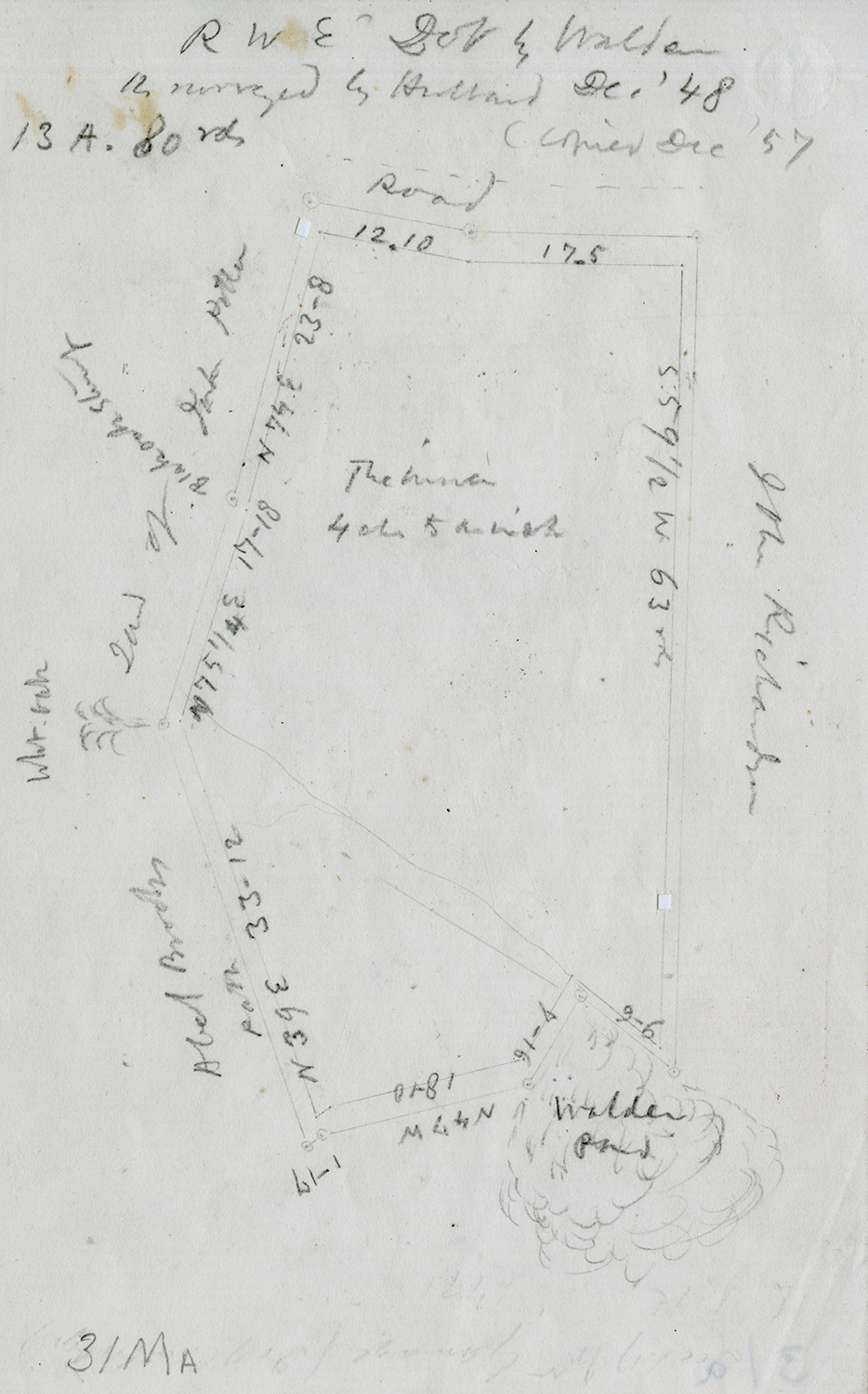
1: aerial view of Walden Pond, 2015; lot and pond surveys, 1848 and 1846.
1: aerial view of Walden Pond, 2015; lot and pond surveys, 1848 and 1846.

Eastern Shore
GPS coordinates
42°26'21.98"N, 71°20'05.14"W, 154 ft.
“The shore is composed of a belt of smooth rounded white stones like paving stones,
excepting one or two short sand beaches, and is so steep that in many places a single leap will carry you into water over your head.”
— Thoreau in “Walden”
Thoreau wouldn’t recognize today’s Eastern Shore. Because of the lake’s perilously steep slopes, he only reached the thin strip of pebbly beach here by boat or over ice. Thorson beckons us down a long, steep ramp. At the bottom, we pass a new bathhouse and step right onto a sprawling beach. Early birds with beach towels pick their spots. Fishermen cast off to the north.
At the turn of the 20th century, Thorson tells us, an intrepid entrepreneur turned this shore into a swimming hole when he dragged a raft and diving boards out onto the water, cleared a path, and — despite not owning the property — started collecting fees from swimmers. The crowds poured in, increasingly by automobile, and the most dramatic human-made reinvention of Walden Pond was set to begin.
Over the 20th century, local governments constructed bathhouses, cut a path around the pond, built stone walls to mitigate erosion, and imported sand to widen the beach. “This entire thing, what I call the Eastern Shore,” Thorson explains, “is all made up. It’s all engineered. The sand is hauled in from somewhere; the stone from somewhere else.” The acceleration of changes directly corresponds to car ownership and the completion of nearby Route 2. “On one hot Sunday in 1935, 35,000 people showed up. It was mobbed.”
Today, park officials keep crowds in check by offering a finite number of parking spaces, as Walden Pond continues to be one of the most beloved swimming holes in America.
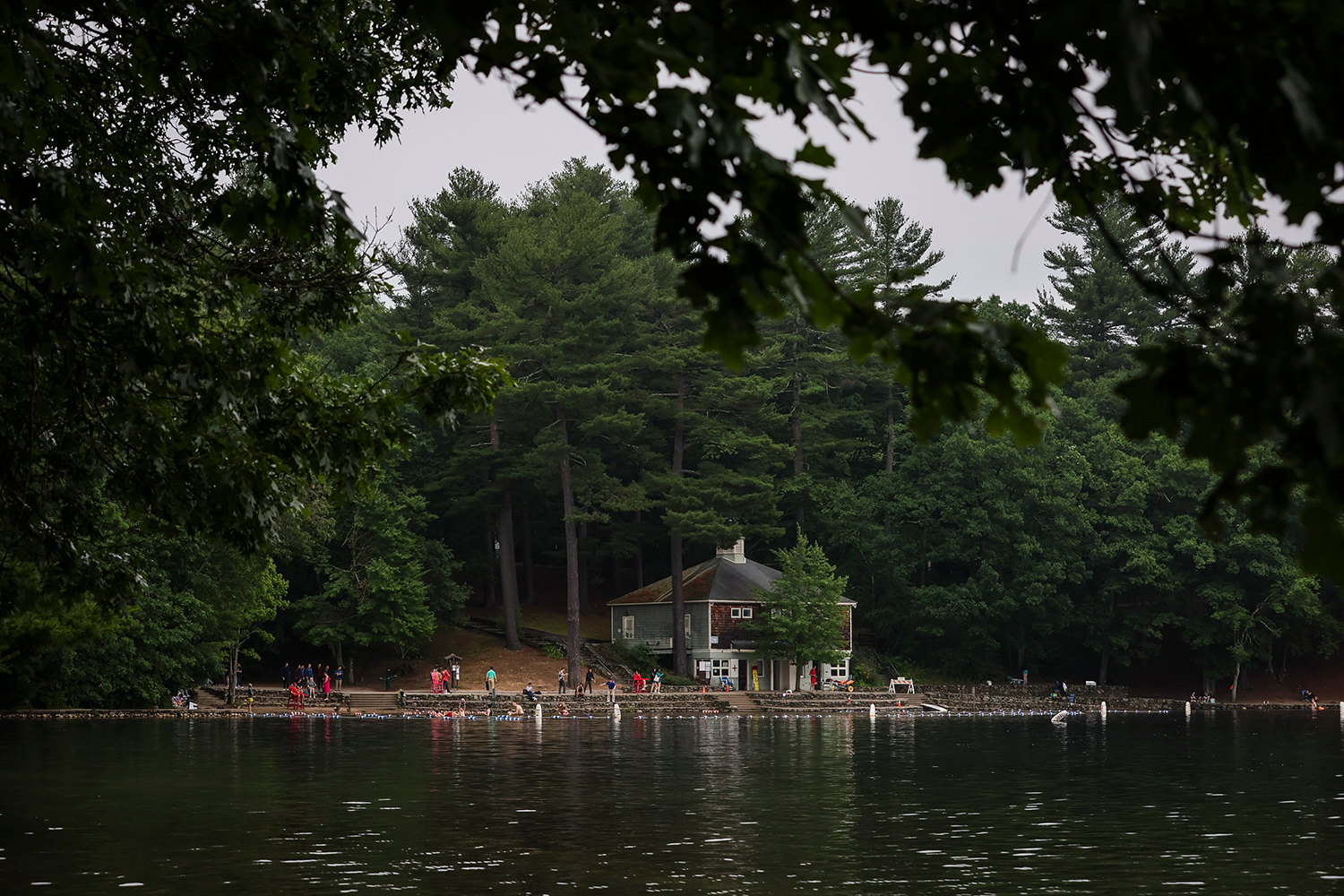
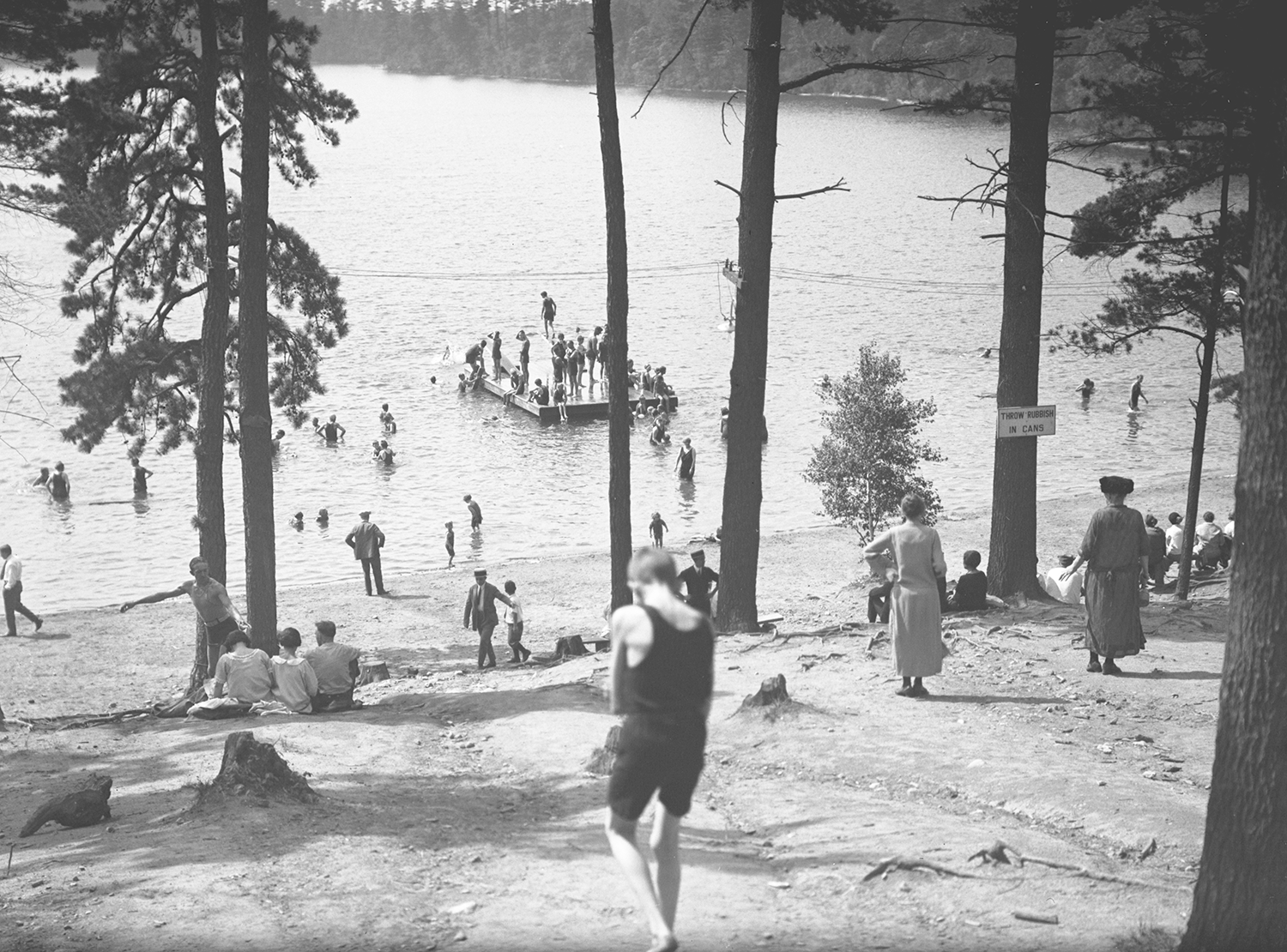
2: swimming beach, 1924 and 2024 — a summer that found the beach largely covered with water.
House Site
GPS coordinates
42°26'31.23"N, 71°20'33.20"W, 184 ft.
“Let your life be a counter friction to stop the machine.”
— Thoreau in “On the Duty of Civil Disobedience”
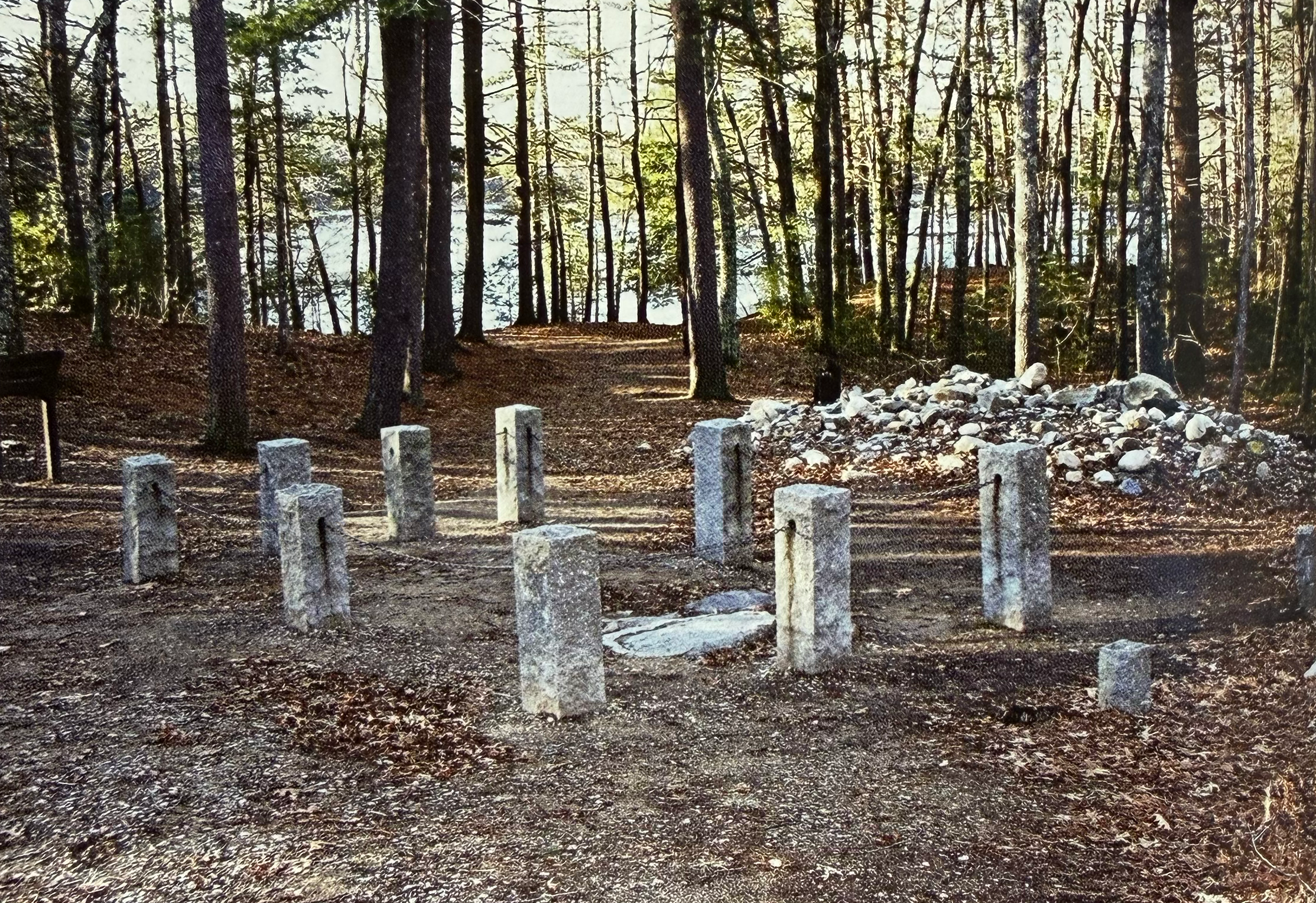
Only a 10-minute trek on the path brings us to a spur with a sign: “House Site.” This is the trail to the shrine, the mecca, “the epicenter of ‘Thoreau’s World,’” as Thorson calls it in “The Guide to Walden Pond.” When it comes into view, it’s both moving — here’s where he lived! — and strangely disappointing. Nine imposing posts of chiseled granite, all linked by a thick chain, mark the perimeter of the original 10-by-15-foot structure. Created by a local wealthy architect in 1948, the memorial rankles Thorson. Thoreau found monuments, and especially cut stone, offensive. “He would have hated it,” Thorson says. To its left, the cairn, more heap than sculpture, proves a great climbing spot for the schoolchildren who’ve just overtaken us. Two boys knock stones out of place and root around for the best shapes and patterns. Thor welcomes the distraction.
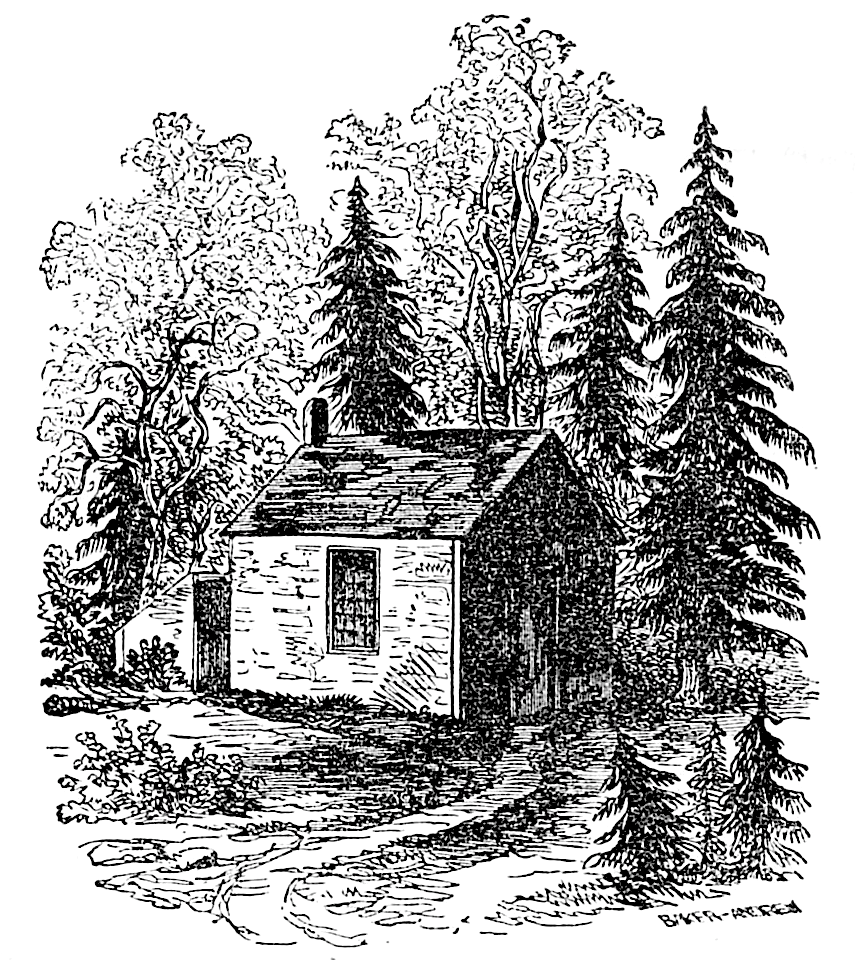
3: house illustration from the title page of the original 1854 “Walden”; the granite monument that marks the site today.
It’s a good time to sit and think about not what we do see here but what we don’t.
In August 1846 Thoreau hosted a meeting of the highly influential Concord Female Anti-Slavery Society at his little house. “Women were in charge of the local abolition movement,” says Thorson. “And Thoreau’s mother and two sisters were important members of the society.” Together, they recruited Thoreau, Emerson, and other local intellectuals to aid them in the Underground Railroad. “As many as 30 people attended the meeting that day. Thoreau jokes about how there wasn’t much room for getting around.” Lewis Hayden, an enslaved fugitive from Kentucky, was the special guest, sharing a harrowing account of his experiences.
In the years to come, Thoreau would become increasingly vocal in his opposition to slavery and his outrage over the Commonwealth’s complicity. In a withering speech in 1854, “Slavery in Massachusetts,” Thoreau tried to rally his fellow citizens to defy the Fugitive Slave Act of 1850 and prioritize “laws of humanity.” After the Civil War, Hayden was elected to the Massachusetts state legislature, where he advocated for civil rights and women’s suffrage until his death in 1889. Thoreau, who died in 1862, would not live long enough to see slavery abolished in the U.S.
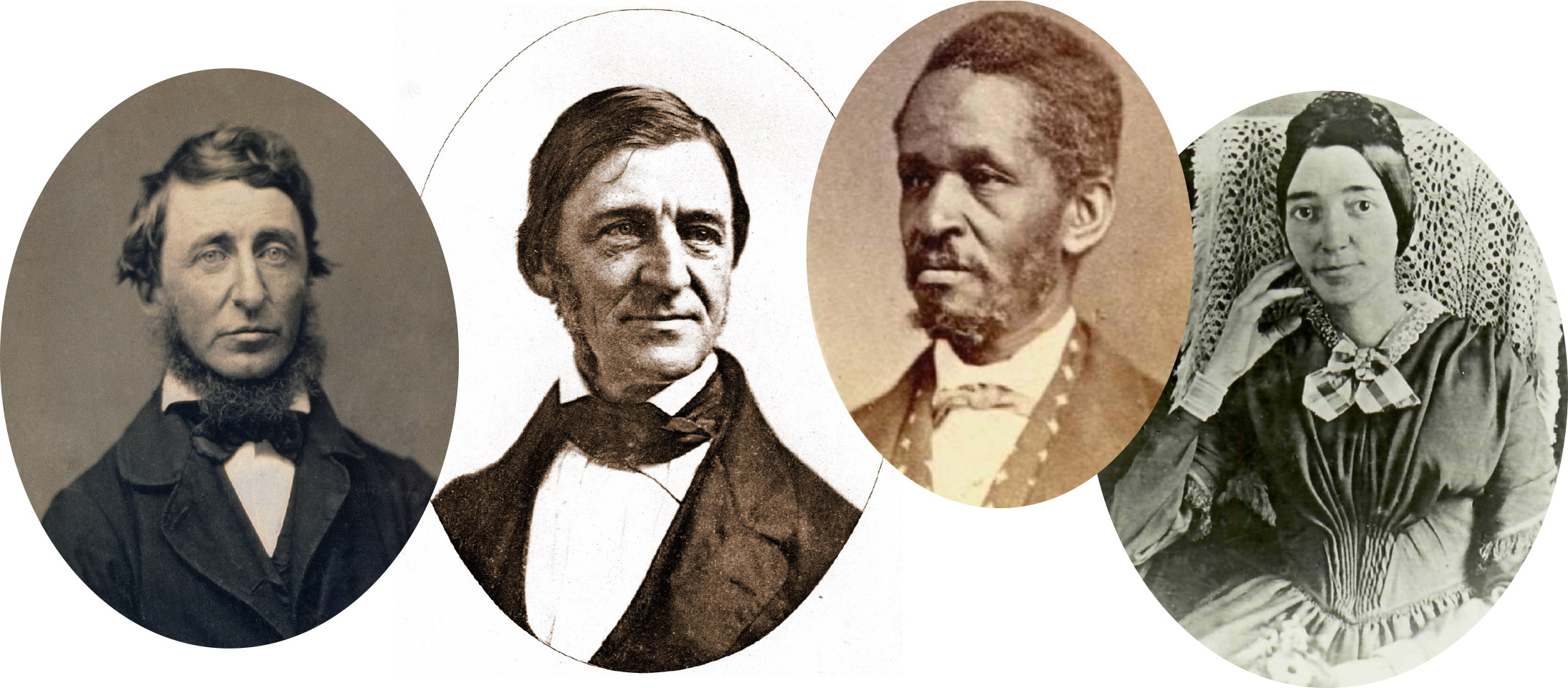
3: from left, restored daguerreotype of Henry David Thoreau in 1856; his friend and onetime mentor Ralph Waldo Emerson in 1859; Lewis Hayden, an enslaved fugitive who in 1846 spoke at one of Thoreau’s abolitionist gatherings co-hosted by his sister, Helen Louisa Thoreau (at right), of the Concord Female Anti-Slavery Society.
Bean Field
GPS coordinates
42°26'33.77"N, 71°20'33.81"W, 200 ft
“The farmer is endeavoring to solve the problem of a livelihood by a formula more complicated than the problem itself.”
— Thoreau in “Walden”
It’s time for us to head to the terrace above the house site in plain view of the old carriage road to Concord village. This is where Thoreau experimented with farming. Modern agriculture, he argued — with its focus on mass production and its dependence on bank loans — was a disaster for both humans and the land, turning farmers into “serfs of the soil.”
As a response and in a bit of theater, he grew white bush beans — the variety used in Boston baked beans — as a cash crop, planting, hoeing, and harvesting them himself. Curious neighbors would stop to watch, waving to him from the road. Thorson did the calculation and found that the combined length of Thoreau’s 2.5 acres of bean rows planted 18 inches apart would amount to 7.5 miles.
Looking through the grove of trees that have filled those fields, Thorson tells us, “He was desperately doing what you or I would call regenerative agriculture.” Equally important, he was connecting to the people who had come before him. “This was his chance to do archaeology. He was disturbing the ashes of what he calls ‘unchronicled nations.’ People were hunting or migrating or warring on this sand plain and he finds musket balls and broken glass and ceramics from the colonial period. So he’s putting it all together.”
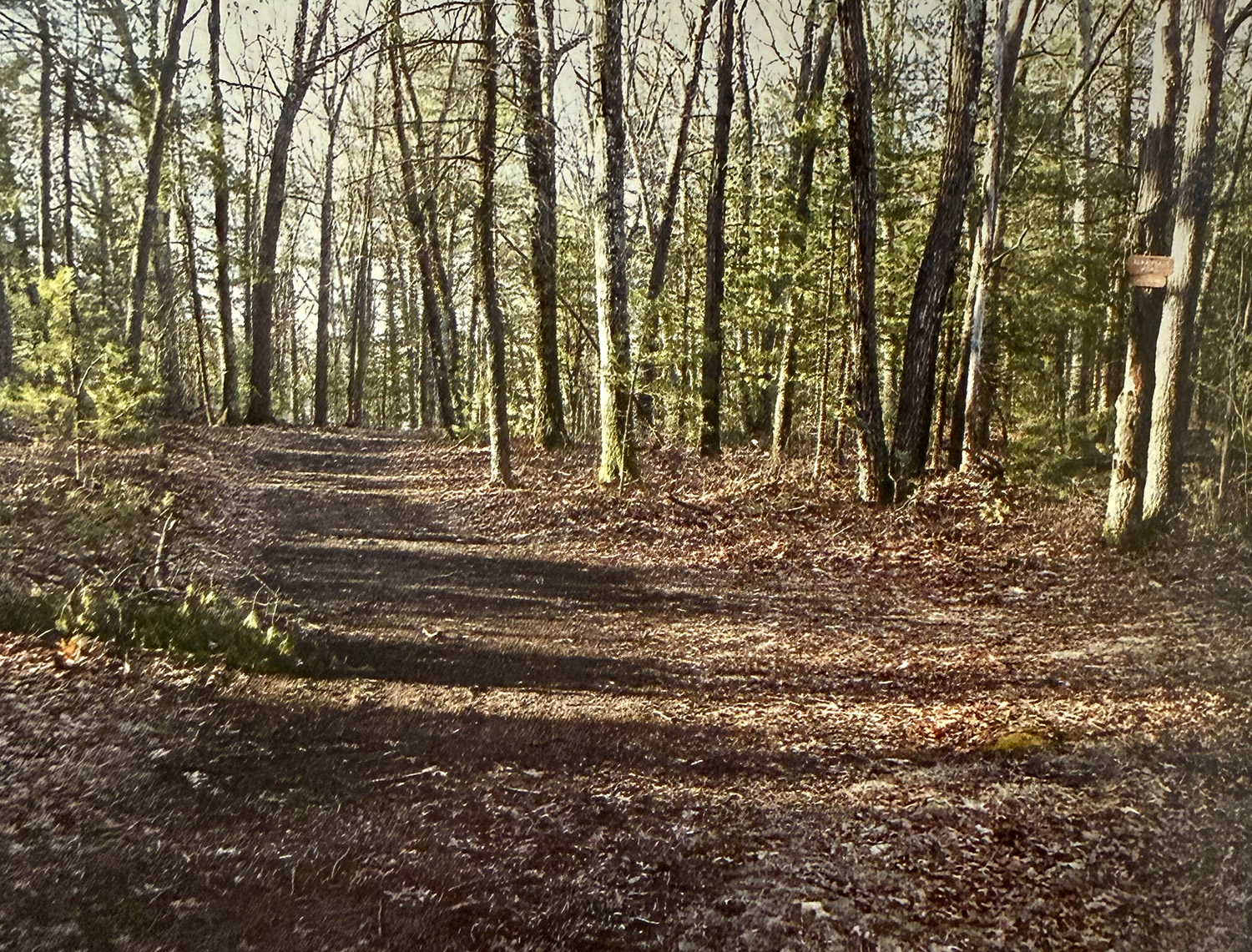
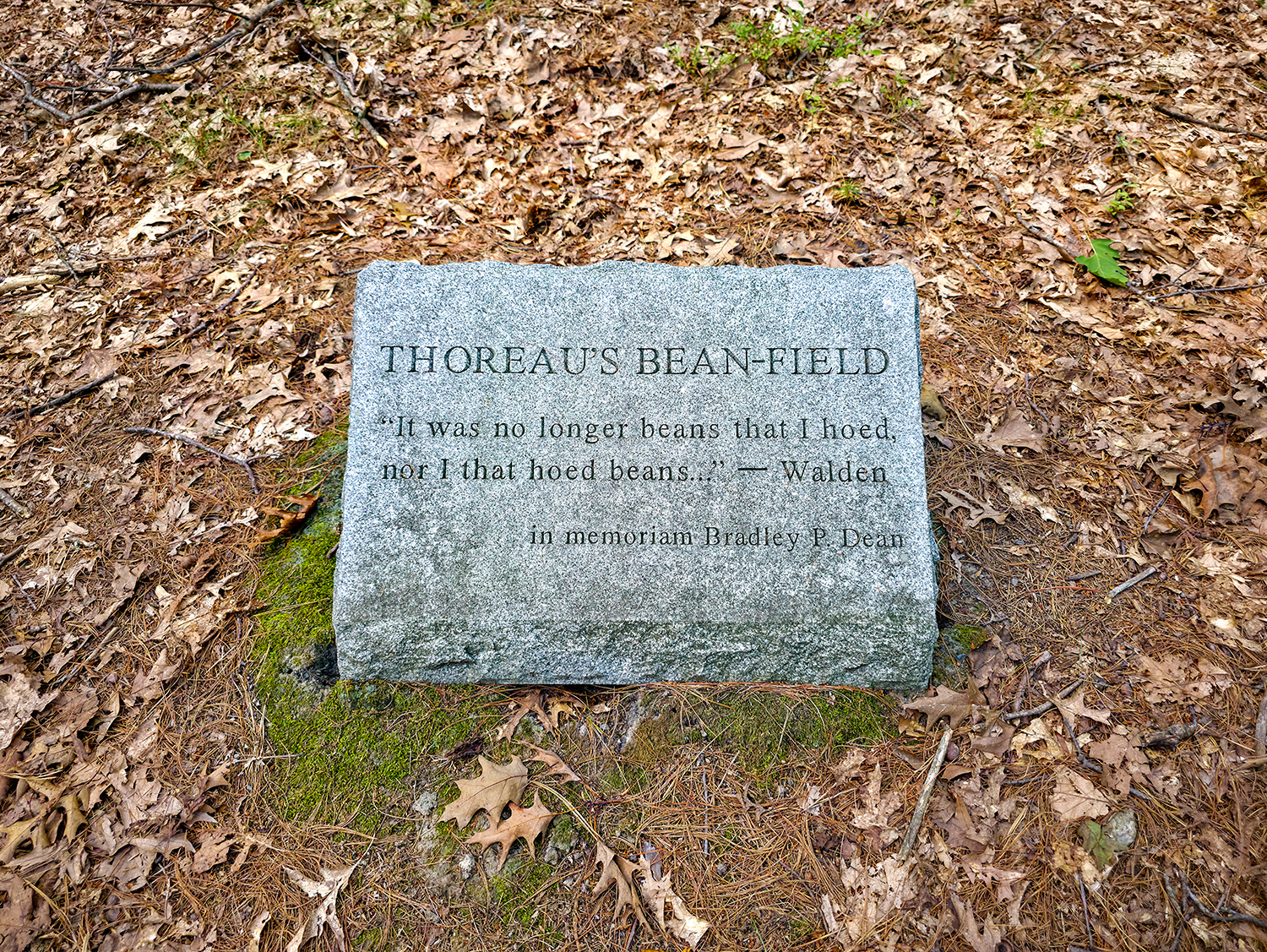
4: the trails near where Thoreau grew his 2.5 acres of white bush beans are some of the most popular among today’s hikers.
Ice Fort Cove
GPS coordinates
42°26'20.36"N, 71°20'41.86"W, 154 ft.
“A man is rich in proportion to the number of things which he can afford to let alone.”
— Thoreau in “Walden”
Many businessmen sought their fortunes at Walden Pond. From the path above Ice Fort Cove, Thorson prompts us to imagine what Thoreau saw during his first winter: a hundred Irish laborers cutting and stacking 300,000 cubic feet of ice cakes. That’s five football fields’ worth. Though intended for Boston, the ice was, inexplicably, never loaded onto the train. Over the next two years, it melted.
In 1866, four years after Thoreau’s death, the Walden Lake Grove Excursion Park opened its gates on a hill overlooking Ice Fort Cove. The amusement park attracted thousands of Bostonians, who arrived by train for water recreation, camping, dancing, music, and baseball.
It closed in 1902 after a fire burned most of it to the ground. (“You can see the outlines of the pavilions on lidar,” says Thorson.) Thankfully, many other plans, like a site for a slaughterhouse and pig farm, never materialized.
In 1922, the commercial exploitation of Walden Pond finally came to an end. Recognizing how popular the pond was for locals, the Emerson, Heywood, and Forbes families donated most of its perimeter to the state, and Walden Pond State Reservation was born.
The park is an admirable, if tricky, outcome, says Thorson: “Walden Pond presents a management trade-off between being conserved as an international cultural icon and being overdeveloped as a local swimming hole for residents of greater Boston.”
More than 600,000 visitors a year come to swim, fish, hike, and get inspired by Thoreau.
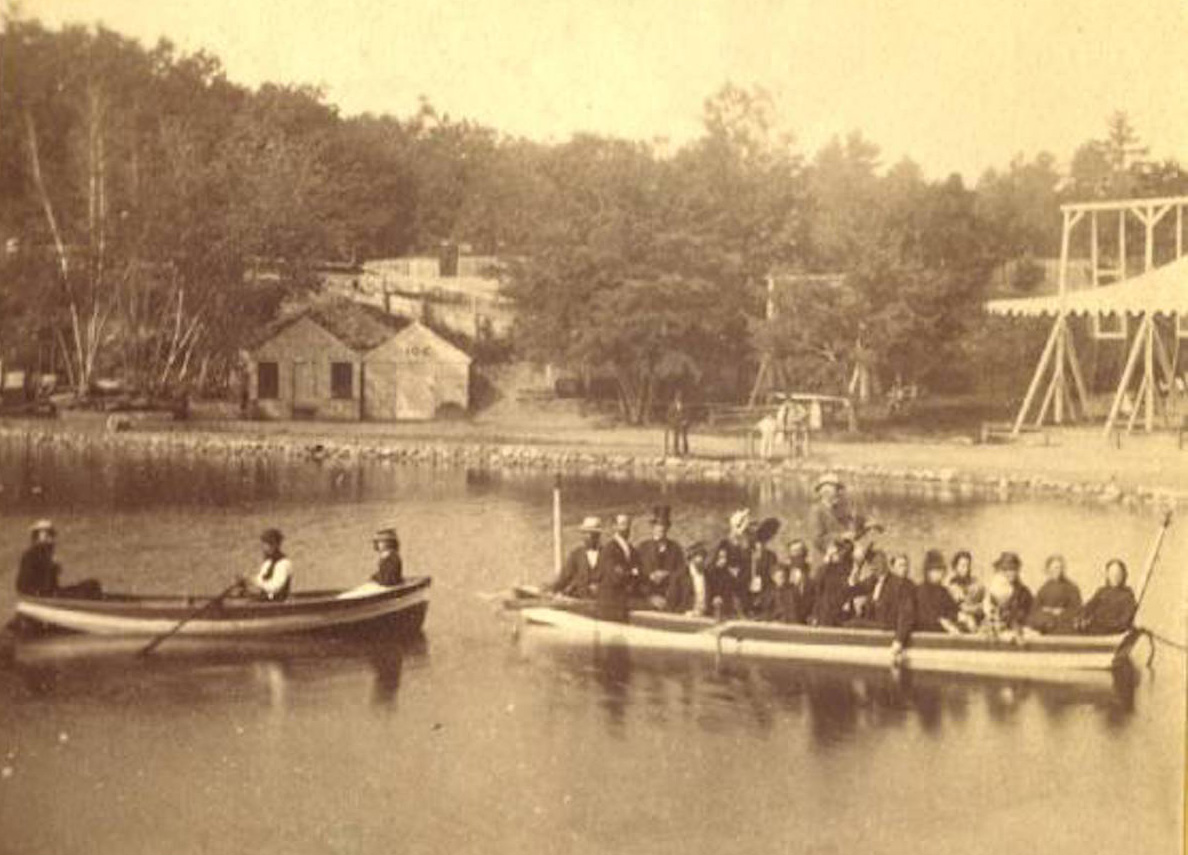
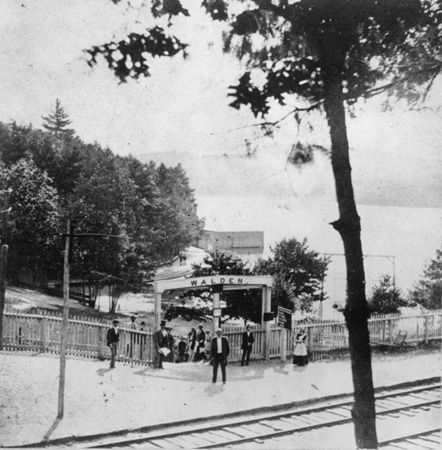
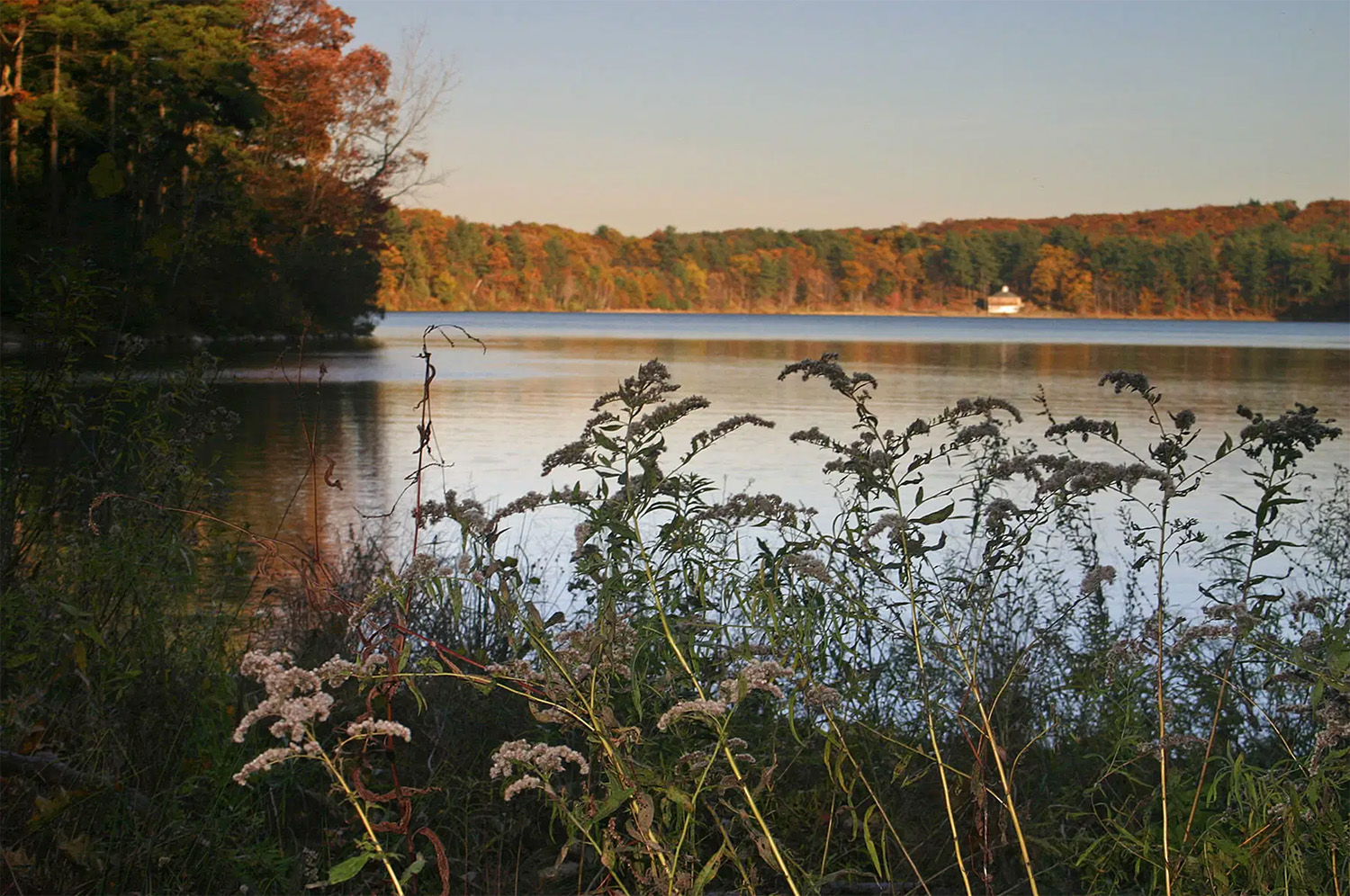
5: boating at the amusement park, looking west over Ice Fort Cove, 1868; the entrance gate to the amusement park, which was built at Ice Fort Cove in 1866, complete with its own train station; and today, looking across the pond to the Eastern Shore’s bathhouse.
“He was a prophetic scientist who sought the divine in nature.”
Sandbank Cove
GPS coordinates
42°26'13.44"N, 71°20'37.54"W, 167 ft.
“I watch the passage of the morning cars with the same feeling that I do the rising of the sun, which is hardly more regular.”
— Thoreau in “Walden”
Hear that train? Thorson cuts right and up a hill so we can investigate. Shortly before Thoreau built his house, the Fitchburg Railroad connected Concord to Boston. A thousand poor Irish immigrants laid the tracks a stone’s throw from the western edge of the pond.
To create the straightaway that a train requires, Thorson explains, pointing down a long corridor of tracks, they notched a canyon into the slope and then dumped megatons of sandy debris into nearby Sandbank Cove. It remains today, just a fraction of its original size.
When Thoreau moved to the pond, many laborers lived in a shantytown nearby. He purchased boards for his house from one of them and mixed plaster for his walls using sand he hauled from the bank. “Watching the coming and going of the train became a pleasant part of Thoreau’s routine,” Thorson says. “It united him with the rest of the globe.”
By the time he had “Walden” ready for publication, Thoreau’s feelings about trains had changed. He resented the railroad industry for its endless appetite for wood fuel and complained about how the new technology was changing American culture. It was all about speed and commerce: “We do not ride on the railroad; it rides upon us.”
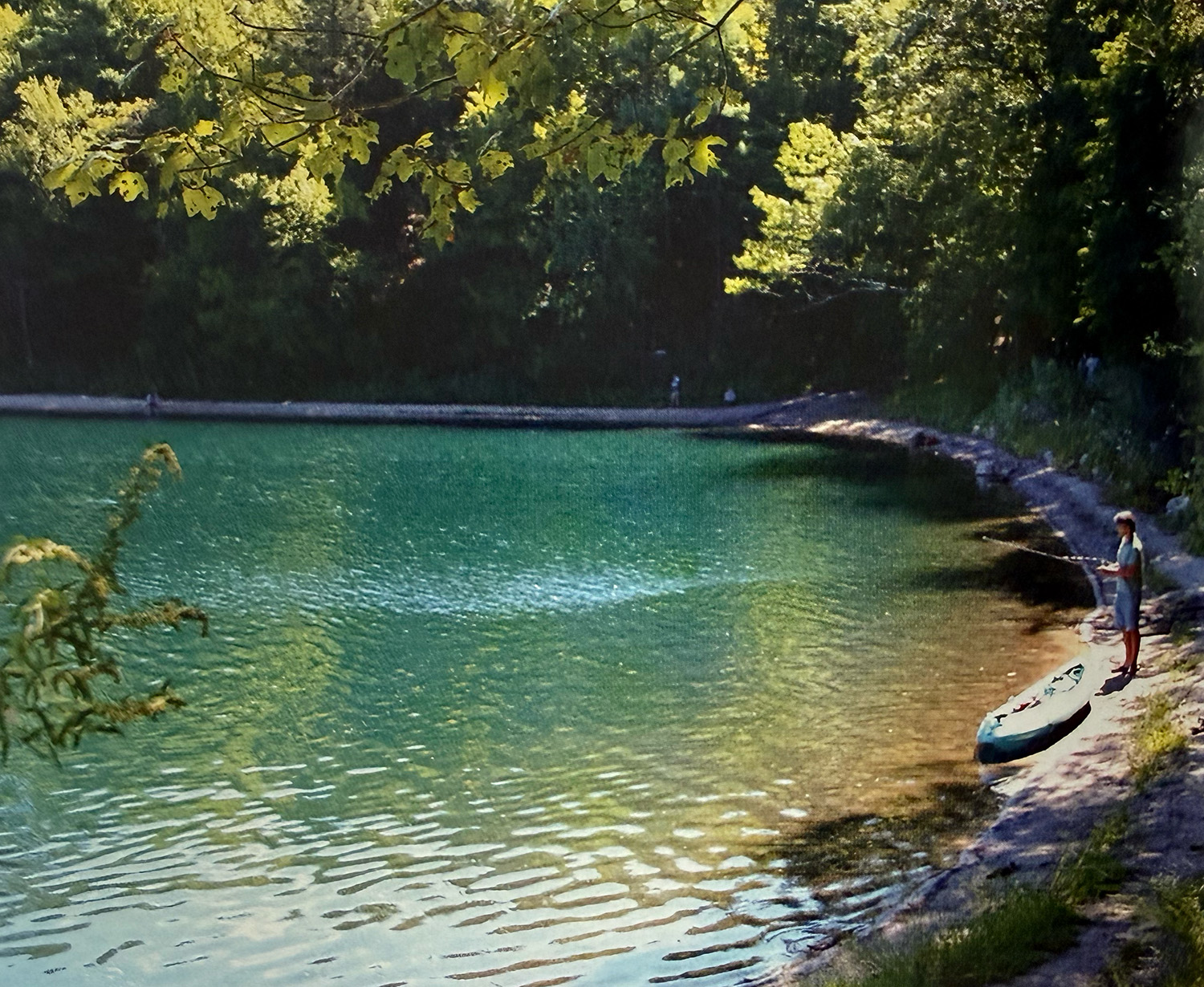
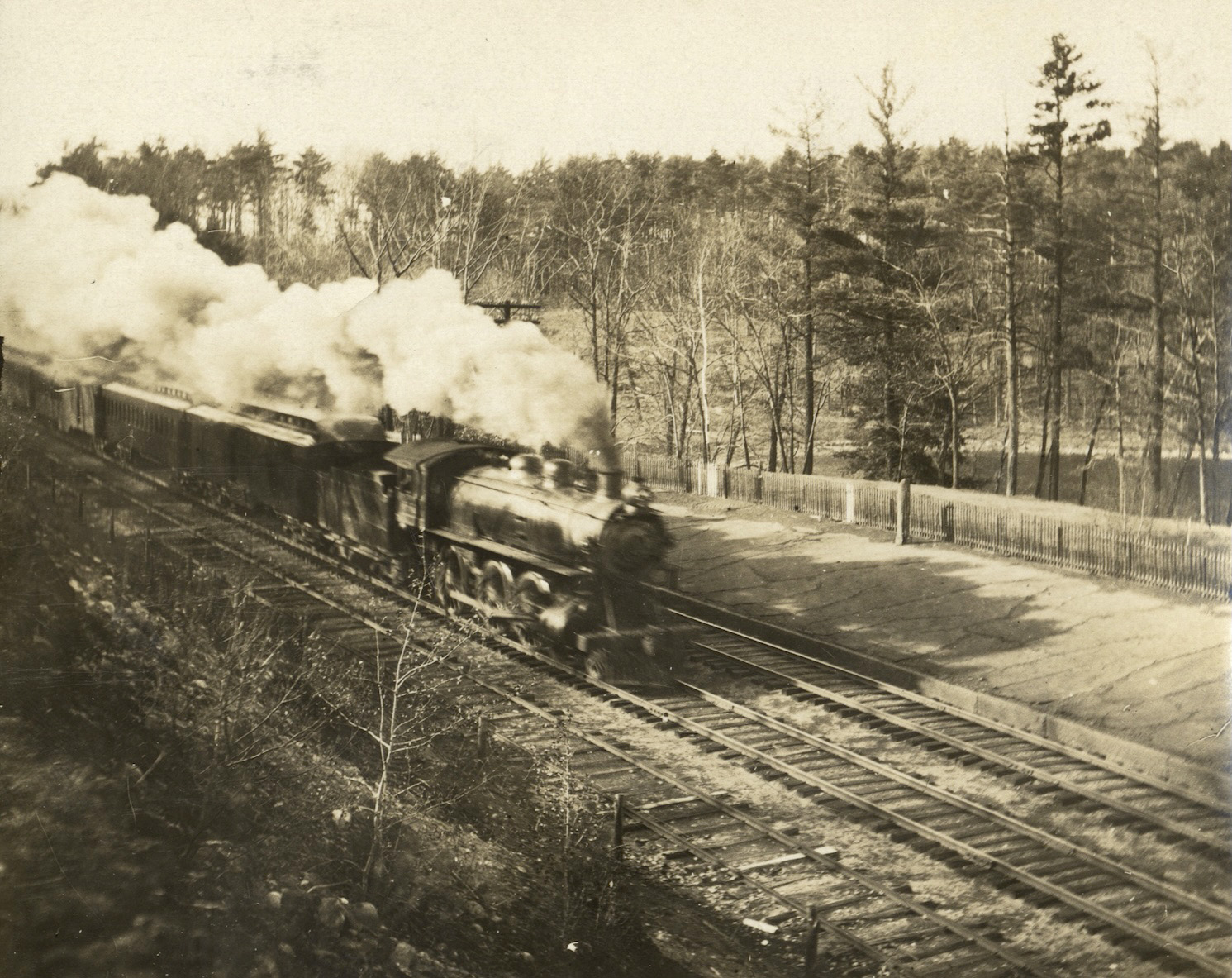
6: Sandbank Cove’s curved shoreline is a 1900s phenomenon; A locomotive steaming away from Concord above Ice Fort Cove during the early 20th century.
Panorama
GPS coordinates
42°26'17.36"N, 71°20'18.39"W, 163 ft.
“It is life near the bone where it is sweetest.”
— Thoreau in “Walden”
On the southeast side, along the return, Thorson leads us down to a sandy spit. “Nowhere else on the lake are we in a better position to ponder how Walden has changed through time.” To the west, we see the coves and wooded hills Thoreau once called home — where, as Thorson says, “he lived in a hollow in a hollow.” To the east, we see the bathhouse and pale golden beach still filling with sunbathers. A long-distance swimmer cuts quietly through the water in front of us. The panorama is a study in dichotomies and American dreams.
After Thoreau moved back to Concord village, Emerson leased the empty small house to his Scottish gardener, who hauled it away. It served for a while as a corn crib until it was eventually salvaged for parts. Nearly a decade after Thoreau’s death, Bronson Alcott brought one of Thoreau’s admirers, a woman from Iowa, out to the site. The two of them laid the first stones to mark where Thoreau’s house once stood — the start of the cairn that continues today.
For more than a century, many of our great thinkers — Walt Whitman, John Muir, Rachel Carson, Jack Kerouac, Emma Lazarus, Bill McKibben, E.O. Wilson, E.B. White, B.F. Skinner — have made pilgrimages to Walden Pond, some laying stones on the cairn at the house site. They came, like we did, to learn and pay homage.
For Thorson, a committed environmentalist, Thoreau has been a galvanizing teacher. “Earth’s global sustainability crisis requires that we lead with our aesthetic hearts and follow with our utilitarian heads,” Thorson concludes in his new book. “That we let our love of nature motivate us to manage Earth with the scientific skill and respect it deserves.”
“We’re part of nature,” Thorson tells us, summoning Thoreau. “Let’s just love it. Let’s be in the moment. Let’s appreciate the sunshine. Let’s give thanks.”
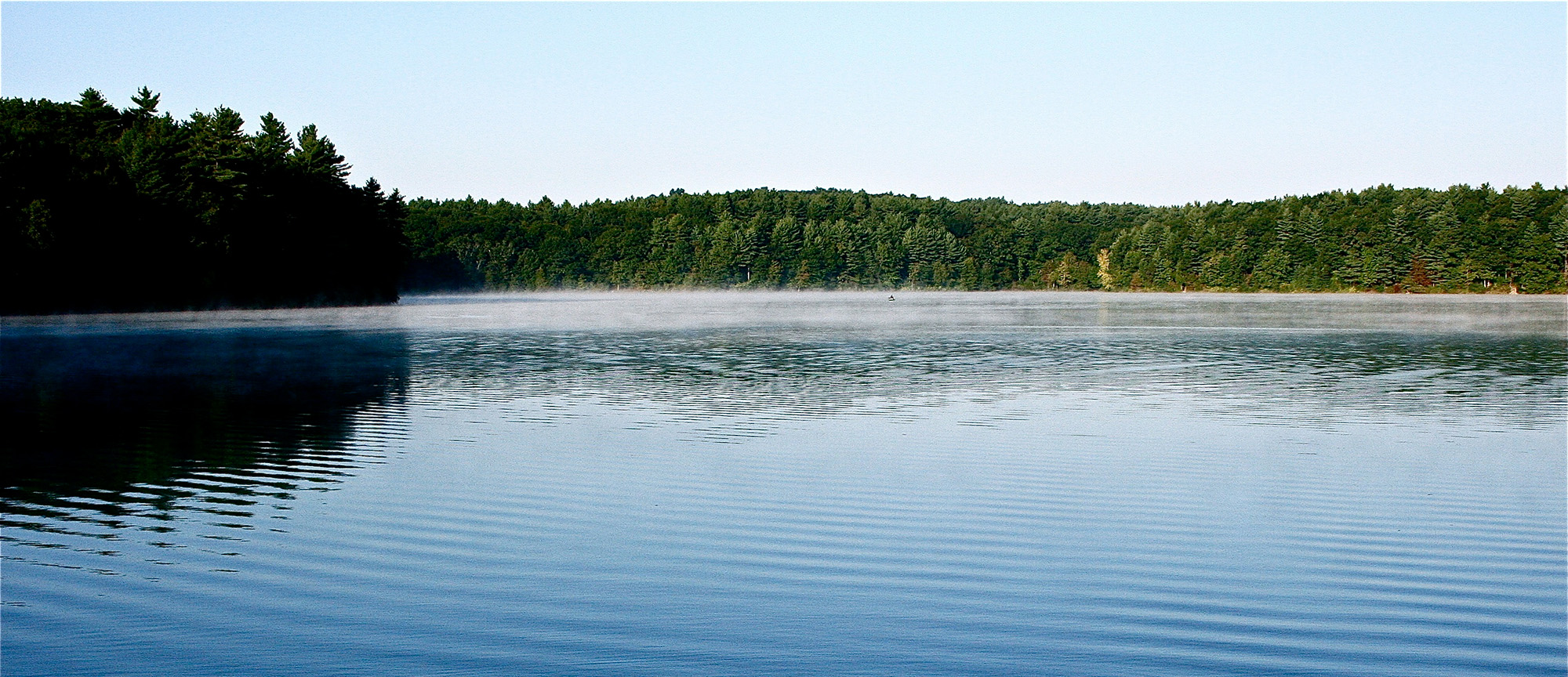
7: In the 1800s people believed Walden Pond, the deepest natural lake in Massachusetts, was bottomless. Thoreau measured its 102 feet of depth by drilling more than 100 holes in the ice and lowering a stone tied to a cod line, then putting those depth soundings onto a map made by triangulation, arriving at the same number later scientists did.