Winging It
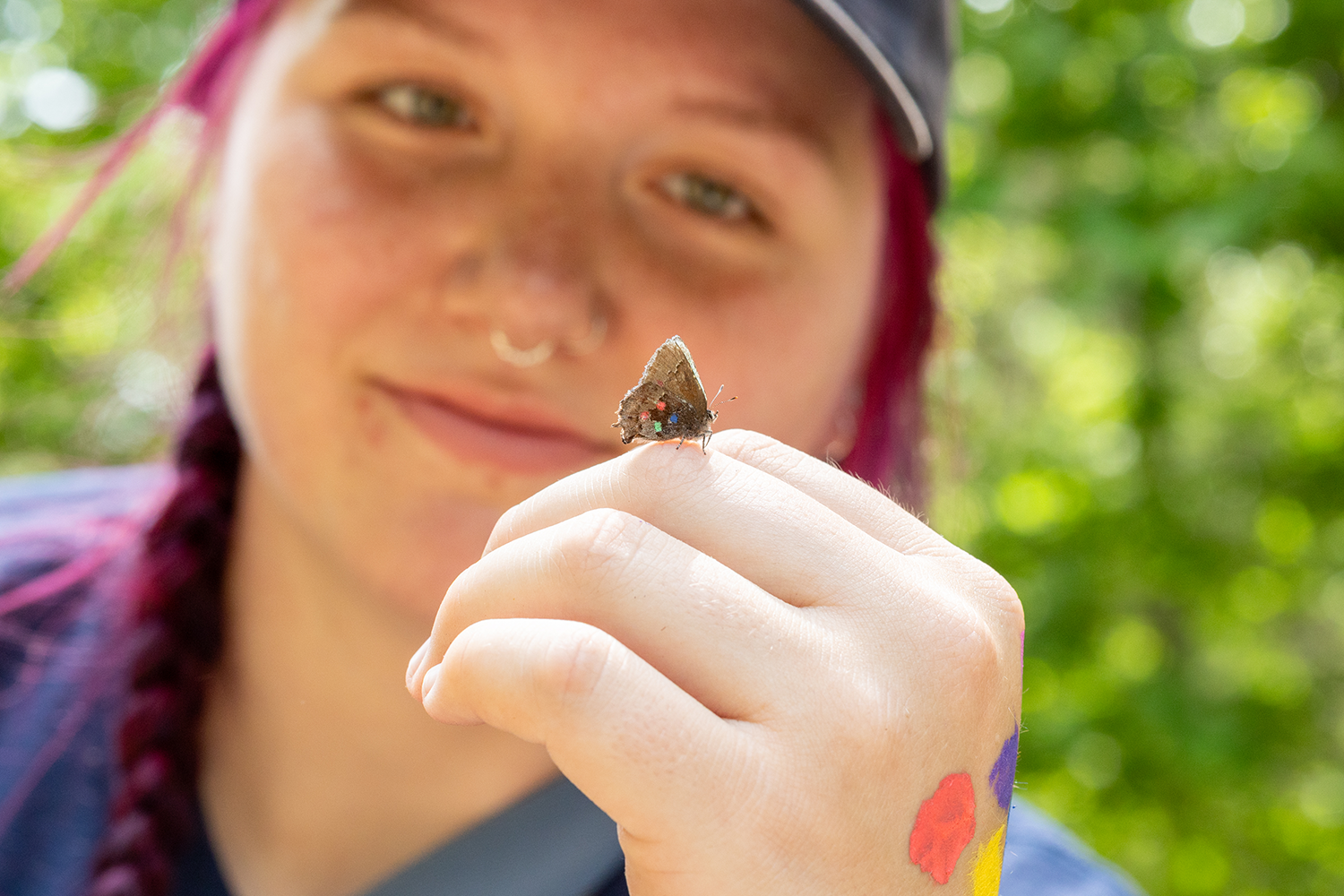
Kayla Gilbertie ’27 (CAHNR) at Mansfield Hollow with the frosted elfin marked 1 Blue, 1 Green, 2 Red. “The four dots are an individual identifier,” says team leader Charlotte Brennan. “Every butterfly gets a different code so we can track its individual movements and life history.”
This summer, as part of her master’s research, Natural Resources and the Environment graduate student Charlotte Brennan ’26 MS, oversaw a team of researchers doing daily capture-mark-resight research at the Mansfield Hollow Restoration Area and UConn’s Hillside Environmental Education Park, often called HEEP.
The group sought the rare frosted elfin butterfly, a species in decline to the point of being considered for federal protection under the Endangered Species Act due to factors like habitat loss and fragmentation.
“They’re called ‘elfin’ because they’re so little,” says Brennan. “Spotting them is hard, but this is what we do every single day, and we get used to it. We mark them and then release them from the net. Sometimes, after we release them, they crawl on us and hang out.”
Work to recover the species in Connecticut is focused on habitat restoration and habitat expansion. “We’re trying to figure out where the species lives throughout the state, how far they can move, and how we can expand their habitat. Since habitat loss is the main threat, expanding their habitat is the main way that we’re going to help them,” says Brennan, who credits the group of researchers, including talented undergraduate students like Kayla Gilbertie (shown above), for the team’s success in locating the butterflies.
by Elaina
Hancock
Photo by Sydney Herdle