
CE 2110: Applied Mechanics I
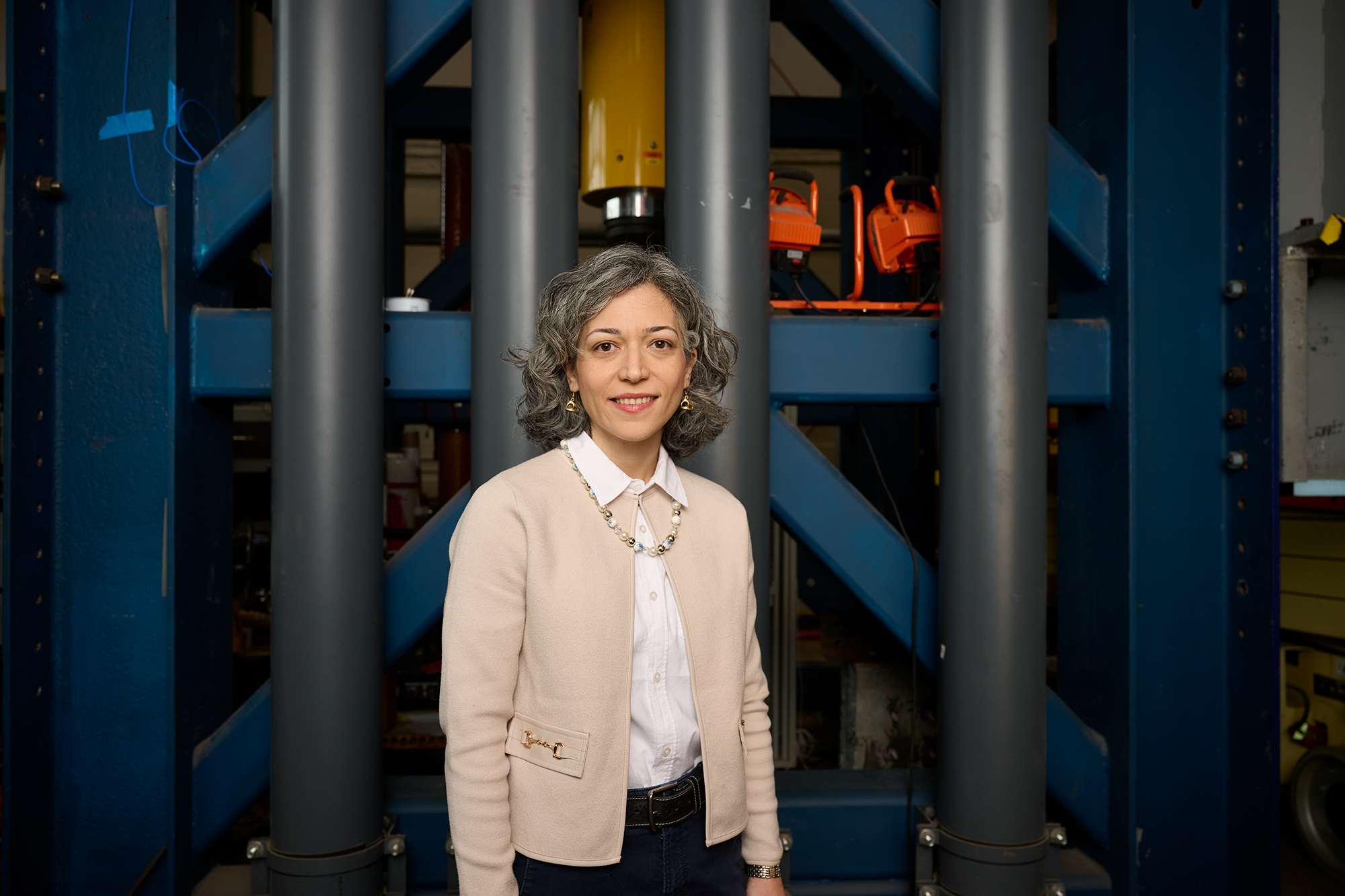
The Instructor
Even when walking her dog, Sarira Motaref, professor-in-residence in the School of Civil and Environmental Engineering (SoCEE), is attuned to structures and forces — and to her classes. Looking at how her dog’s tail moves and how the leash is being pulled might give her an idea for a real-world example that can help her students grasp a complex concept. “My teaching,” she says, “is always at the back of my mind.”
Motaref’s own engineering education began in her home country of Iran, where she obtained a bachelor’s degree in civil engineering and a master’s in earthquake engineering. She moved to the U.S. with her husband in 2006, obtained her Ph.D. in civil engineering at the University of Nevada, Reno, and joined the UConn faculty in 2011. Since then, she has received numerous teaching awards and accolades from both students and colleagues, served as assistant director of faculty development for the College of Engineering, and currently directs SoCEE’s Program for Innovation and Student Success.
For the past several years, Motaref’s research has focused primarily on engineering education, specifically neurodiversity in engineering education and the use of AI-powered personalized learning. She is part of the core team of Include, a project within SoCEE, funded by the National Science Foundation. Through the project, 16 I Courses (“I” for “inclusive”) were redesigned to better support neurodiverse students. Course content is offered in multiple formats, a variety of assessment modalities are used, and students have diverse options for showing their work. In one I Course, students were asked to choose a mechanics concept and apply it to their own interests.
“We had students who used engineering concepts to analyze backpacks, toys, sports equipment, even an orchid plant,” says Motaref. For another I Course, she and a colleague provided some students with 3D models to see if they performed better on exams than students who had access to only 2D models. (They did.)
“Probably our most important realization,” Motaref says, “is that the methods we are developing benefit everyone, not only students typically classified as ‘neurodiverse.’ After all, when you think about it, everyone is neurodiverse in some way.”
The Class
On a Thursday morning, more than 100 students file into a lecture hall in the Science 1 building, open their laptops, and turn to the front of the room, where Motaref is filling a whiteboard with equations. Today’s lesson is on beam analysis — used to understand how a beam carries loads by identifying the forces and bending effects within it as it supports weight from natural sources like snow or human-made loads like cars.
Usually, Thursday sessions include time for collaborative problem-solving, but an exam on Tuesday means that this one is lecture only. Still, Motaref pauses frequently, scanning the room for raised hands or puzzled faces and answering questions as they arise.
The material is technical, but she sprinkles in nontechnical examples. “You realize that your shoulders are a beam holding up your head, right?” she asks. When class is over, a bunch of students surround Motaref. She answers questions, provides reassurance, and encourages them to come to office hours for help working on problems.
While incorporating examples you might expect to see in an engineering course, such as bridges and buildings, Motaref constantly reminds her students that engineering is not removed from the rest of the world.
“The mechanics concepts are universal,” she says. “I want them to be able to apply these concepts to anything around them.”
A core requirement for multiple engineering disciplines, and recommended for most others, CE 2110 involves extensive problem-solving, critical thinking, and the application of mathematics within engineering contexts. It’s offered in several high schools around the state through UConn’s Early College Experience program.
“When you think about it, everyone is neurodiverse in some way.”
Teaching Style
“I believe from the bottom of my heart that teaching involves a mutual relationship between human beings,” says Motaref. “I want my students to know they are my highest priority.” Students are clearly getting the message.
“She adjusts to what the students need and makes sure that no one’s question goes unanswered,” says Fernando Osorio-Morales ’27 (ENG). Adds Saif eddine Moutawakeel ’27 (ENG), “I truly respect Professor Motaref’s hard work ... She is always enthusiastic and full of energy.” Nina Fishman ’29 (ENG) says she appreciates the ways Motaref accommodates different learning styles. “She always makes the effort to get to know her students, and that has had such a positive impact on my learning.”
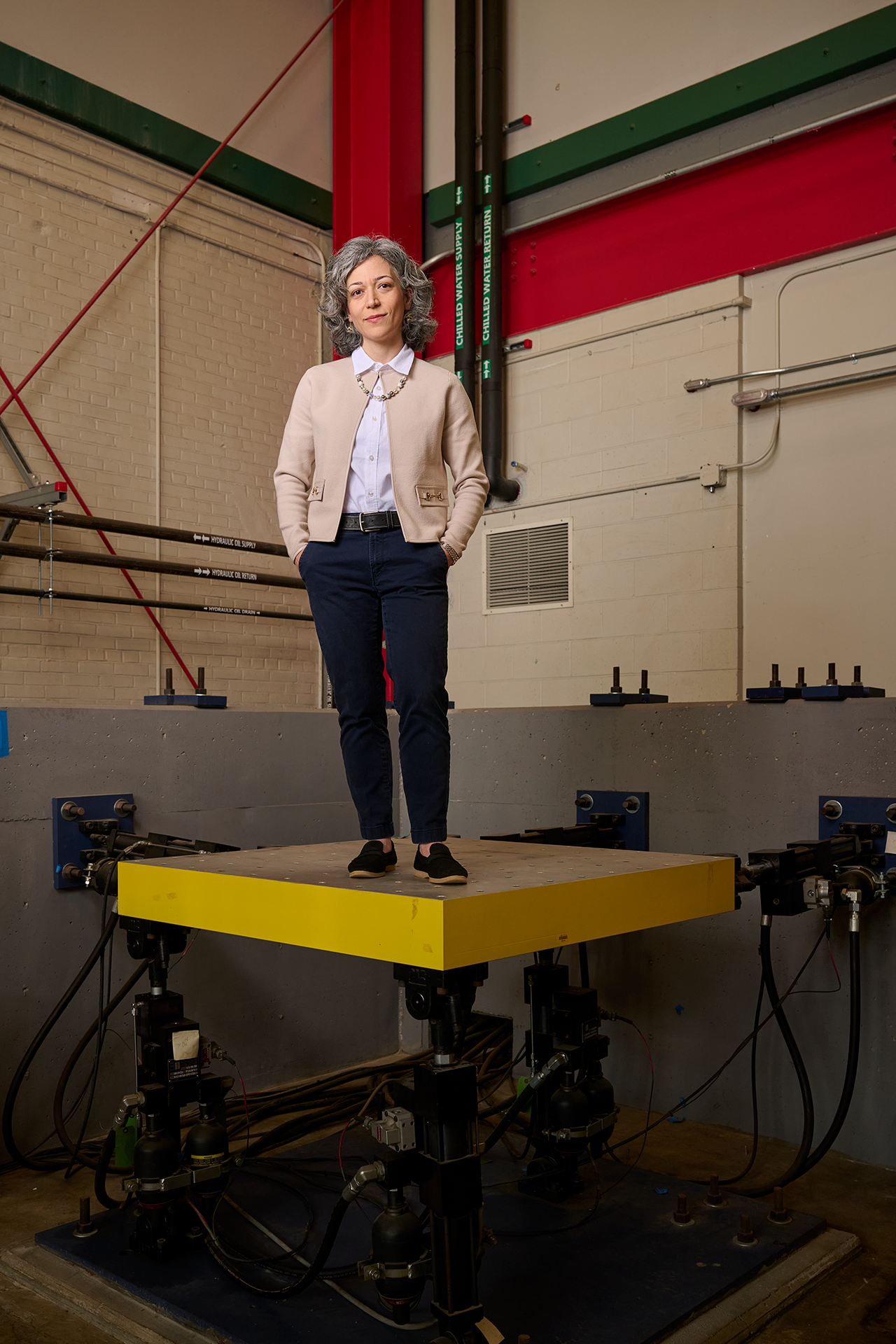
Motaref atop a shake table students use to test a structure’s ability to handle forces like earthquakes. Seismic engineering is one of her ongoing research interests.
To reinforce concepts, Motaref provides numerous examples, including references to the natural world. “When trees lose their leaves,” she points out, “they are facilitating survival by reducing the load on their branches that comes with snow.”
She brings models to class, offers online access to lecture videos, and assigns weekly collaborative problem-solving (CPS) assignments. Moutawakeel and Fishman note that working with classmates on CPS assignments, which simulate exam questions, can be particularly helpful for those who may feel overwhelmed.
Students also appreciate Motaref’s accessibility, whether it is her prompt response to emails or her extensive office hours, during which students can practice solving problems with her guidance. “I encourage them to come with their friends,” she says, “so they won’t feel so anxious, even if that means having 10 people sitting squooshed together on my floor.”
Motaref reads student feedback carefully and grades exams herself. “The exams give me information about what students are missing and where I need to do a better job of teaching,” she says.
When she thinks that a change is needed — for instance, when she recently adjusted a group activity in response to student concerns about fairness of the evaluation process — she will make that change and again ask students for feedback. “The feedback loop is essential. They are my stakeholders.”
Why We Want to Take It Ourselves
“This is not a class for the general public,” Motaref says. “You do need a specific kind of math background.”
But if you have that math background, Motaref’s students would urge you to give this course serious consideration.
Described by students as “engaged” and “passionate” about both engineering and teaching, Motaref offers consistent feedback and encouragement and uses whatever methods she thinks will help students grasp the material.
That might be a session of voluntary arm wrestling to help students understand the concept of “moment,” a measure of the tendency of a force to cause an object to rotate about a specific point or axis. Or asking students to figure out how best to keep a mailbox stable.
As Gan Prottas ’27 (ENG) says, “I am learning how to think critically and rationally. This is not just an engineering skill but a life skill.”