The Last
Cookie in
the Box
What follows is at heart a UConn love story, one still going strong as it nears the half-century mark.
It is excerpted from the recently published “Dual Identities: Living in Meier’s Shadow” by Arthur M. Horwitz ’76 (CLAS). In the memoir, Horwitz bookends his UConn story between tales of a childhood that includes delivering papers and mucking stalls in a tight-knit Jewish neighborhood of New Haven, Connecticut, and a newspaper career that — begun on said paper route — cycles through copyboy, reporter, bureau chief, and publisher stages to culminate in the establishment of the Arthur M. Horwitz Collection at the University of Michigan and the author’s enshrinement in the Michigan Journalism Hall of Fame.
Layered throughout is the “Meier” of the title, the younger brother of Horwitz’s mother who, unlike her, did not survive the Holocaust. His absent presence has permeated Horwitz’s life and was one factor in his career choice.
It also helped Horwitz recognize “even as a paperboy” that every individual has a story to tell, and it is one of the things that made him “fall in love even then with a profession” focused on finding and telling those stories, on “giving voice to people whose voices are unheard or underrepresented. … As a child of a survivor,” he considers, “that is six million individuals, each with a life, a path, a reflection.”
Horwitz’s mother, Sally, died in 2014 at age 86, but, he says, “I can hear my mother’s voice, ‘You little pisher! You have a collection at the University of Michigan!’”
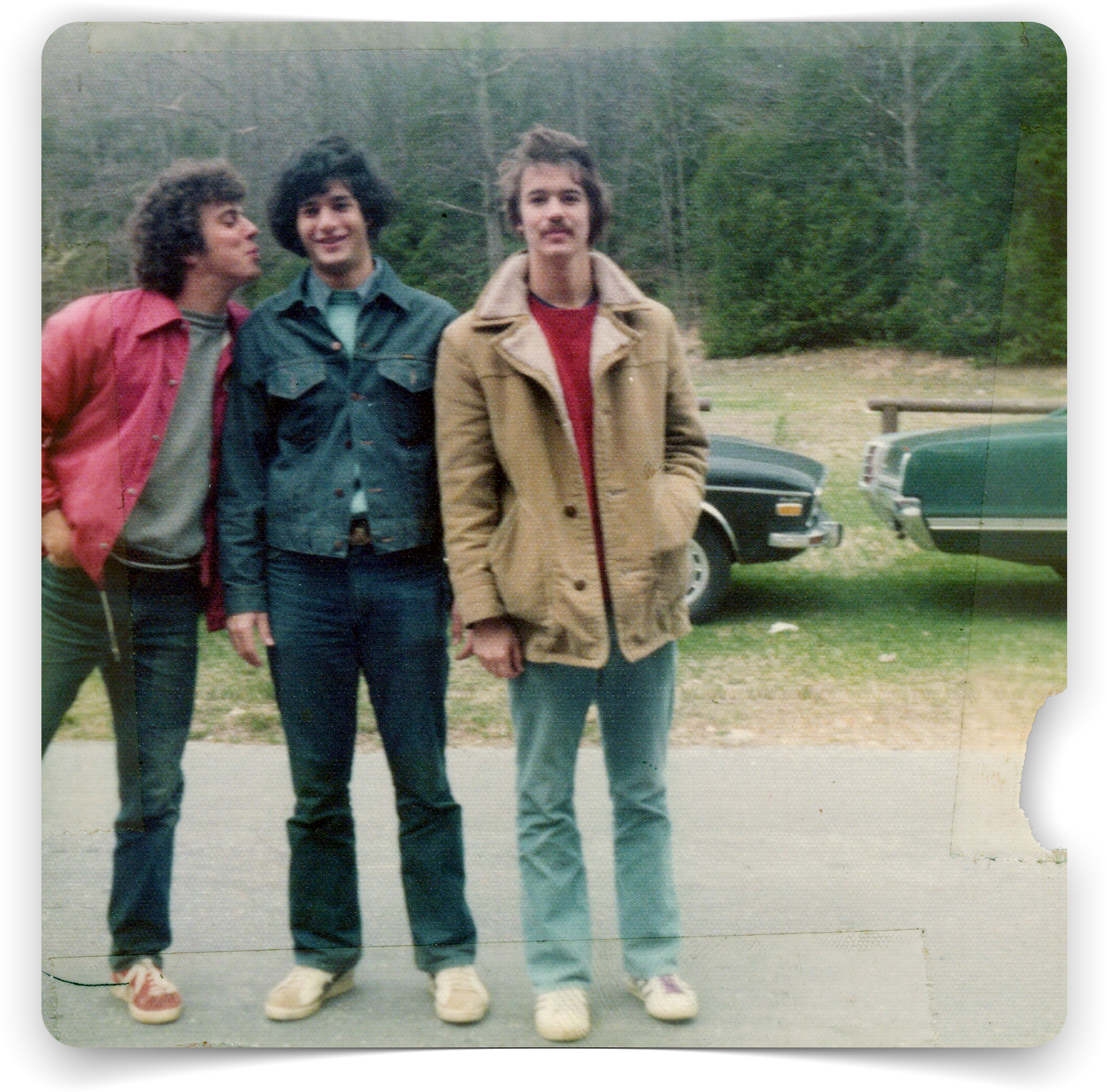
Horwitz, center, with Andy Karpie ’79 (CLAS), left, and Geoff Marion ’77 (CLAS) on a college-break camping trip in 1974
Kingston House, part of the University of Connecticut’s Towers dormitory complex, was an unimpressive four-story brick structure built to withstand the vim and vigor of 66 testosterone-crazed men. Depending on one’s perspective, it was either the closest place on campus to Interstate 86 (now Interstate 84) and a fast escape to Boston and Hartford or the farthest from almost everywhere else except the Dairy Bar and its acclaimed ice cream.
Perhaps half the on-campus students headed elsewhere each weekend. I wasn’t going anywhere. A visit home assured overhearing discussions about business problems or the risk of at least one “you’re dishonoring Meier” moment. Since early adolescence, my Holocaust survivor mother, Sally Horwitz, burdened me with the responsibility of living two lives — mine and the one denied to her murdered little brother, Meier, whose Hebrew name I carried. Parental communications consisted of a Sunday evening phone call and twice-weekly receipts of envelopes stuffed with newspaper clippings curated by my father. In response, I sent occasional letters summarizing — and sanitizing — my activities.
Even if I wanted to leave campus, I suspected my upcoming job would require covering the UConn football team every Saturday afternoon throughout the fall season.
With work-study paperwork in hand, I entered the Department of Public Information’s Office of Sports Information. Director Joe Soltys met me at the door.
“Aahtha Hooorwitz,” the frail-looking and bespectacled Soltys said in exaggerated tones while extending his hand. He quickly put me to work, interviewing varsity athletes for their hometown papers and writing stories to supplement wire service coverage of football games. During basketball season, I sat courtside with beat reporters from the state’s major dailies. Flirtatious female students noticed my front-and-center presence. I liked that. At halftime, some came by to chitchat while others invited me to their rooms after games … to listen to music. I didn’t screen them by religious affiliation. At UConn, I was free to socialize with any girl of my choosing. Unlike at home, every day wasn’t Holocaust Remembrance Day.
My work for Soltys and occasional bylined stories in the New Haven Journal- Courier and Register captured the attention of the editors at the Connecticut Daily Campus. Was I willing to handle some feature assignments? Sure, even though my work-study writing load remained undiminished. By the end of the academic year, I had agreed to become the newspaper’s co-sports editor. A third summer of reporting padded my portfolio, with stories appearing multiple times a week in the New Haven dailies.
“I’m only 19! Editor-in-chief is a full-time job! I won’t graduate with my class! I entered the bathroom …
There, I vomited on the floor.”
A few months into my sophomore year, I was contacted by former Daily Campus editor-in-chief Lincoln Millstein ’77 (CLAS). He said he was impressed by my writing, work-study output, and daily newspaper experience and invited me for a beer. I accepted. He had an agenda. Would I consider applying for his former position? I demurred, not feeling remotely capable of leading the newspaper while still maintaining a full course load. After the third beer, I agreed to proceed.
In support of my candidacy, I secured letters of recommendation from New Haven Journal-Courier editors Danny Wallace, Bill Guthrie, and Bob Granger, as well as Soltys. The Daily Campus editorial advisory board individually interviewed three candidates.
Then we waited beyond a closed conference room door for a decision.
Outgoing editor-in-chief Alan Reisner ’75 (CLAS) and managing editor John Pallatto ’75 (CLAS) emerged several moments later.
“Congratulations!”
The board had selected me.
I hurried back to my dorm room, harnessing butterflies of fear as I passed the university administration building, Wilbur Cross Library, the Hillel building, and St. Thomas Aquinas Center before ascending the pathway to Towers and huffing and puffing my way to Kingston House. My mind was spinning.
I’m only 19! Editor-in-chief is a full-time job! I won’t graduate with my class! I entered the bathroom just beyond my dorm room. There, I vomited on the floor.
“See, I told you writing can take you places!” my mother proclaimed when I later shared the news with my father and her over the telephone.
Yes, but where?
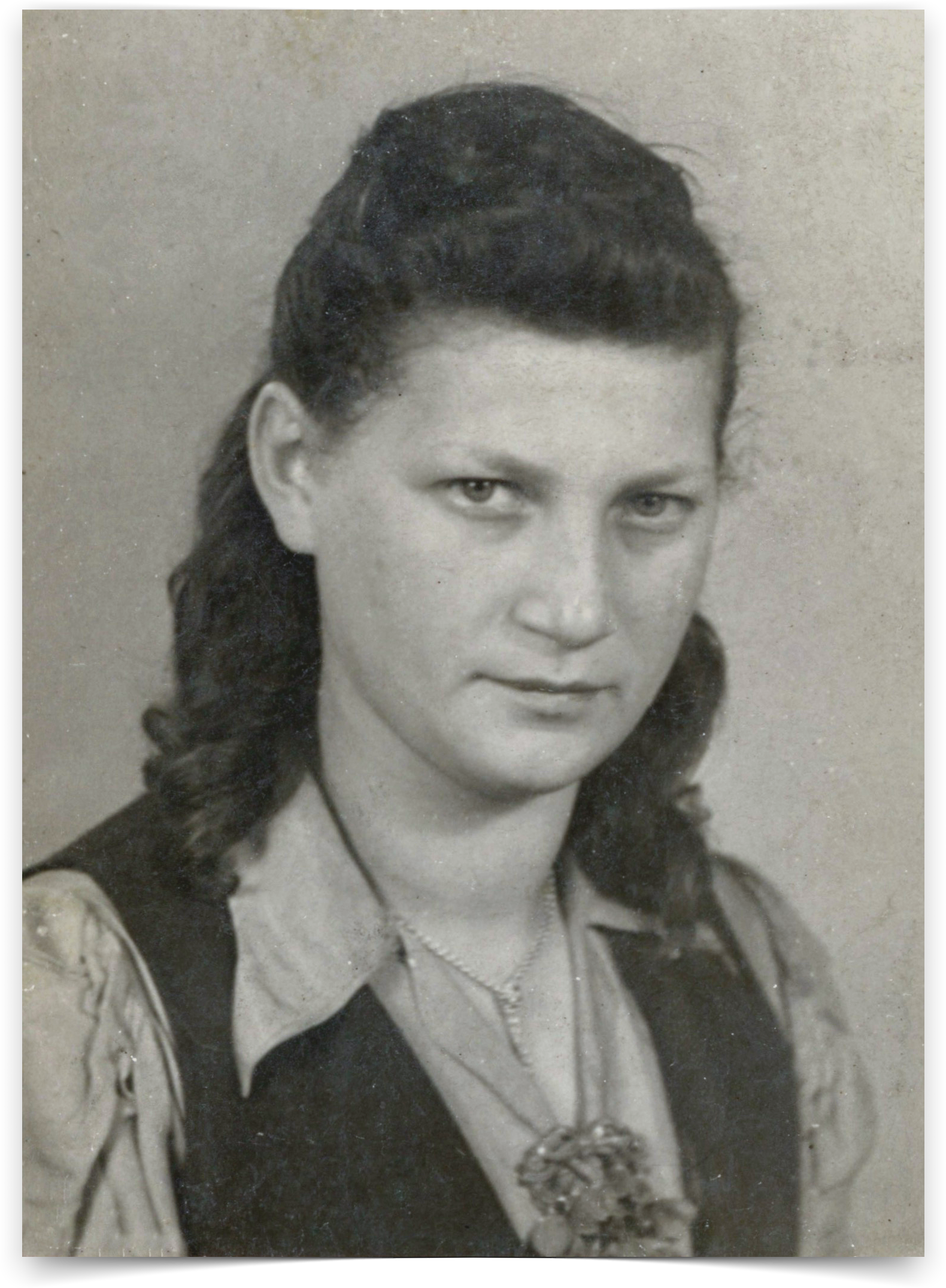
Sally’s identity photo,
Bamberg, Germany, 1946
It was my junior year, and with Passover approaching, I felt the pull of home and family — and the dread of accompanying baggage.
Several weeks before the first Seder meal, my mother transitioned into cooking, baking, and brooding mode. On most nights, her single oven and four-burner electric stove pumped out a small but steady array of less than exceptional kugels, sweet-and-sour meatballs, matzo balls, chicken broth, tzimmes, pre-sliced brisket, marble cakes, and brownies. After cooling, each item was tightly wrapped in Saran or Reynolds wrap and squeezed into every square inch of the refrigerator’s undersized freezer.
There was no smile on her face or Richard Tucker renditions of the Haggadah’s greatest hits playing in the background. Tears occasionally dripped from her swollen eyes, but the onions weren’t to blame. The ancient Israelites escaped slavery from Egypt, but my mother was incapable of freeing herself from images of mass starvation. This night of our Seder was always different from all other nights. Because on this night, Sally Finkelstein Horwitz was feeding her family — living and murdered.
I took more than leftovers back to my dorm room.
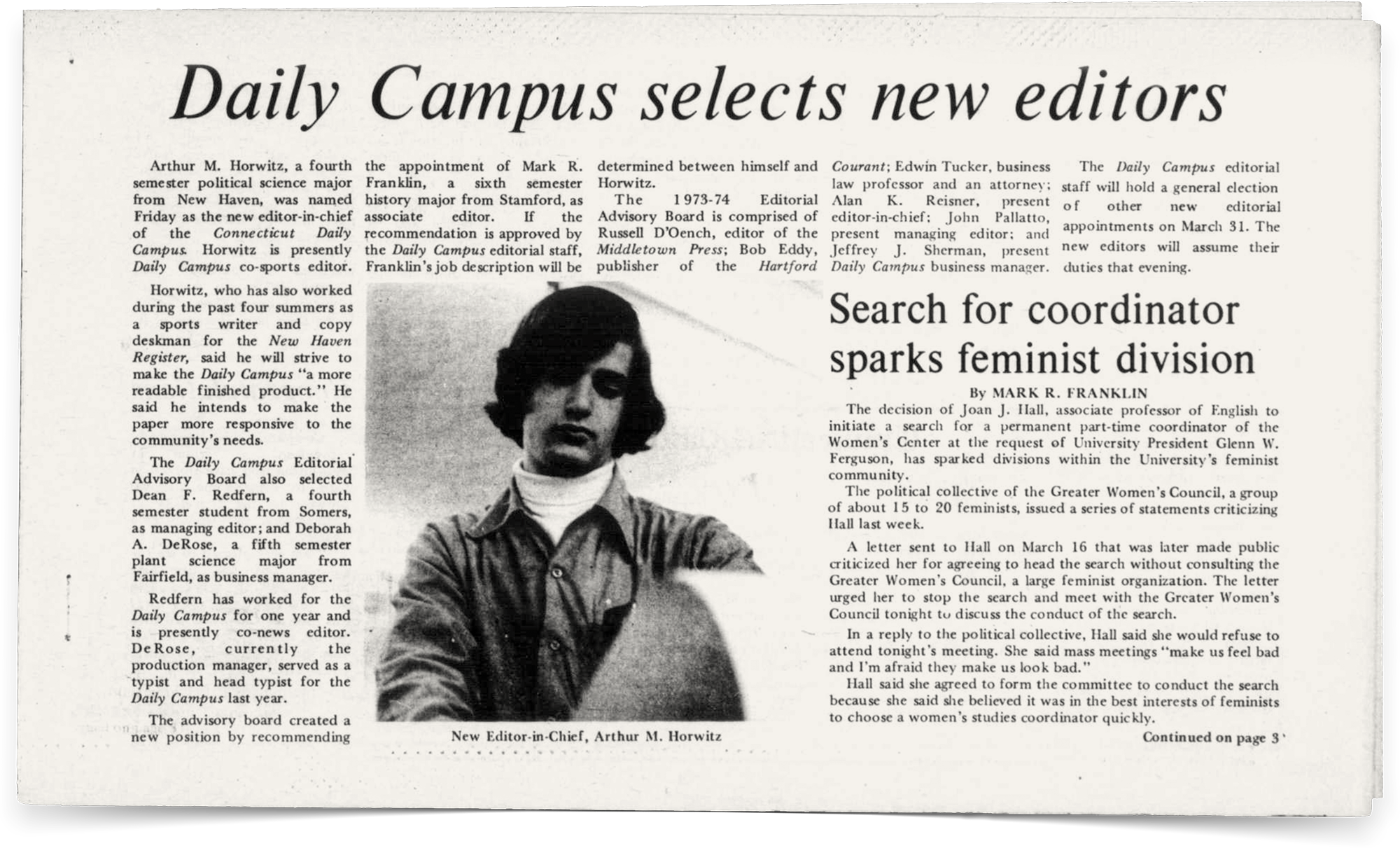
The Connecticut Daily Campus, Monday, March 25, 1974
For the remainder of the Passover holiday week, I opted for kosher meals at UConn’s Hillel House. Looking past discolored gefilte fish patties and platters of sweaty dark-meat chicken, I noticed volunteer waitresses who were more appealing to the eye. From a blur of jeans, wrinkled and soiled sweatshirts, curly hair, and olive skin, one stood out. Her fair complexion, blue eyes, and from-birth perfect nose were complemented by a stunning pantsuit accented with a silky floral-patterned scarf. She was more than a waitress. She looked like a fashion model.
“Wow, she’s nice!” New Haven friend Jeff Macarz whispered. We continued my not-so-discreet staring throughout the meal’s main course.
Time for dessert.
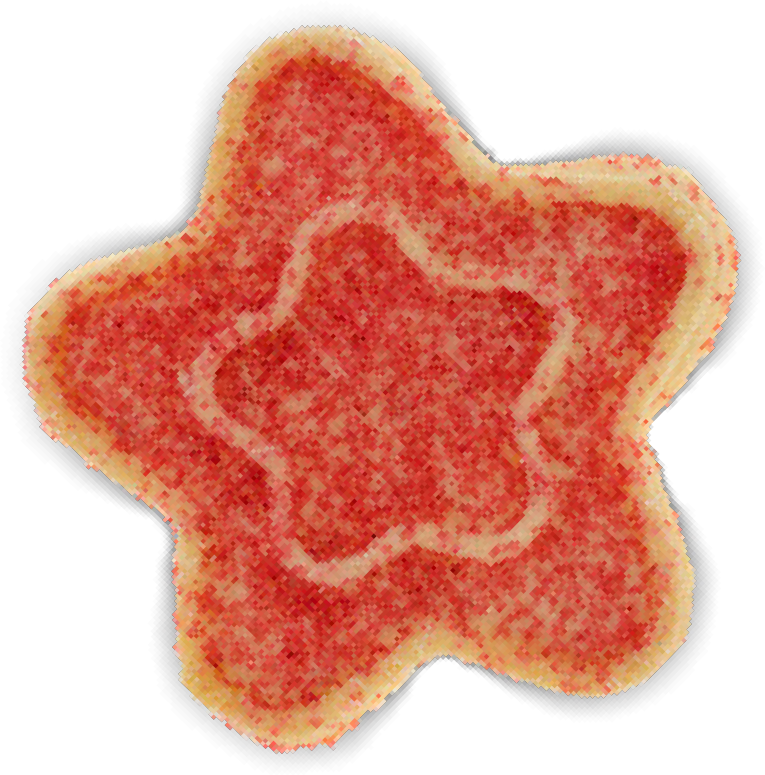
There was no sweet table covered with fluffy 13-egg sponge cakes, flourless chocolate tortes, delectable almond cookies, or bowls of freshly cut fruit. In fact, there was no table at all. Instead, one box of a Manischewitz not-so-fancy cookie assortment was being distributed by the golden goddess. Strong hands and outstretched arms grabbed — at the box — as she weaved among the tables.
She’s coming our way!
Bypassing several others, she abruptly stopped at my side and lowered the box so I could make a selection. However, there was only one cookie remaining. It had red sugar crystals on top. She had saved it for me. As I reached for it, our eyes locked. Hers twinkled. My heart fluttered.
After rushing back to my room, I breathlessly shared the waitress encounter with my roommate, Geoff Marion ’77 (CLAS).
“She was radiant, beautiful … she gave me the last Manischewitz cookie!”
He cut me off.
“Don’t waste your time on that one,” he insisted. There was a Jewish — his emphasis — girl in his friend Marie Mulhall’s Crawford D South Campus dorm. They wanted me to meet her. Were they secretly in cahoots with my mother, who, scarred by Holocaust trauma, insisted that I only date Jewish girls?
Sure. Why not?
About a week later, Crawford D hosted a pizza and beer party with our dorm. Hmm. Would I be introduced to their mystery maiden? As a debate swirled at our table about whether UConn men or cadets at the nearby U.S. Coast Guard Academy treated women better, Marie suddenly waved.
“There she is!”
I pivoted in my chair in time to see an arm-in-arm couple pausing briefly before heading out the door. It was her — the provider of the last Manischewitz cookie. There she goes, so I thought.
“That’s Gina, my roommate.”
I was sitting with Jill Johanessen ’78 (Home Ec.), whom I had met inside a postcard-perfect white church in rural Voluntown the previous July. It was not a happy occasion. Her sister Cindy and Kingston House friend Tim Scaia were among the 24 victims of a devastating fire at Gulliver’s, a pulsating nightclub attached to a bowling alley straddling the Connecticut–New York state line. Cindy and I had been occasional partying companions. Jill had been randomly matched with another freshman, Gina Wesler ’78 (Home Ec.)
At a similar pizza and beer gathering the following week, Gina sat directly across from me. This time, she was unescorted. We had a chance to talk, which didn’t keep me from being entranced by her blue eyes, smile … and the tomato skin stuck between her front teeth. She intended to major in fashion merchandising and was from West Hartford. Gina’s Ken-doll dress-up companion had been “just a friend” from Trinity College. I quickly realized that Gina was approachable, self-effacing, and that I wanted to be with her. At my request, she provided a phone number.
A few days later, I dialed. She answered on the first ring.
“I thought it might be you,” she offered.
After exchanging pleasantries, I swallowed hard and asked if she could join me for a bite.
“Yes.”
There was no hesitation.
I circled May 8, 1975, on my calendar.
After disconnecting, I panicked. Where would I take her? Husky’s? Rapp’s? Pizza House? Kathy John’s? Such poor choices! Then I remembered a billboard along Interstate 86 near Vernon Center. “Rein’s NY Style Deli — this exit.” It was about 25 minutes from campus. I had a car. Let’s go.
Rein’s was a monument to Jewish comfort food. Chicken soup. Corned beef. Pastrami. Pickles. Halvah. And not just any hot dog, but Hebrew Nationals. Gina was in mixing-milk-and-meat mode, a kosher no-no. She ordered a cheeseburger followed by a generous slice of New York–style cheesecake. I ate something, but I don’t remember what. I was fixated on the quantity of calories she was shoving into her mouth.
On the ride back, I didn’t risk hand-holding or an attempt at a good-night kiss. My desire was to continue seeing her. She declined my first two follow-up invitations. Crushed, I decided there wouldn’t be a third … until I received a quirky, humorous May 25 birthday card. She signed it, “Always, Gina.”
Was this a bashert (meant to be) moment? Perhaps an angelic intervention from little Meier? Here, like me, was the daughter of a Holocaust survivor mother and American-born father who shared and understood the crosscurrents inherent in our identities. Three years later, we were married.
Indeed, it would be always Gina.
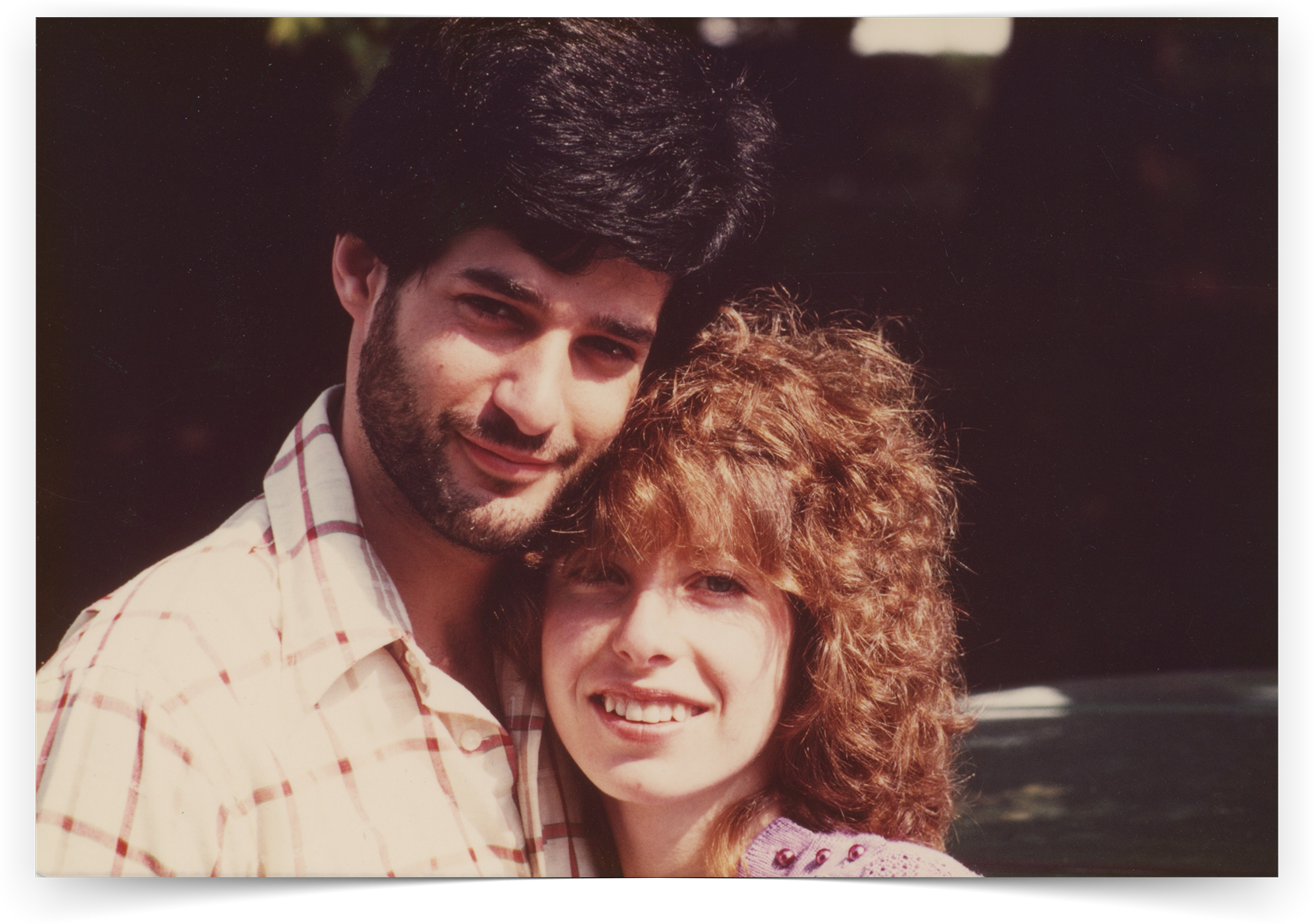
Arthur and Gina in 1975. They married in 1978 and remain happily so today. Until the company discontinued the assortment, Gina brought Arthur the last red-sprinkled cookie in the box every passover.