
The Yogi Inside
“A practice like this is meant for a place like this,” says alum Nicole Hellthaler, director of the global Prison Yoga Project.
By Danny Freedman
Photos by Robert Sturman

As Tuesdays go, this one might be unusual, says Nicole Hellthaler ’14 (CLAS). She offers that gentle disclaimer, though, not because we’re walking into the county jail in Little Rock, Arkansas, and not because she’s about to lead a clutch of incarcerated men to an unbound plane of stillness and calm.
It’s because today’s yoga session — offered by the global nonprofit she leads, Prison Yoga Project — marks a return to the jail after a few weeks’ yuletide hiatus. Six days into the new year, Hellthaler is thinking about emotional bruises that might linger from the holidays. She’s wondering how the men are adjusting to the return to routine. Some will be joining her class today for the first time, as much of a question mark to her as she — and maybe yoga itself — is to them.
At a raised security station that still wears a wreath, we surrender IDs, lock up everything that’s not a yoga mat — except my pens, notebook, and voice recorder — and pass through metal detection.
After going up in an elevator and down a long series of hallways, we’re let into the outer entrance of a compact two-story housing unit. Hellthaler chirps a good morning to one of the guards in the security roost, and he sends us through a gate into the unit, where the walls stand in a wide V-shape with a staircase down the middle.
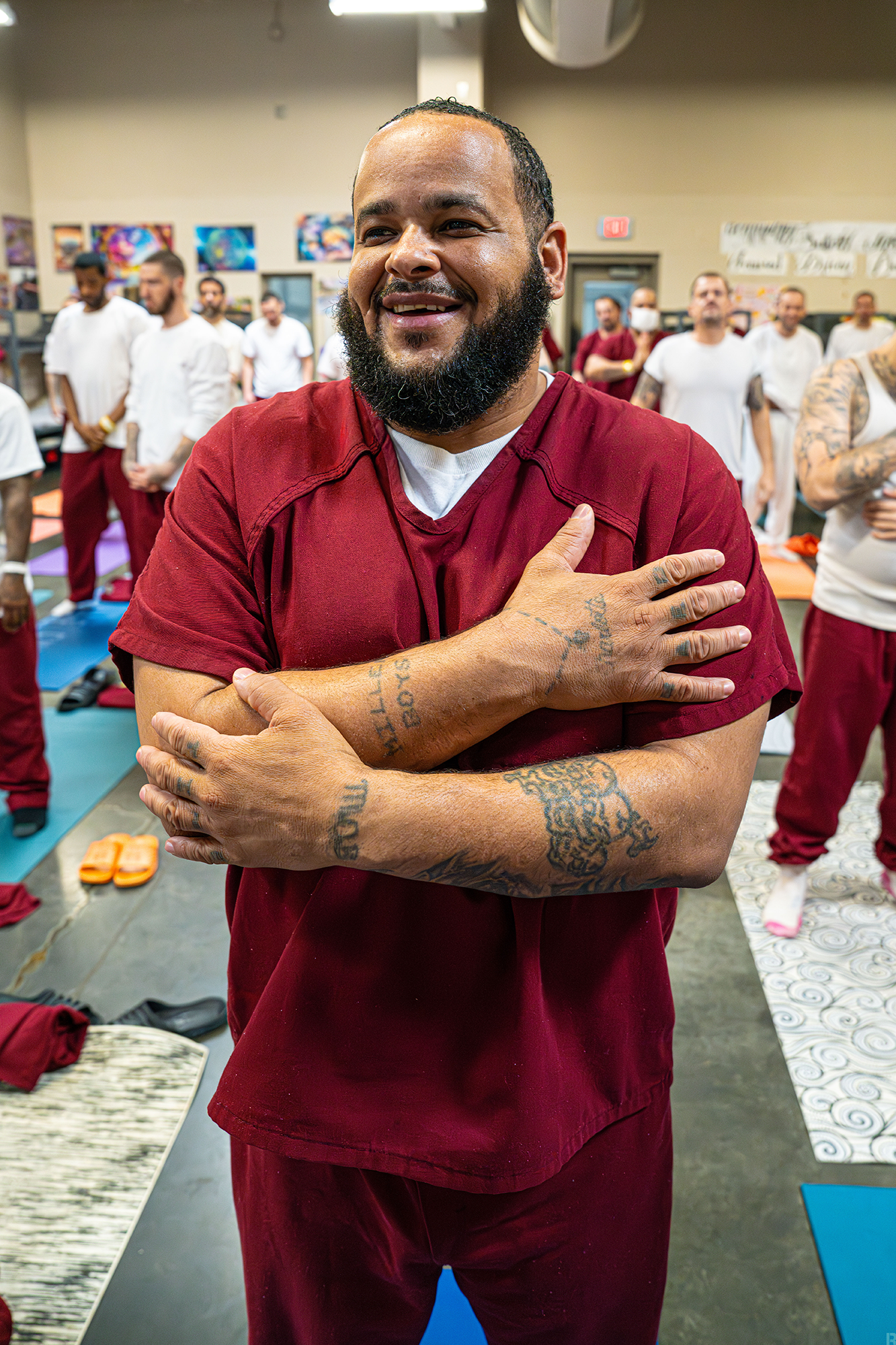
A longtime participant at Pulaski County Regional Detention Facility, where Hellthaler teaches, shares one of his favorite poses. He “was always smiling and brought immense joy to the class,” she says.
Instantly, a few dozen heads turn, and their eyes seem to lock on to us. Hellthaler, 33, looks at ease under the scrutiny, a sunbeam in loose black workout clothes and color-splashed, guitar-pick-shaped earrings. Trailing behind, I probably look like the shadow of her composure, a bit overwhelmed and sporting a nervous smile.
In the week since nailing down the clearance to be here, reality has curdled some of my gusto. I haven’t actually been in a corrections facility before. Should I have considered issues beyond a pulled muscle or a dry pen? Earlier, Hellthaler said that as many as 80 incarcerated men took this class. We agreed that perhaps I ought to find a spot near the back, to be discreet about my note-taking, though I wondered how it would feel to be that embedded. (It turns out that the 80 men are now split into two less daunting classes.)
This is the state’s largest county jail, with 1,200 detainees on any given day, according to the sheriff’s website. It’s a final stop for some, a way station for others awaiting trial, sentencing, or transport to another place to serve out their sentence, including state or federal prison. One housing unit here is the subject of the Netflix reality series “Unlocked: A Jail Experiment,” which I started to watch, briefly, before thinking it might be better to starve my anxiety than treat it to a buffet.
Prison Yoga Project operates in a different unit, though. It’s in the re-entry program, mostly for people here on drug-related charges, and it’s stocked with classes and privileges that one might be loath to risk losing. And even as I nervously fret over my well-being, I worry about theirs, too: What emotional harm might be caused by one more outsider looking in, or worse, disrupting a meaningful hour of calm?
As we enter the unit, the stairs drain everyone to pool around us, and the space suddenly feels like Times Square. Hellthaler introduces me. But instead of resentment or annoyed indifference, it brings a stunning rush of welcomes and handshakes, and my guardedness thaws into guilt.
One of the men, Rylan Perryman, reaches over a wall of shoulders to offer me a folded sheet of notebook paper. In neat print, he had written that Prison Yoga Project and its instructors had changed his life — helped save it, even.
At Hellthaler’s suggestion, the group agrees to head outside, where, at 8 a.m., it’s a chilly and overcast 60 degrees or so. Around three dozen men grab yoga mats, and one of the last, Frank Ortega — tall, 44, and solid-seeming in his gray sweatsuit, with Ray-Ban glasses and dark, slicked-back hair — generously coaxes me to take one, too: “You gotta do yoga with us!”
On the other side of a metal door, the men quickly settle into rows in a rectangular yard. Its gray concrete walls are topped with a matching sky, seen through a lid of chain-link fencing.
“I missed you,” Hellthaler says after everyone’s acclimated.
“Not as much as we missed you,” someone replies.
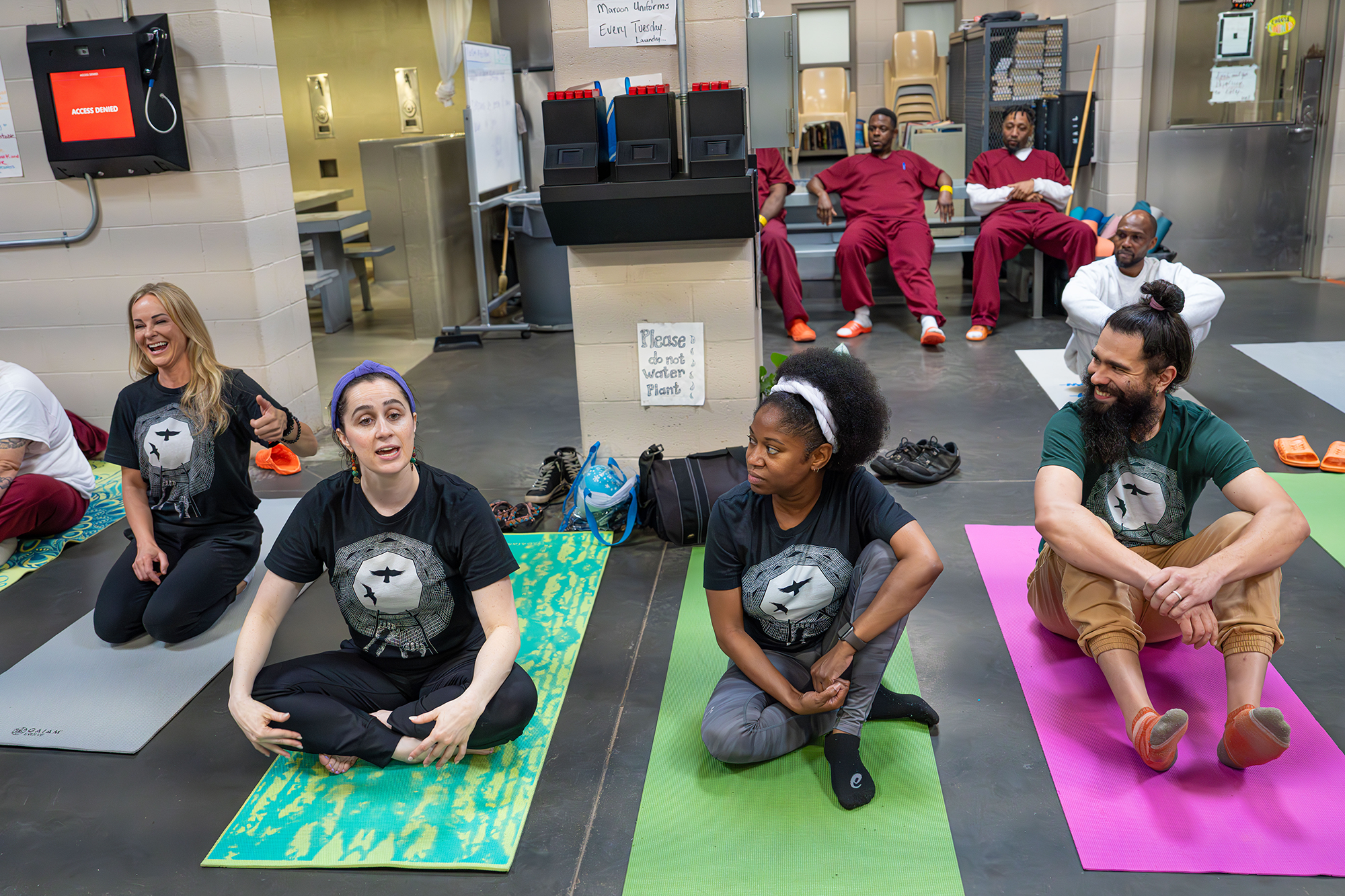
Prison Yoga Project members at the Pulaski County facility. To check energy levels and break the ice before each session, says Hellthaler (second from left), “we share our names and respond to the question, ‘If you were driving a car right now, how fast would you be going?’”
Hellthaler, Prison Yoga Project’s executive director, has been ministering yoga at the Pulaski County Regional Detention Facility since 2019, at first with juveniles, and then with men and women as part of the jail’s reentry program. From the start, she felt that “this just makes so much sense; that a practice like this is meant for a place like this.”
It’s an idea Prison Yoga Project has been spreading since its founding in 2010 by yoga instructor James Fox, an outgrowth of the classes he has led since 2002 at California’s San Quentin Rehabilitation Center (formerly San Quentin State Prison). Last year, the nonprofit was active in more than 135 correctional facilities in 21 U.S. states and in 10 other countries from Mexico to Australia.
The yoga that it practices and teaches is adapted to maneuver around the gauntlet of trauma that an incarcerated crowd might collectively bring to the mats, including the trauma of incarceration itself. There’s a focus on yogic techniques as a balm, rather than as purely physical exercise or the adherence to any one guru or style. Hellthaler’s class wouldn’t be unfamiliar to many studio-goers, in terms of its general arc and the placidity of the instructor. On the other hand, it’s a party compared to the studio environment, with good-natured chatter and games, like the surprisingly popular, “Simon Says”-inspired “Yogi Says,” which is a way to exercise impulse control. There’s a sense of togetherness, rather than a sense of standing together seeking solitude.
Largely, though, the differences are the subtleties.
For instance, agency is sacred. Even in a mandatory class like the one in Little Rock, whether and how a person participates is optional. One man did so from a chair, and at least one appeared not to at all; shoes on, leaning against the back wall.
Hellthaler doesn’t haunt the aisles to scrutinize form, and she avoids poses that might feel too vulnerable, such as child’s pose, where one is on their knees and folded forward, head to the ground. She also educates seamlessly as she goes. She’ll ask participants to flex large muscle groups — with, say, a leg-and-core-squeezing chair pose — to make a point of the release that follows. And she frequently cycles the group between movement and stillness.
“It’s about training their nervous systems how to go from a heightened state to a state of rest,” she says. “When you’ve experienced trauma … the body gets stuck in fight-or-flight or, in this context, protective mode. So we’re trying to teach them how to come out of that in a safe way, and yoga is a safe way. We’re just moving our body.”
Her men’s classes generally become invested quickly. Hellthaler sometimes has to chide newcomers that they’re missing the point by trying to telegraph masculinity or hold a plank longer than she does. “That doesn’t impress me,” she’ll tell them. “What impresses me is you taking a break and admitting when you’re tired.” With her women’s classes, it may take more time and tenderness to build trust and buy-in.
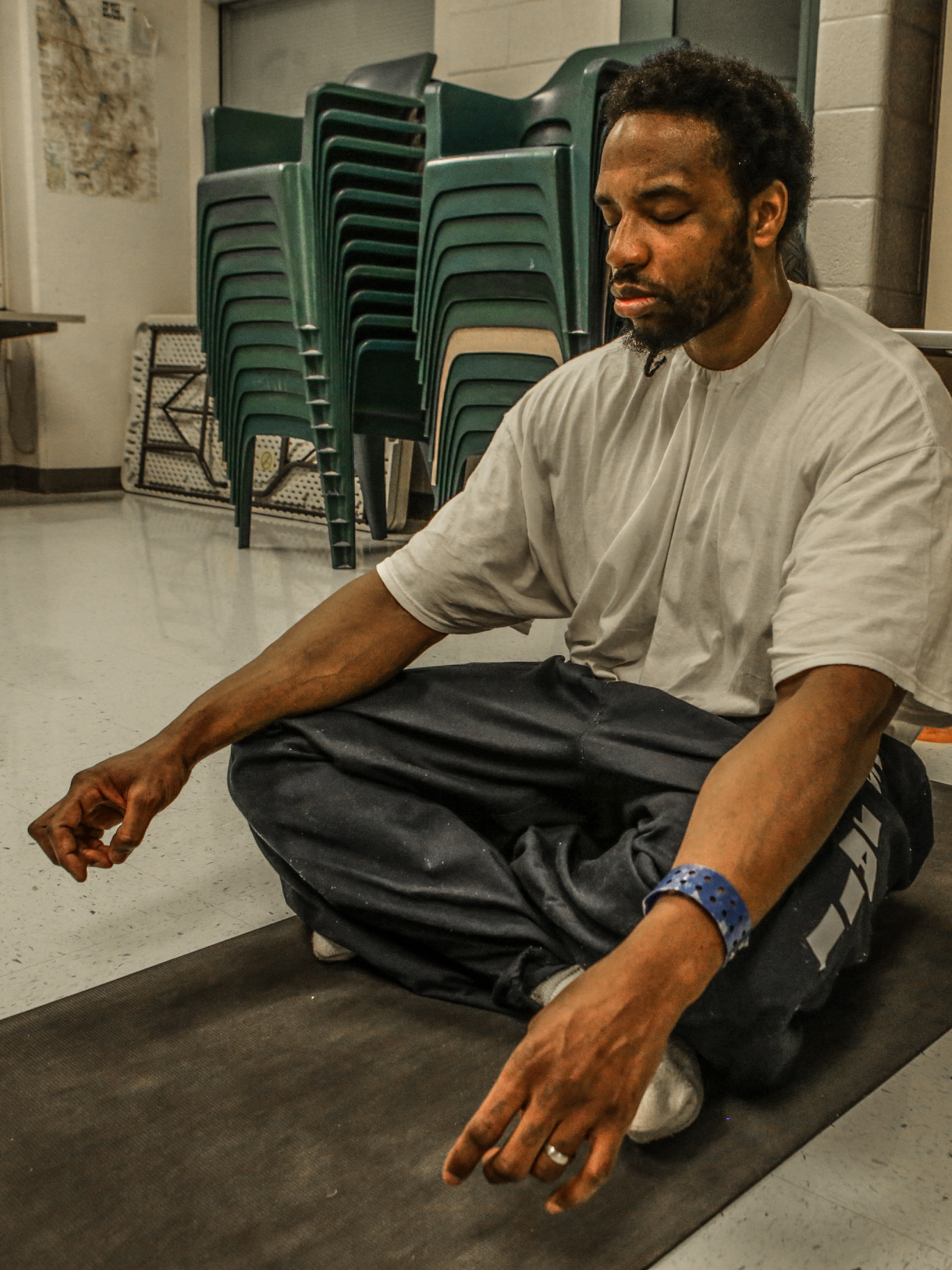
A participant at San Diego Central Jail practices conscious breathing.
That rapport, in part, comes from simple consistency. “There are people who come into jails and prisons and do service,” she says. “But what means the most to them is that this person wants to come back. They’re choosing to come here every single week.” And Hellthaler comes every Tuesday for the men’s class and every Wednesday for the women’s, even after climbing into the executive director role in 2024 from her post as assistant director.
Prison Yoga Project has a full-time staff of just seven, plus a phalanx of part-timers, contractors, and volunteers. So Hellthaler has the email inbox volume of an executive director while she also handles budgeting, human resources, the hunt for grants and other funding, and saying yes to interview requests, in addition to her yoga sessions.
“We feel scrappy,” she says, and she doesn’t seem to mind the full hat rack that comes with that. “I’m in it.” Even when she’s not at her desk or at the jail, she is still cheerfully in it.
After the yoga class, we go to a coffee shop that sometimes hires people released from the reentry program. Before we reach the counter, Hellthaler spots a woman she knows from the jail. Later, another runs up to our table and wraps her in a hug before clocking in for work.
Hellthaler also occasionally sees former participants at an evening Vinyasa class she teaches at a yoga studio a few miles away. “When they get out, it is hell,” she says. “You have to find a job, you have to find a car, you have to find a home. I don’t expect yoga to be their focus. So it’s always really meaningful to me when someone comes and it’s resonated with them in that way.”
Previously he’d felt yoga wasn’t masculine; something that ‘housewives did in their spare time. ... But after the first time, I was hooked. Man, it’s like this is what I was missing out of my life — yoga. The breathing, the meditation of it, the peacefulness.’
Hellthaler essentially arrived in Arkansas via South Africa.
It was on a three-month study abroad trip to Cape Town, during her sophomore year at UConn, that the speech-language pathology major realized that social justice and service work needn’t be a hobby. On the trip, students augmented classes with internships and service projects under the wing of a now-retired women’s studies professor, the “radical, amazing, and exceptional human” Marita McComiskey ’01 Ph.D. Hellthaler’s work with underprivileged kids in the city’s once-segregated townships — engaging them in activities and field trips, getting to know their communities, and being invited into homes in struggling places that others would glimpse from tour buses — changed her.
That experience, along with UConn Community Outreach service trips to Boston and New Orleans, emboldened her to shake up her plans to find a job in her major. Instead, she applied to Teach for America and was placed in El Dorado, Arkansas.
At UConn, she had taken up yoga as a form of exercise. It was during her three years at a high school in El Dorado, near the Louisiana border, that a teacher training introduced her to the use of mindful, yoga-like principles to diffuse stress for herself and her students. Recognizing that “students were being punished for essentially acting out because their basic needs weren’t being met,” she demonstrated alternative techniques. “If a student yelled or acted angry, I might say, ‘I’m feeling a little stressed; I’m going to take a deep breath.’” Eventually, the tenor of the room would shift.
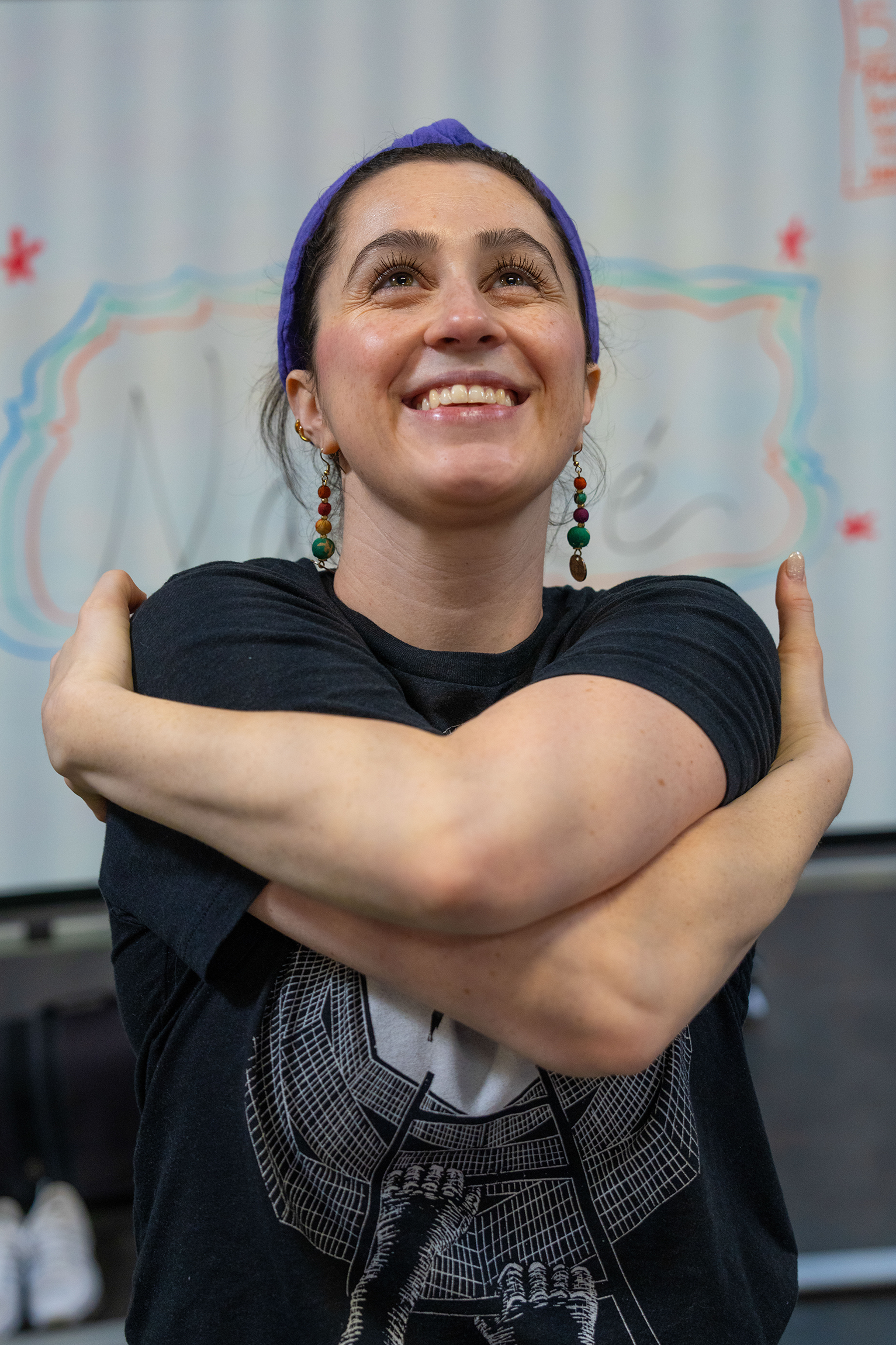
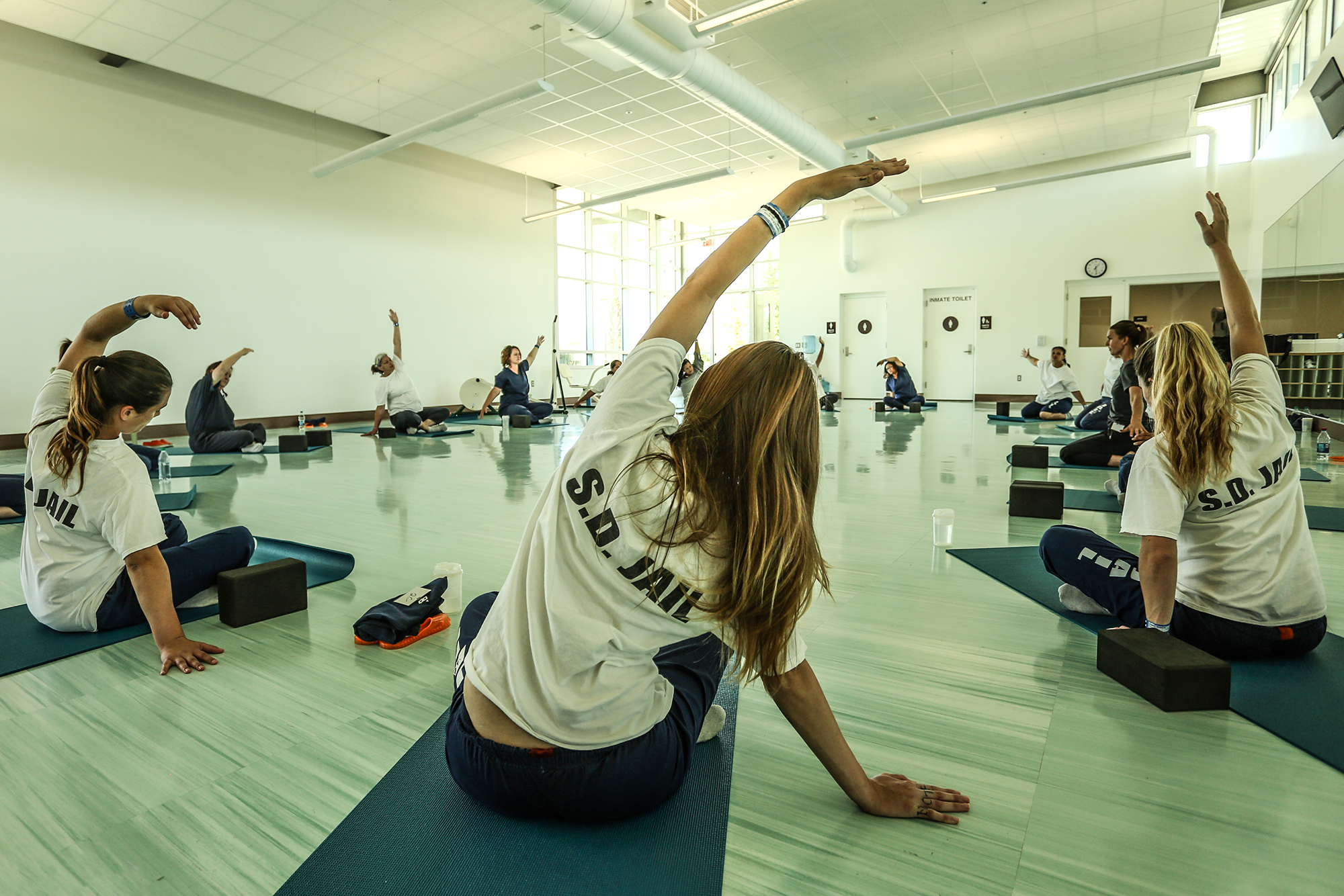
Above: Hellthaler leads a class at Pulaski. Right: Women at Las Colinas Detention and Reentry Facility in San Diego County, California, warm up with variations of a side-body stretch. “Offering choices is essential,” says Hellthaler.
Above: Hellthaler leads a class at Pulaski. Below: Women at Las Colinas Detention and Reentry Facility in San Diego County, California, warm up with variations of a side-body stretch. “Offering choices is essential,” says Hellthaler.
The focus on healing, she says, doesn’t come at the expense of accountability and justice. They’re in tandem with ‘seeing the human ... and understanding the trauma that often leads people to the circumstances that they’re in.’
Hellthaler moved to Little Rock, 120 miles north, for a master’s degree from the Clinton School of Public Service and pressed deeper into social justice and the idea of healing-centered approaches to misbehavior, which is how she encountered Prison Yoga Project. She worked with the organization for her degree-culminating project in 2018 and was hired the next year as national program manager.
The focus on healing, she says, doesn’t come at the expense of accountability and justice. They’re in tandem with “seeing the human … and understanding the trauma that often leads people to the circumstances that they’re in.”
It’s an approach that seems to resonate at the Little Rock jail.
“Some classes, people are kinda like, ‘Eh. I don’t really want to do this,’ or ‘It’s not really my thing,’” Holly Handley, the jail’s prevention and reentry director, tells me. “But in my five years of being here, there has not been one person say, ‘I don’t really want to do yoga today,’ or anything negative about Nicole’s class.”
Kendric Herd, who works front-of-house at a gastropub in North Little Rock, completed a second pass through the program in September 2025. Hellthaler’s capacity to remember names and recall past conversations mattered in an environment where a person “could easily be made to feel like you’re just a number — because typically you’re just a number,” says Herd, 40. “When an individual … listens to you and is able to call you by name in a good, healthy way, it really does allow you to [feel] seen.”
His experience there gave him an awareness and a language that allowed him to relate more deeply to those around him, and to isolate the drivers behind his own feelings — an ongoing practice that’s helped bridge the transition to life outside the jail, too.
Chris Lerma, who graduated from the program in December 2024, says the yoga sessions remain a “beacon in one of the darkest parts of my life.” Hellthaler “comes in, no judgment; she’s just full of energy and life and positivity, and she just made that hour the best hour of my week, every week.” So much so that Lerma, 40, who now works on his fiancée’s family farm in Fairview, Kansas, plans to complete Prison Yoga Project’s yoga teacher training to give back in the same way.
She ‘comes in, no judgment ... full of energy and life and positivity, and she just made that hour the best hour of my week, every week.’
There’s barely a yoga-mat’s width to spare in the yard as everyone settles in. Ortega calls me over to an opening as he moves his mat closer to the front wall on our right, and we inch over a little farther for Anthony Casey, 43, who squeezes in on my left, nearer than he probably prefers to the metal door that will cah-chunk open and shut throughout the hourlong session.
Most of the men are in white socks and burgundy pants, with either a burgundy top or a white T-shirt over a thermal layer. Some are bundled under all three shirts and multiple socks.
After introductions and an icebreaker, someone comments on a graphic novel the nonprofit published a few months before, to Hellthaler’s delight. It sparks a conversation about the story’s takeaways and whether there will be a second book.
It’s part of a spontaneous rhapsody that differentiates this — at least as much as the lack of spandex and the concrete container do — from the usual studio session: the offhand commentary or a rumble of laughs; the yawning door and warble of a loudspeaker calling men to collect medicine; a collective exhale; the exchange with Hellthaler as she guides them through poses, like a sequence of mountain to plank to cobra.
“How was that?” she asks. They answer with applause.
Later, the group sits and Hellthaler asks us to reach one arm across the opposite hip and to plant the other hand directly behind, so the whole torso is twisted to one direction. We turn slightly to look over the back shoulder, then crane our necks the other way, over the front shoulder, and some of the men bellow, “Vogue!”
“That’s our little ditty,” Hellthaler explains to the new guys.
We twist our torsos in the opposite direction now, and then our necks. “Vogue!”
“They surprised me with the little ‘vogue’ thing,” Tommie Glaspie, 44, tells me after the session. “Normally, I’d be like: ‘Hey, bruh; hey.’ But then it’s like, it felt right. They made it feel right, like it was okay. Vogue!”
Glaspie has been in the reentry unit for less than a month. This is his second yoga session. Previously he’d felt yoga wasn’t masculine; something that “housewives did in their spare time. … But after the first time, I was hooked. Man, it’s like this is what I was missing out of my life — yoga. The breathing, the meditation of it, the peacefulness.”
Glaspie and others say yoga has changed the way they relate to one another, and how they handle stressors inside the jail and concerns that exist beyond it.
Casey, still sitting near the door after class, says that across eight months of yoga he’s become more humble, quicker to apologize, quicker to show gratitude. “The officers will tell you, I was one of the hotheads in here. But with yoga, it helped me become — I’m happy. It’s crazy to say. How can you be happy in jail? I’m more happy in here than I was in the streets. … It brings peace to my life.”
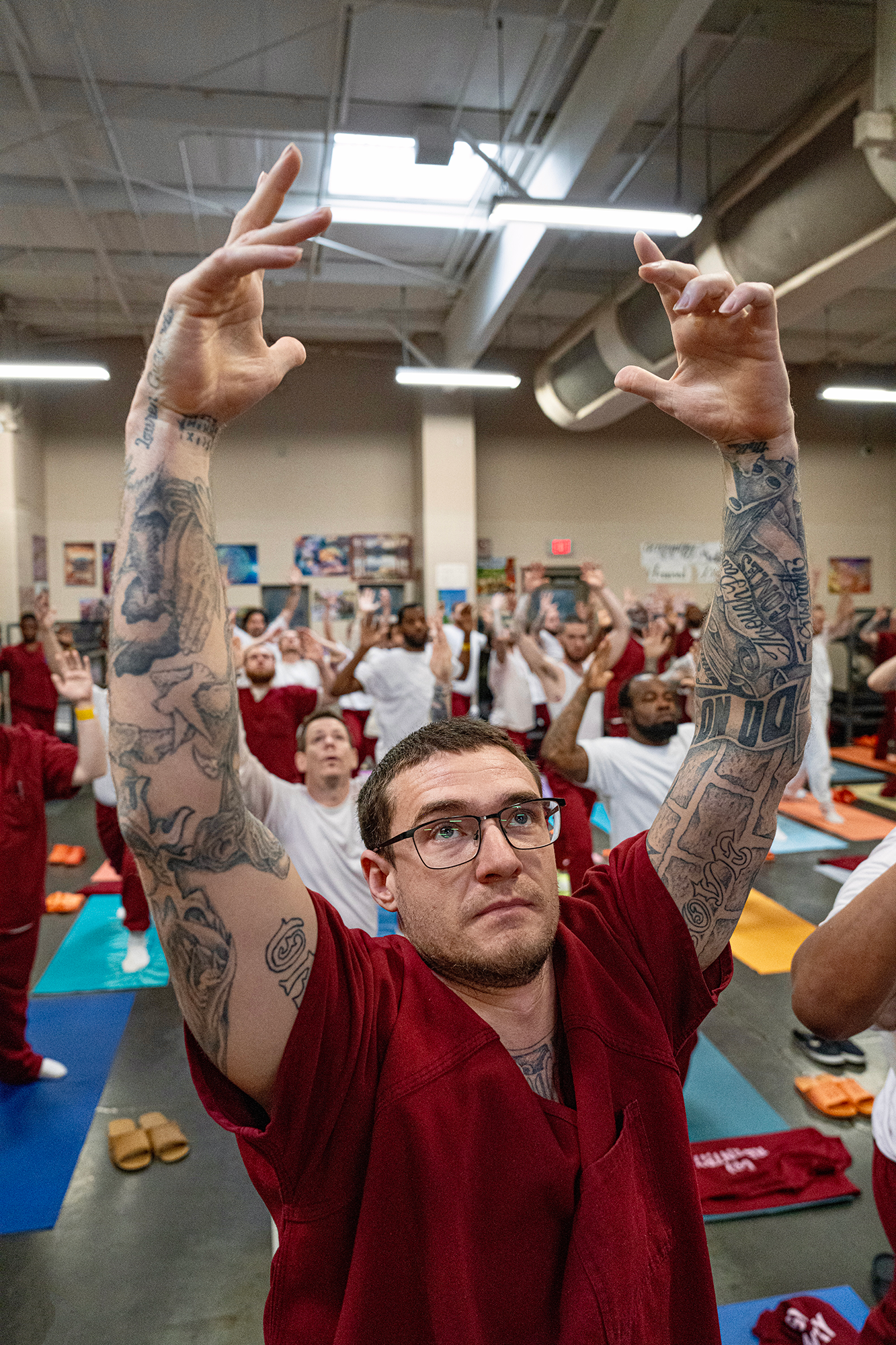
Doing Warrior I at Pulaski: “On the inhale, they reach their arms overhead; on the exhale, they bend their elbows. While we typically recommend practicing in a circle, this group is large and well-established, allowing for mats to be arranged in rows,” says Hellthaler.
Fifteen minutes earlier, with the yoga session drawing to a close, there is one moment in which Hellthaler requests silence. Many lie on their backs, eyes closed, as she guides them through a relaxation exercise, a flex-then-release of muscles that cascades from the toes to the face. Now, for the next two minutes, she says, their only job is to rest.
The metal door opens and shuts periodically. There’s the drone and metronomic beeping of something like construction equipment on the move. The sound of a bird pokes through. Then, briefly, the vehicle stops and the door stills while the bird sings on. For a fleeting moment, eyes closed, we could be anywhere.
Hellthaler rouses the group. She offers a meditation and invites them to repeat it, and many do, in a chorus of baritones:
May I be happy,
May I be healthy,
May I live in peace,
May my life be blessed with ease.
It continues, extending the same to others and then to the world. Then she says, and they repeat, “The light in me sees and honors the light in each and every one of you.”
Danny Freedman’s writing has appeared in The New York Times, The Washington Post, Smithsonian magazine, and elsewhere. He lives in Memphis, Tennessee.