
We want to hear from you! Please share thoughts, insights, discrepancies, recollections, photos — and how’s your Tom’s Trivia win-loss percentage coming? Post to our website at magazine.uconn.edu, email the editor at lisa.stiepock@uconn.edu, or send by regular mail to UConn Magazine Letters, 34 N. Eagleville Rd., Storrs, CT 06269-3144.
Here’s a sampling of web, social media, mailed, and emailed comments on our last issue, edited for clarity and length.
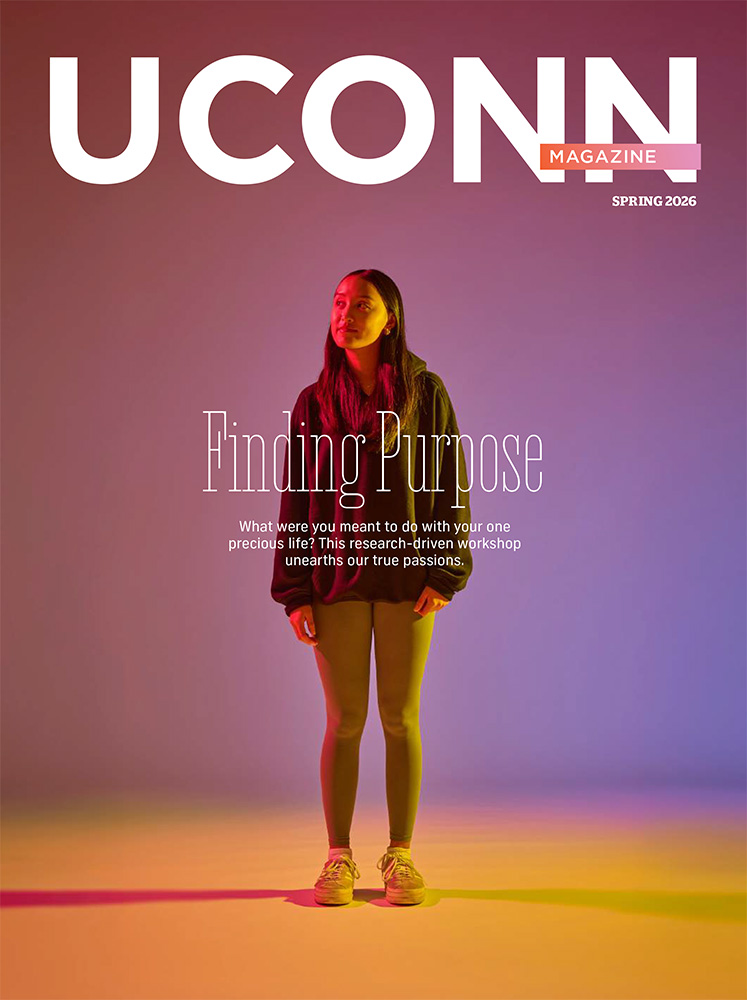
Do What Matters Most
 I recently finished reading the UConn Magazine Spring 2026 edition. I always enjoy the magazine, but I was particularly captivated by the article titled “Do What Matters Most.”
I graduated from the University of Connecticut in 1967 (yes, I’m 80 years old). After graduation, I had no clear direction or purpose. Over the years, I explored various career paths, but I finally found something I enjoyed and excelled at. I’ve dedicated the past 30 years to computer consulting and teaching. I wish I had taken a Life Purpose Lab workshop during my college years, as it could have provided me with a clearer sense of direction for my future.
As a senior citizen reflecting on my journey, I believe that a Life Purpose workshop should be a mandatory course for freshmen.
Bruce Taylor ’67 (CLAS)
Palm Beach Gardens, Florida
I was thrilled when I read “Do What Matters Most.” Finding purpose and meaningful work throughout our lives gives deeper significance to one’s life experiences. I was touched by the story of Professor Wright’s crisis of faith when he lost hope that his work would be taken up by others, because I’ve been there, too. More times than I want to admit.
The words resonated with me because I found my purpose when I was 13 years old, and I’m still finding my purpose. It is truly self-transformative. Graduating from the University of Connecticut helped me get there. I graduated in 1977 with a Bachelor of Fine Arts degree, and I will be forever grateful for the wise and dedicated professors who gave their time and wisdom to help me on my path. I wanted to paint and I did, and I’m still painting.
And I’m writing down the things I’ve learned along the way from then till now, in hopes that my words will help and guide someone, but who knows?
Helen S. (Welcher) Ashmead ’77 (SFA)
Jacksonville, Florida
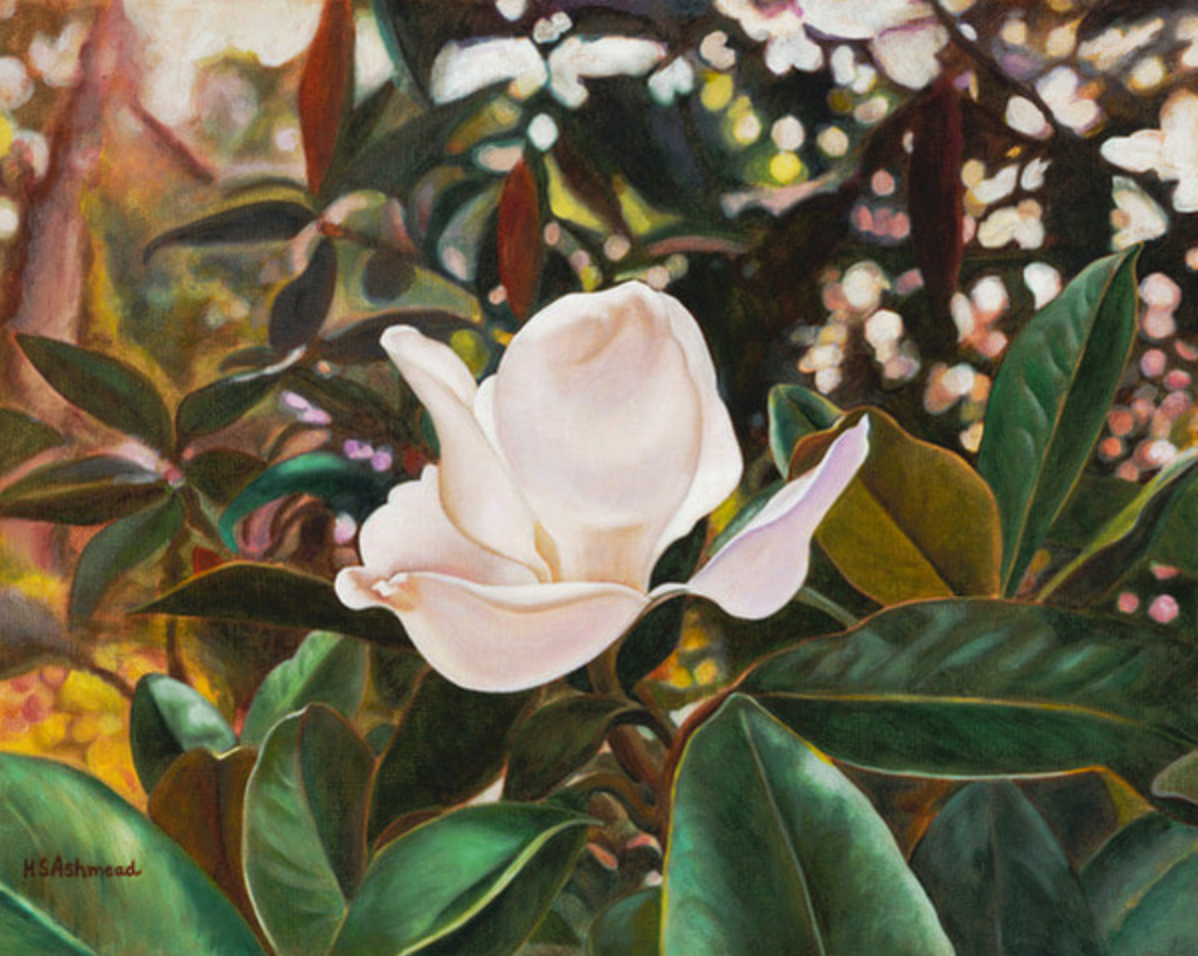
A sample of Ashmead’s found purpose titled “Magnolia Grandiflora.”
Yes, And ...
Hines points out the value of a liberal arts and sciences degree: “For Hines, sustainability doesn’t mean locking down the future — it means building systems that can bend with it.”
It’s about preparing for many possible futures — even one we didn’t expect!
Joel Nebres
UConn Academic Advisor
What a great piece. All of us UCMB eccentrics are proud of you!
Pamela (Bauers) Mingo
Cheshire, Connecticut
I love this so much. The pix are incredible. The story is sweet. I look forward to the next 20 years of this story.
Dave Will
Marshfield, Massachusetts
Mag Love
My wife is a ’75 UConn social work alum, and I have spent years ignoring the magazine when it comes in the mail. Just as I have ignored my own, from Yale. But for some reason, your spring issue grabbed me and wouldn’t let me go.
The stories were genuinely engaging, not the more typical alumni mag fare. UConn was right there, of course, but usually a layer down, not in my face. And the design has a special vibe that pulls me into the text. So I will be on the lookout for the next issue.
Keep up the good work.
David Kellogg
Purchase, New York
In the Wild
You never know where you’ll meet a fellow Husky. On a late-February flight from Washington, D.C., to San Juan, Puerto Rico, I read the new spring issue in print. The woman seated to my left noticed the magazine’s cover and asked if I’d graduated from UConn. When I replied affirmatively, she pointed to herself and responded: “Class of ’09.”
Her name was Alexandra (Victor) May ’09 (CLAS), traveling to Puerto Rico on a work trip for her job in government relations at a global bank. This wasn’t even a flight departing from Bradley Airport in Connecticut, where such an alumni connection might more reasonably be expected.
This story also demonstrates the benefits of print editions, even in our modern digital age. After all, she almost certainly wouldn’t have realized what I was reading if it was on my tablet or phone!
Jesse Rifkin ’14 (CLAS)
Arlington, Virginia

The Principal Formerly Known as DLew
He is an amazing person and educator. Thank you for doing this video, it beautifully captures the love he has for his school/students.
@klew_72
The absolute goat shoutout dr. Lewis
@dorioluciana
Beautiful!
@radenkamaric_official
C. Michael White Is on a Mission
My son began using kratom as early as 2015, before the manipulated 7-OH products were available on the market. He used the natural-leaf kratom, which he obtained by mail from Canada. He also lived in Thailand for several years. In 2019 my son died by suicide, and kratom was found in his toxicology report. While I can’t prove that it was natural-leaf kratom that led to his suicide, I can say with certainty that it aided in his psychosis. Professor C. Michael White and Matthew Lowe admit that natural-leaf kratom is not “risk-free.” I would caution both men and anyone reading this article about concluding that natural-leaf kratom is an “accessible option” for “people with opioid use disorder and chronic pain” and to seriously think about natural-leaf kratom’s availability and the ramifications of use by those who experience neither opioid use disorder nor chronic pain. My son didn’t experience either yet relied on its recreational use and took his life at the age of 25.
Carin Buckman
Bloomfield, Connecticut
Response from C. Michael White:
Carin’s story is a tragedy. While I can’t confirm the cause of her son’s death, the available data suggests that while many vulnerable people function better with a reduced risk of harm from illicit substances while using natural-leaf kratom, some percentage of people are significantly harmed.
In one large assessment, 63% of people felt that natural-leaf kratom was lifesaving, but 3% found it not only addictive but a burden on their lives. Another study found that 80% of people using natural-leaf kratom were able to meet their family and work obligations because of the leaf, but up to 5% of people felt it made it harder for them to function. Favorable odds don’t dampen the tragedy if the harm is borne by you or a loved one. I also want to be clear that if a patient has access to an FDA-approved option for opioid use disorder or for pain, they should try that first.
However, there are so many people who don’t have access to those options for financial reasons, for whom those options didn’t work, or the adverse effects were intolerable, and they are turning to illicit opioids instead. Illicit opioids are killing tens of thousands of people annually in the United States, causing many times more brain injuries after overdose, spreading many infectious diseases, and leading people to being incarcerated or having their children taken away. Natural-leaf kratom is an accessible option as a substitute for illicit products that looks to have a much better risk profile. That is why the FDA, WHO, and HHS are not recommending a natural-leaf ban, because while it is not risk-free, it is functioning as a Band-Aid on a broken healthcare system.
This is a complex area, and I don’t have all the answers, but the more perspectives I have, the better job I can do advocating for proactive ways to better public health in this area. I really appreciate Carin’s perspective, and I believe it is valid.
Suggestion Box
You should do a feature on George Springer, UConn’s and Connecticut’s greatest MLB player.
I would add #2 is not even close.
Cheers,
Bob Bowen ’70 MBA
Mill Valley, California
We’re working on it! —Ed.

Spring sky through Charles O. Perry’s 1990 “U’s and C’s” in front of the School of Fine Arts along Storrs Road.