
Something Borrowed
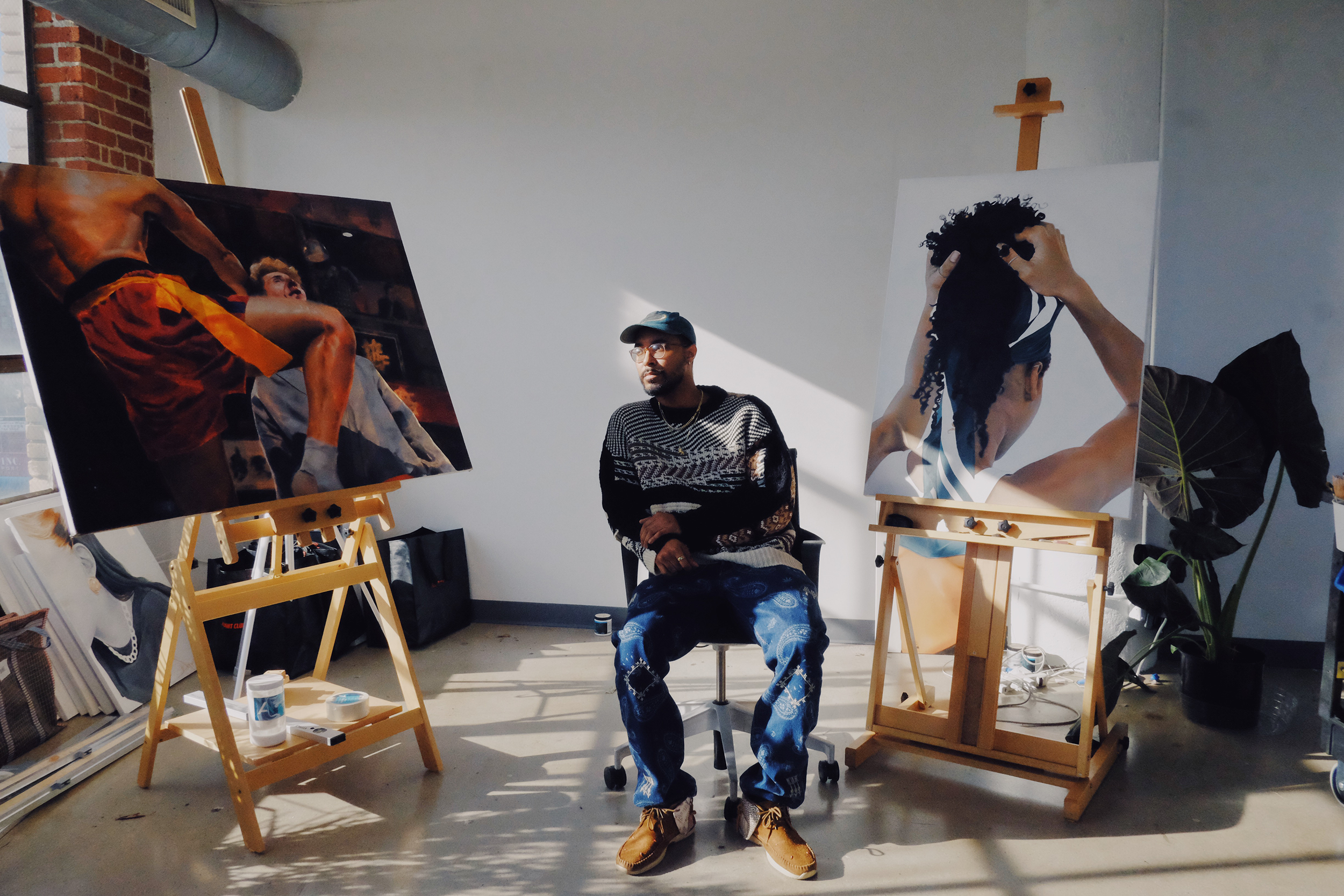
Rochester at his LA studio.
The artist turns a canvas toward the camera on a Zoom call.
It’s a young man in profile, a deep red cap densely pinned with medals, coins, and small charms — a fish, a flag, what might be a passport stamp — a yellow bandana wrapped beneath the brim. He’s dressed in a deep blue satin jacket, a strap crossing his chest, a trumpet resting against his shoulder, its bell pointing skyward.
“I just finished this last week,” says Jacob Rochester ’16 (SFA) from his downtown Los Angeles studio.
The young man is borrowed from a 19th-century French painter, Jean-Léon Gérôme, whose 1868 portrait of an Ottoman mercenary soldier hangs in the Metropolitan Museum of Art. Rochester transformed it using his own process: painting it first in black and white, then building up layers of glazed color to give the finished work what he calls a “jewel-like quality.” He added the trumpet. The cap. His own contemporary point of view. It’s the piece he’s proudest of.
When Rochester was in kindergarten, his teacher called his mother, astonished that at five he’d sketched a drum set in three dimensions — cylinders carefully shaded into snares and toms — a technique his father had taught him at home. His mother wasn’t surprised. She’d watched her son draw since before he could talk in full sentences.
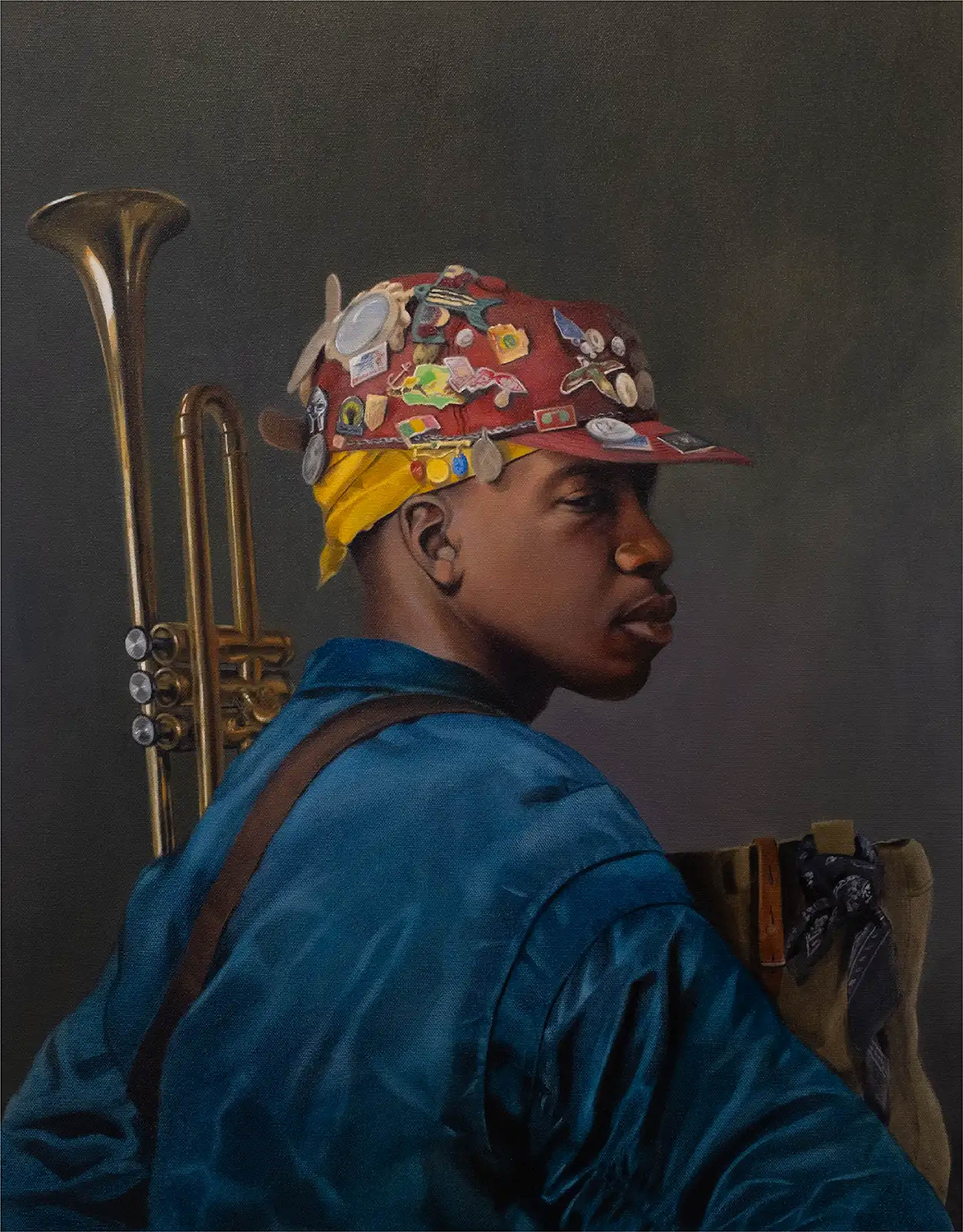
Rochester’s Pride: “Boy with Trumpet,” 2026. Oil on canvas, 22 x 28 in.
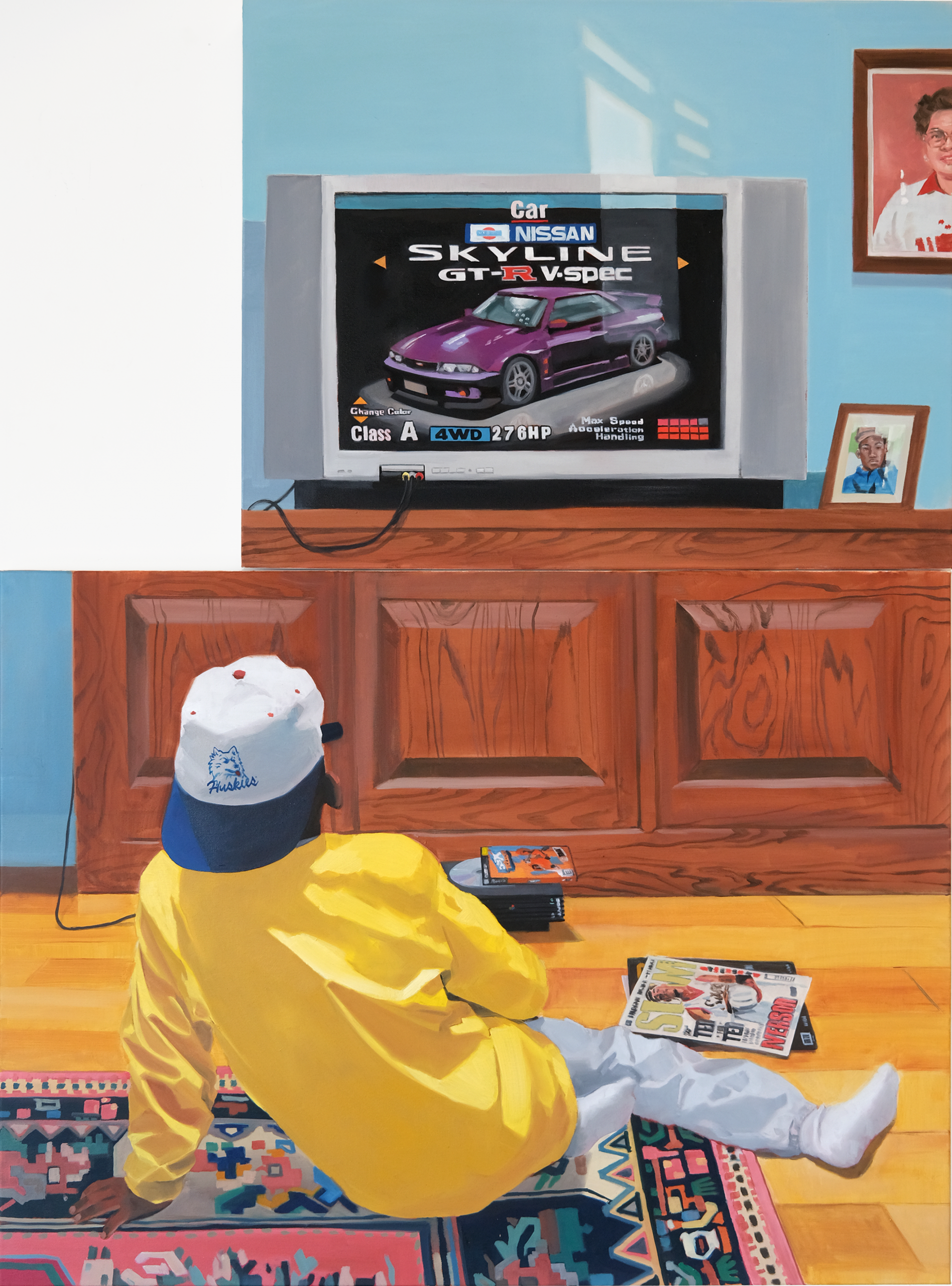
"As You Are," Oil on canvas, 40 x 54 in.
Now 31, he’s fresh off a trip to Mexico City, still turning the “walkable, art-driven city” over in his head. He’s also recently back from Paris, where Construct, the clothing label he founded, showed for the first time at a fashion-week showroom.
Wearing a black T-shirt with white “USA” lettering and Olympic rings, he gives a studio tour, laptop in hand, revealing an expansive warehouse flooded with afternoon light and a lounge-like seating area. Large and small paintings hang on the walls. A clothing rack sits beside unfinished canvases. A synth and turntable mark off his music space. Behind him, a minimalist sculpture turns out to be a metal grid holding dozens of tubes of paint, each suspended in its own square.
Rochester grew up in Bloomfield, Connecticut, in a house he describes as “vibrating with creative energy.” His mother is a figurative painter; his father played drums in a reggae band. Rochester learned to play the kit himself, drumming for his church.
Graffiti was an early obsession. He taught himself tags, what he calls “bombs,” from grainy internet photos of artists working in Berlin and New York. He also spent hours copying comic books and video games, learning about anatomy and how to draw figures. He filled sketchbooks with his own versions of the characters. “I’d put Hulk in street clothes I was interested in wearing,” he says, smiling.
Applying to art schools went less smoothly. “I applied to Pratt — got rejected. I applied to RISD — got rejected,” he says. “Where else? I forgot the other one.”
UConn was the exception: accepted with a scholarship. “I’m so thankful for that,” he says, “because if I’d gone to Pratt or Parsons or RISD, who knows if I would’ve gotten to Central Saint Martins [for a graphic design course in London] or met the people I met.”
He credits professors Mary Banas, Mark Zurolo, and the late Edvin Yegir with shaping how he thinks. He says his classmates — like his friend Renald Louissaint ’17 (SFA), who just helped redesign Instagram’s logo — were “like a family. We all grew from each other.”
Shortly after graduating, he moved to LA. The adjustment wasn’t instant, but once he found his footing, commercial work followed, with several marquee clients: Nike. Apple. Kendrick Lamar. The Tupac Estate. Fine art took hold later with a 2018 painting referencing “Bloodsport,” a movie his father often had playing in the background when he was growing up. “I hate to say ‘pivot,’ because I’ve been painting and drawing my whole life,” he says. “But that’s when I started taking it more seriously.”
By TOMMI LEWIS TILDEN
Photo by Nikita Freyermuth
Paintings by Jacob Rochester ’16 (SFA)