The Principal Formerly Known as DLew
The public STEAM academy in Norwalk helmed by Damon Lewis is such a Cinderella transformation tale that it has garnered the former UConn football captain state and national principal-of-the-year titles.
By Camila Vallejo ’19 (CLAS)
Photos by Peter Morenus
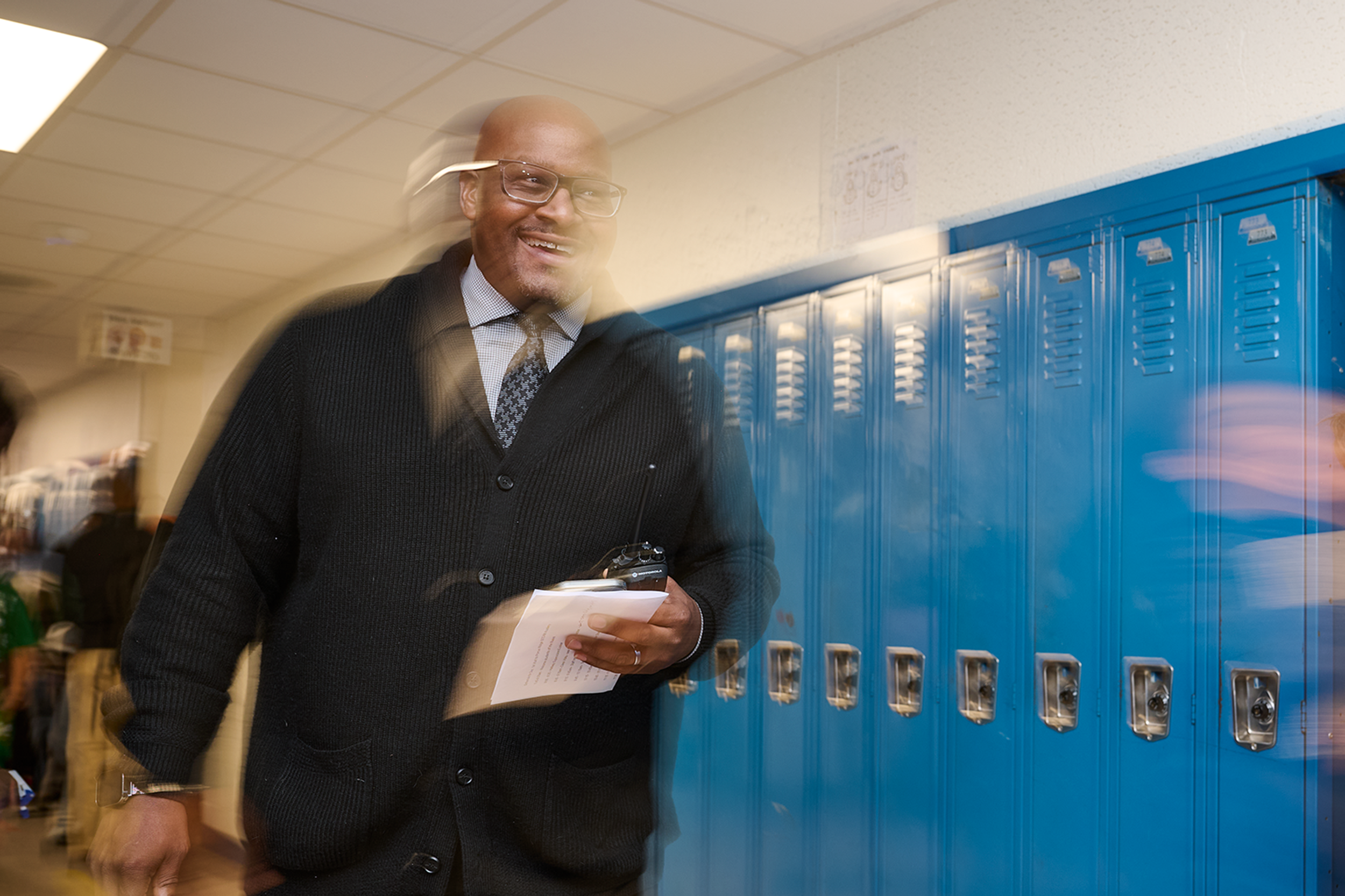
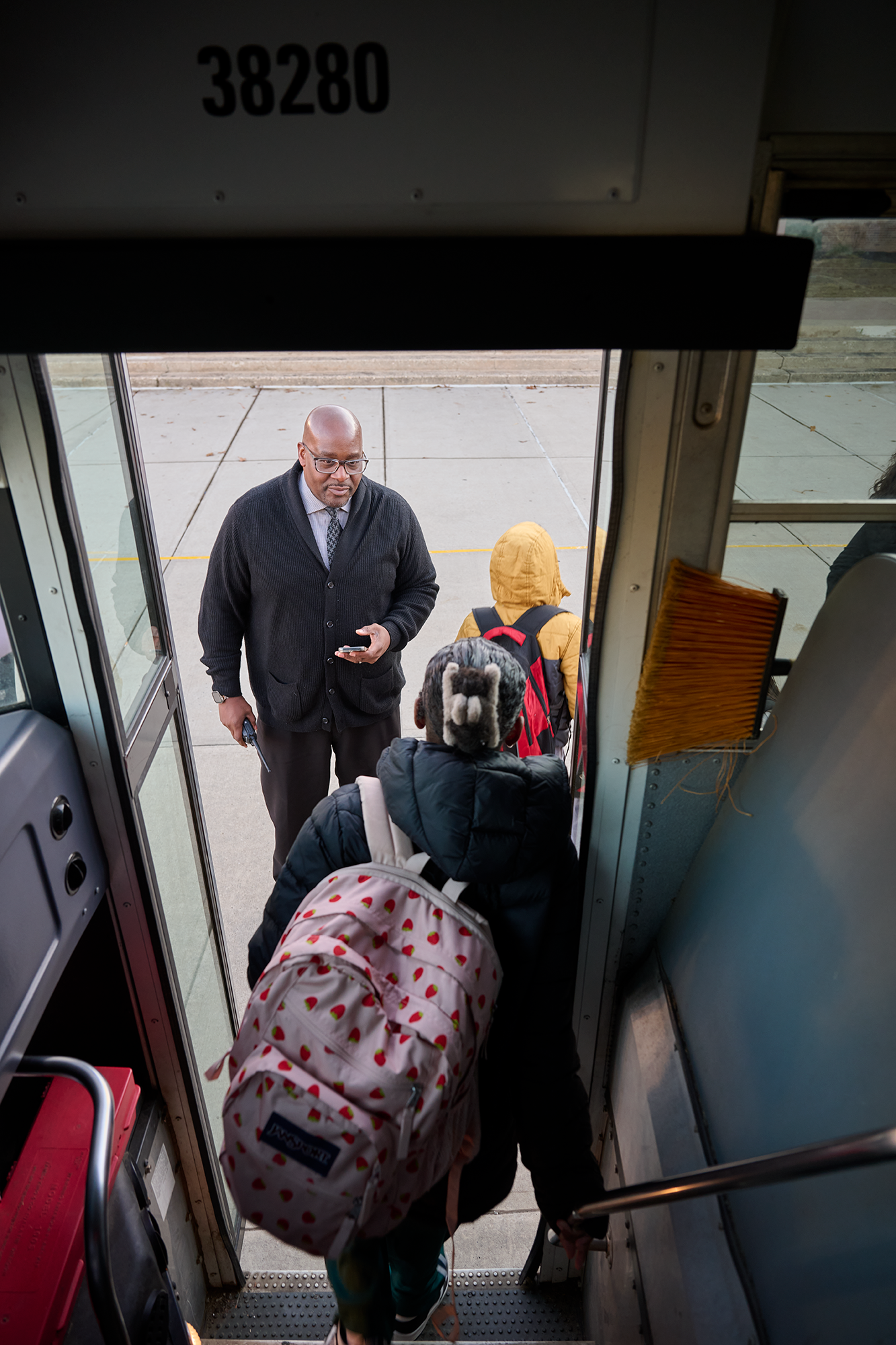
As the first yellow school bus rolls up to the curb of Ponus Ridge STEAM Academy on a cold December morning, Damon Lewis ’95 (CLAS) eagerly stands outside the vehicle door, waiting for it to slide open and children to pour out.
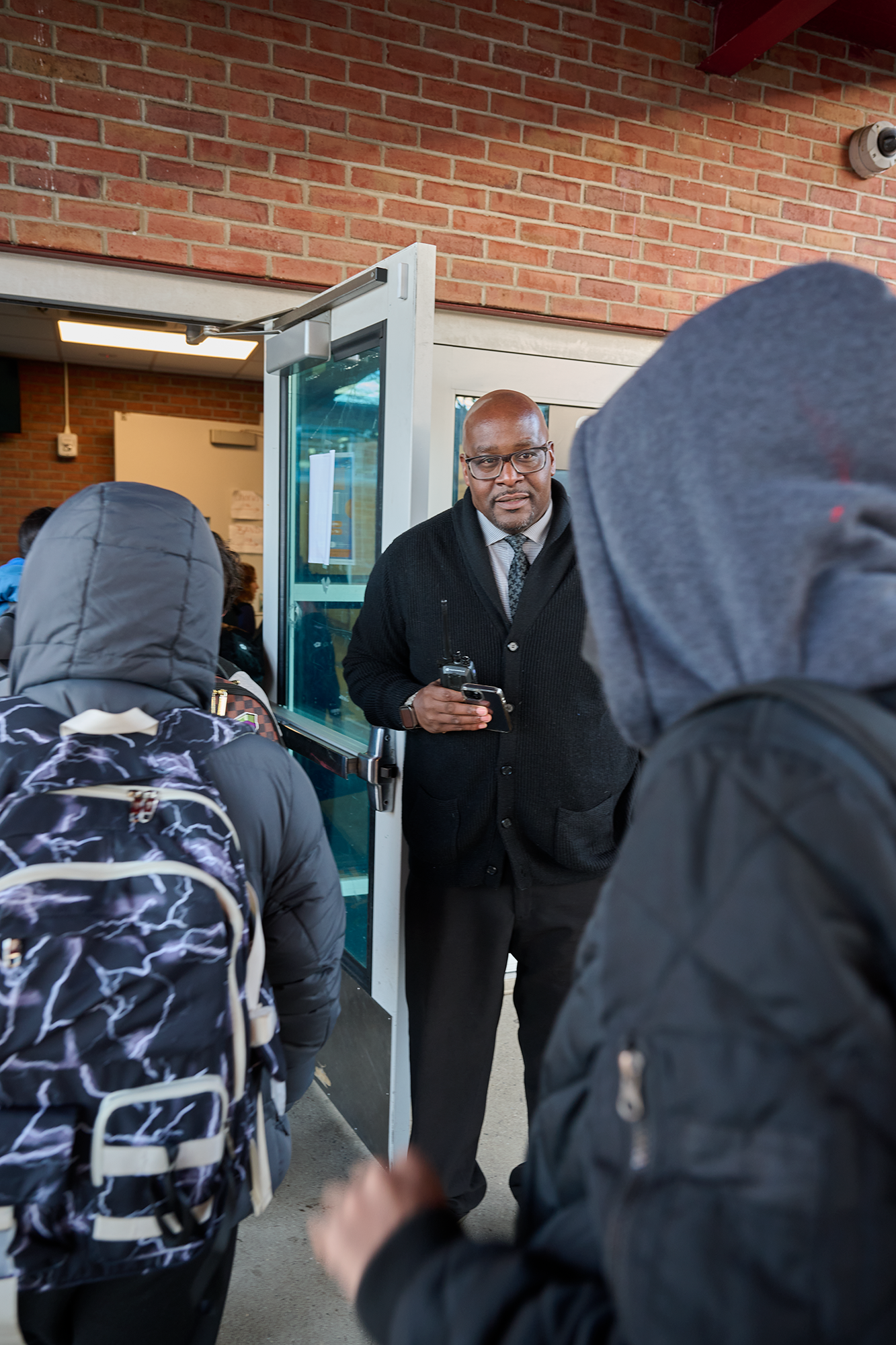
“Good morning!” “Good morning!” “Good morning!” Lewis calls, each time more intentional than the last as his rich baritone voice bounces off the brick walls of the middle school. Children smile and greet “Dr. Lewis” as they run to catch up with friends before school officially opens for the day.
Lewis does this for each of the 12 buses that arrives packed with students, all while greeting drivers and teachers on their first day back from Thanksgiving break. It’s a beloved routine at Ponus Ridge in Norwalk, Connecticut — a pioneering school where by 8th grade over 90% of students are on track to graduate high school, a number that outpaced the state average by about 5 percentage points last school year, despite a third of incoming 6th graders reading below grade level.
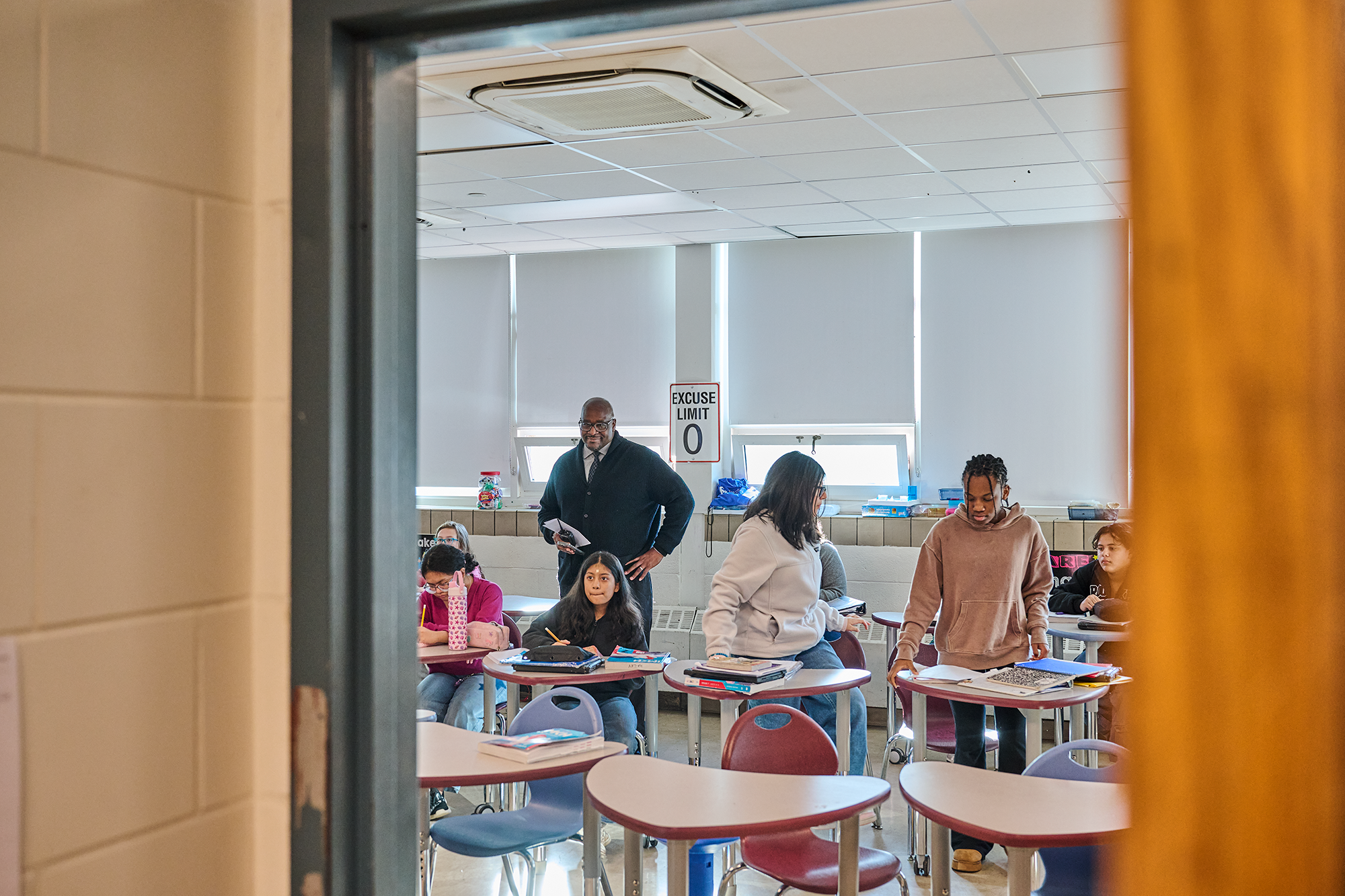
Shortly after 8 a.m., Lewis is finally in the building. Instead of beelining to the office for a full day of meetings and paperwork, he heads for the halls. Lewis has asked the school secretaries to knock on his door whenever he spends more than 20 minutes in his office — or what he jokingly calls his storage closet.
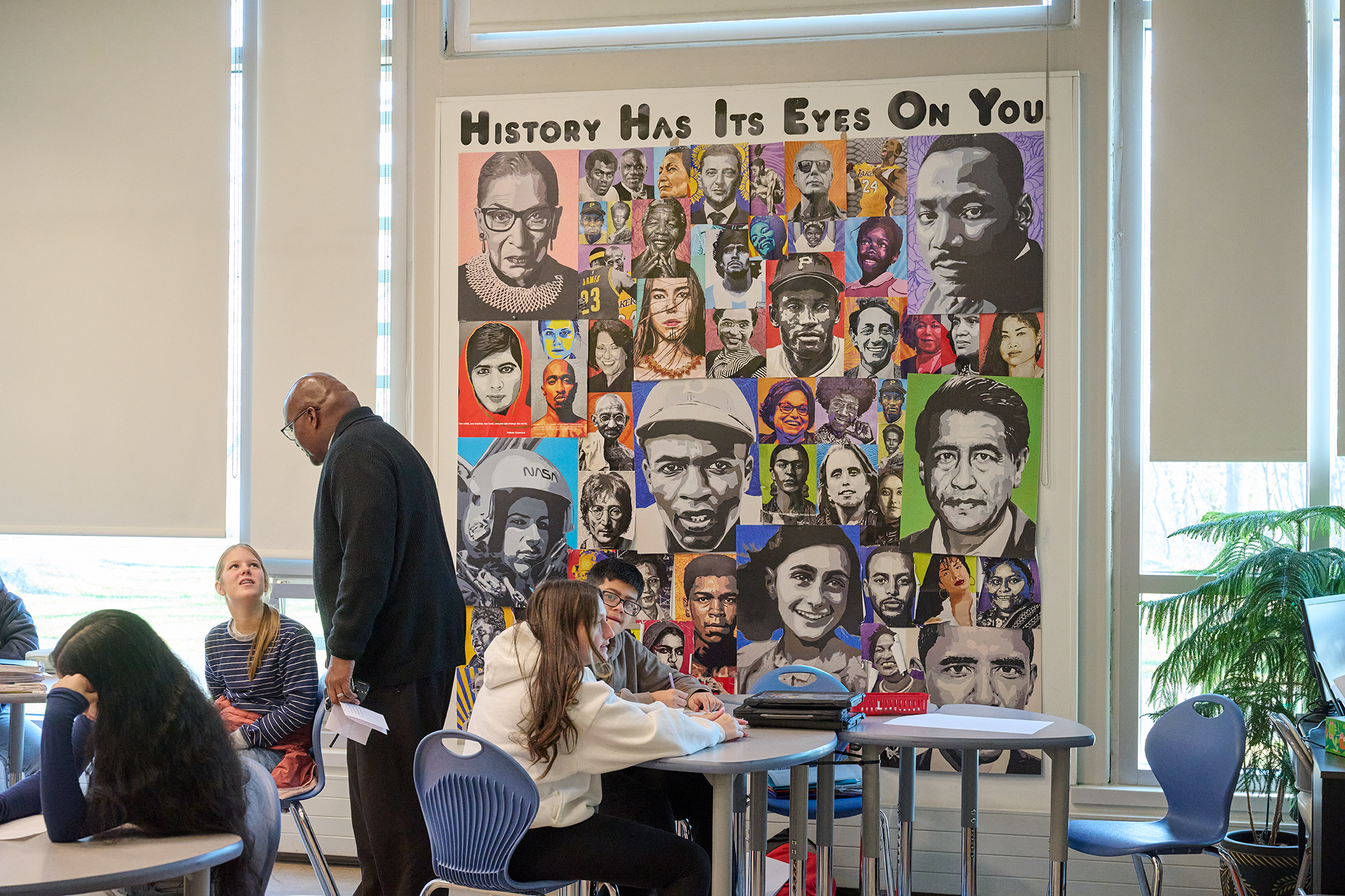
Most of the time, with laptop in hand, he’s bouncing among classrooms and hallways, lunchroom, and recess duty. He helps one student unjam a locker, directing hallway traffic, then pauses to give some teachers feedback — what he calls “glows and grows.”
“You cannot find the pulse of your school behind closed doors,” he says. “This is the best part and how I get to know the kids.”
Years ago, parents “were running from Ponus,” says Lewis. Now there’s a waiting list to get into the public magnet school, and everyone wants to know the secret. Last year, Lewis was named both the 2025 Connecticut Middle School Principal of the Year and the 2025–26 Middle Level National Principal of the Year by the National Association of Secondary School Principals.
That secret? He is unabashed about leading with heart. “Some administrators say we can’t take the job personally. I take this personally because every day I come to the building, the kids look like me. And I don’t want them to go through what I went through.”
Eighth-grader Marley Bramble shares her eager take on Lewis while straightening her pile of middle school essentials — pink water bottle, color-coded folders, green pencil box, and computer. “He’s the cool principal that still keeps us in check,” she says. “Whenever I’m called down to [his] office, I’m not scared that I’m gonna get in trouble. And even if I were to get in trouble, he wouldn’t get frustrated with me. He wants to see the best versions of ourselves.”
“He truly does believe that school leaders and educators are saving kids — kids that may not have opportunities, kids that may not be on the right path.”
Karen Packtor, deputy executive director, Connecticut Association of Schools-Connecticut Interscholastic Athletic Conference

Before He Was Dr. Lewis, He Was “DLew”
In the fall of 1990, when Lewis landed at UConn from a large urban high school, he says he had all the fashion — gold teeth and chains included. Most people knew him as “DLew.”
“I want to make it. I’m not going to come back home,” he repeated to himself like a mantra on the hour-plus drive from Bridgeport to Storrs. Lewis hailed from Harding High School in Bridgeport, where he recalls his classmates were 100% students of color and everyone was on the free or reduced-price lunch program. Twenty books and desks were often shared among 30 or more students. But Lewis graduated near the top of his class with a full football scholarship to UConn and a clear dream: a business degree, a corner office, solitude, and a million dollars.
“I thought I was the cat’s meow,” he says, laughing. “But I put a lot of pressure at that age on myself, because I wanted to be successful so badly. I wanted to prove to people that good things can come from kids in urban schools.”
And he did. But first, he learned how a ZIP code can determine one’s education and future. At Harding, “I graduated 8th in my class, I was in the National Honor Society, I had the sash and everything onstage.” But at UConn, “I was sitting next to kids from Darien and Greenwich, and they knew all this stuff that I didn’t. I was the walking achievement gap.”
His first semester in Storrs, Lewis had to take a non-credit math course to help bridge that gap. But Harding had imparted some key social lessons. “It taught me at a young age to not make excuses and get it on my own.”
He took advantage of connections and professors’ office hours and found his groove. It wasn’t always easy, he admits, being at a predominantly white institution with students from disparate economic backgrounds. Sometimes, with just a couple of dollars in his pocket, he’d opt out of social gatherings in favor of coursework. What felt unfortunate at the time paid off with exemplary grades.
While Lewis was at UConn, his mother would often send him copies of the Connecticut Post, and the news from Bridgeport in one edition in particular resonated with him as he sat in his first-year dorm — McMahon North, room 407. “I remember reading an article about a friend who had gotten arrested, and I turn the page and another friend was dead.
“I thought, ‘How selfish of me to go sit in a corner office and make all this money when kids and families that look like me are falling prey to random acts of violence and drugs.’ I gave up a million dollars before I even had it, and I said, ‘I’m going to be an educator.’”
He switched his major from business to English education.
He still got the office, but one that comes with the dreams and futures of our children. “The best way to change the trajectory of a kid’s life is education,” Lewis says. “You can change years of cycles of poverty, discriminatory practices, and more.”
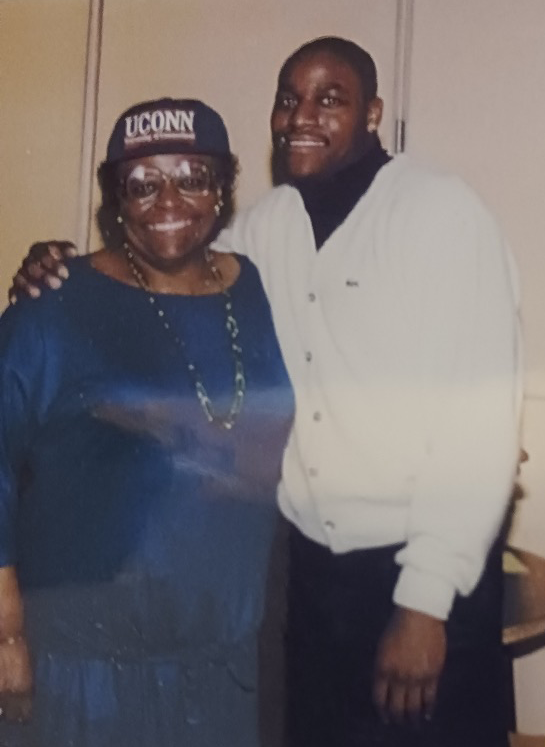
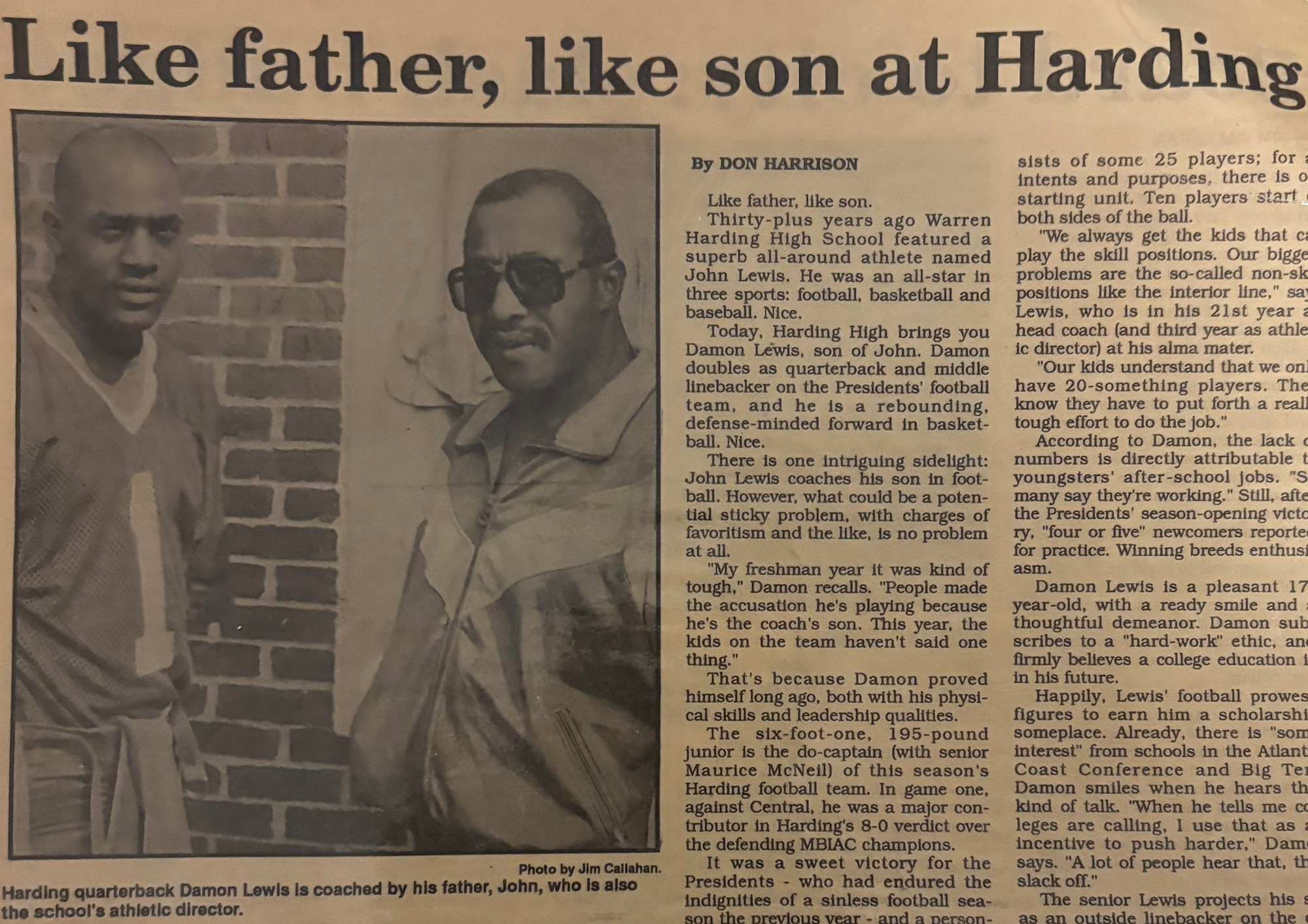
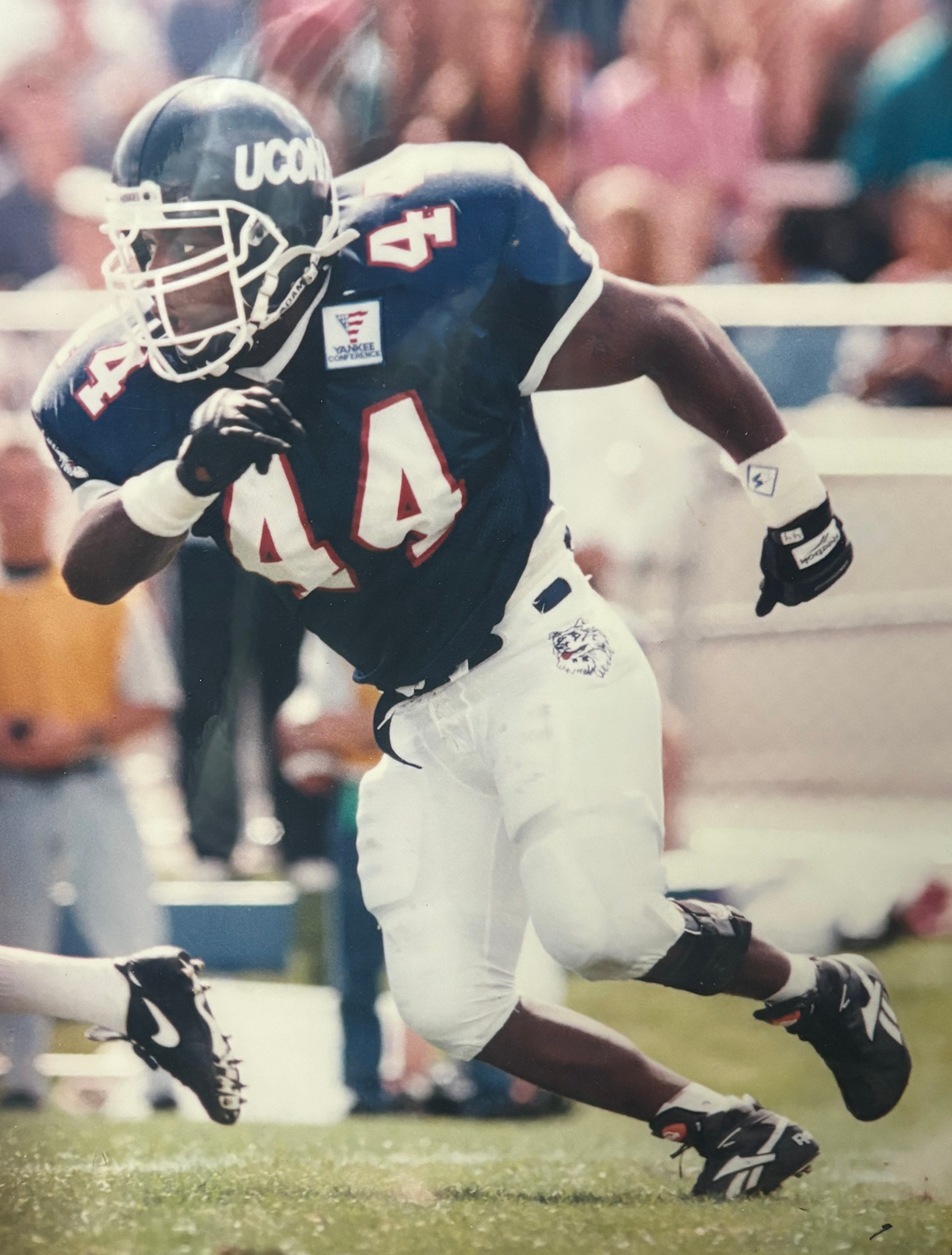
From top: With mom, Beverly, after Lewis announced his decision to attend UConn in 1989; an article on Lewis and his father in the Bridgeport Light in 1988; Lewis as Husky football captain during his senior year season, 1994.
“When I nominated Dr. Lewis, I did it because he is the type of leader that I want to see in every school in my district. He has all of the elements that people would die to have in every single principal in their school community. He has heart. He has high expectations with a strong moral compass. He has a clear vision, consistency, and always focuses on great teaching and ensuring that kids are safe, but most importantly, building a really supportive culture. And above all, he’s a community leader. He is a connector who builds trust with families and partners with them. He shows up, and he always follows up.”
Alexandra Estrella, superintendent, Norwalk Public Schools






Every Day Counts
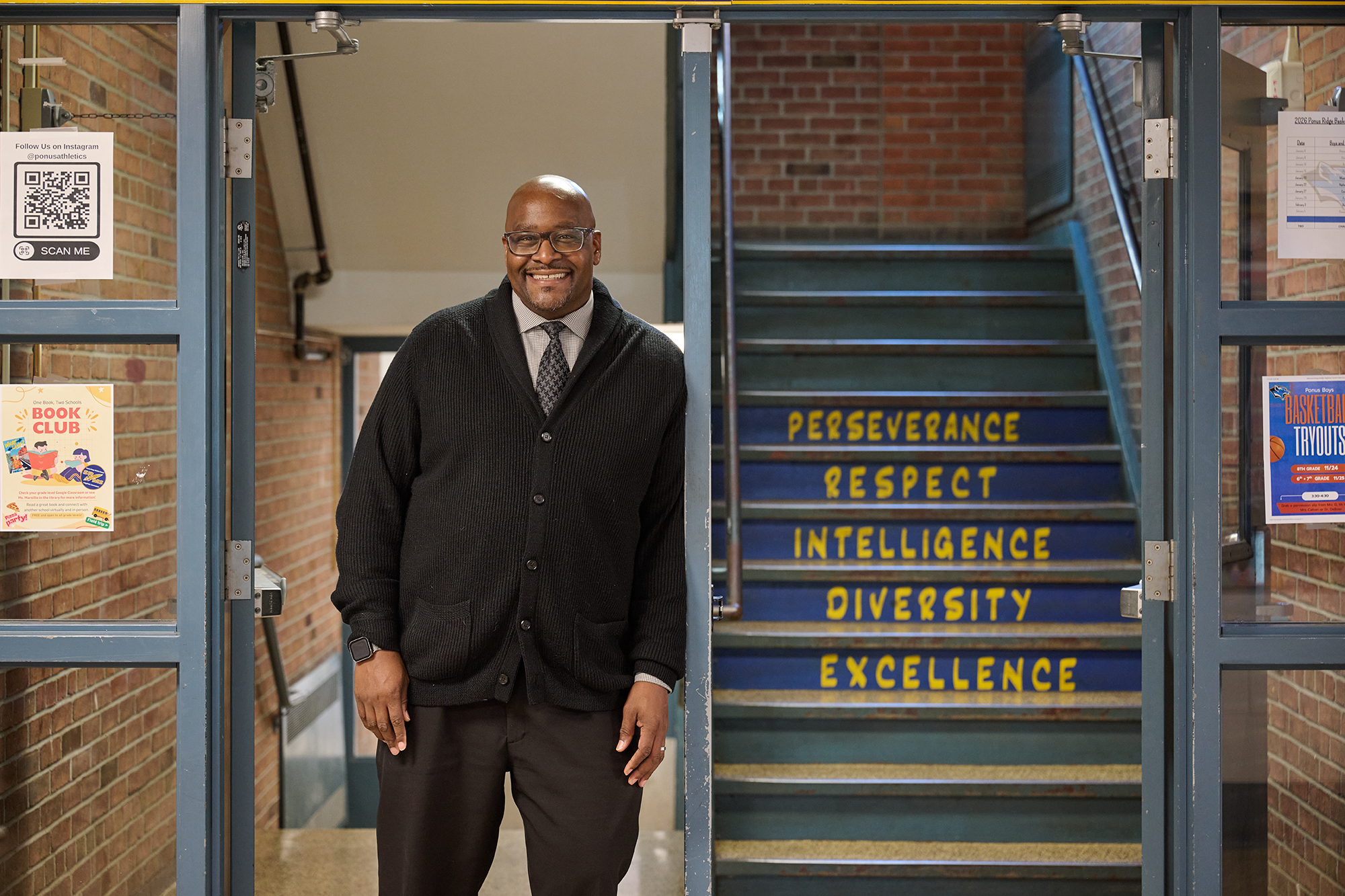
Standing by the main stairwell where signs in English and Spanish adorn the walls in the school’s signature blue and yellow, Lewis towers over students of all shapes, sizes, and backgrounds as they move from music technology to Lego robotics to immersive media to broadcast journalism.
“Walk on the right, drive on the right,” he yells as he greets students by name, switching seamlessly between Spanish and English, and gives generous high-fives or what the students call a “dap up.”
It’s 11:26 a.m. and more than 600 children are moving through the hallways. This is the one moment during the day when all three grades move at the same time, and from the outside looking in, it’s perfectly organized chaos. Ponus uses no bells, and students are asked to keep phones in their lockers. Both directives minimize distractions for teachers and students and underscore Lewis’ belief that when students enjoy school, they know where to be and when.
Every morning those buses roll up to the curb is an opportunity for growth, not just for students but for teachers, the environment, and Lewis himself, because, he says, he’s dealing with “human capital,” and that requires the courage to change. “I think being an educator is the best job in the world,” Lewis says, “because you can press the reset button every single day.”
The Lewis reset has transformed Ponus Ridge from a flailing middle school into a STEAM (Science, Technology, Engineering, Arts, and Math) academy with a first-ever waiting list of nearly 40 families and courses and clubs like music technology and robotics that even college students might envy.
“We’ve gone from this place where students repeat the same electives or opportunities every year to having classes students want to take but can’t. And I know that can sound like that stinks, but it’s a good problem to have. That in the midst of budget [cuts], in the midst of the changing landscapes of middle schools, the changing landscapes of education, through all of that, our programming has expanded,” says Ponus’ assistant principal Evan Byron ’12 (CLAS), ’13 M.Ed.
Since Lewis took the reins just over 10 years ago, Ponus has cut chronic absenteeism from consistently over 30% to a low of 7.7% in May 2025 — lower than any other secondary school in the district. Meanwhile, he has boosted the number of Hispanic and Black students in the school’s Gifted and Talented program and increased female student numbers in the school’s Accelerated Math program to be more representative of the school-wide population. To hear him tell it, it’s as simple as noticing a problem and deciding to fix it.
“It’s setting an expectation and not shrinking from that,” Lewis says. “There’s so many negative connotations about Black and brown kids — behaviorally, academically, socially — and we’re just taking it and turning it around.”
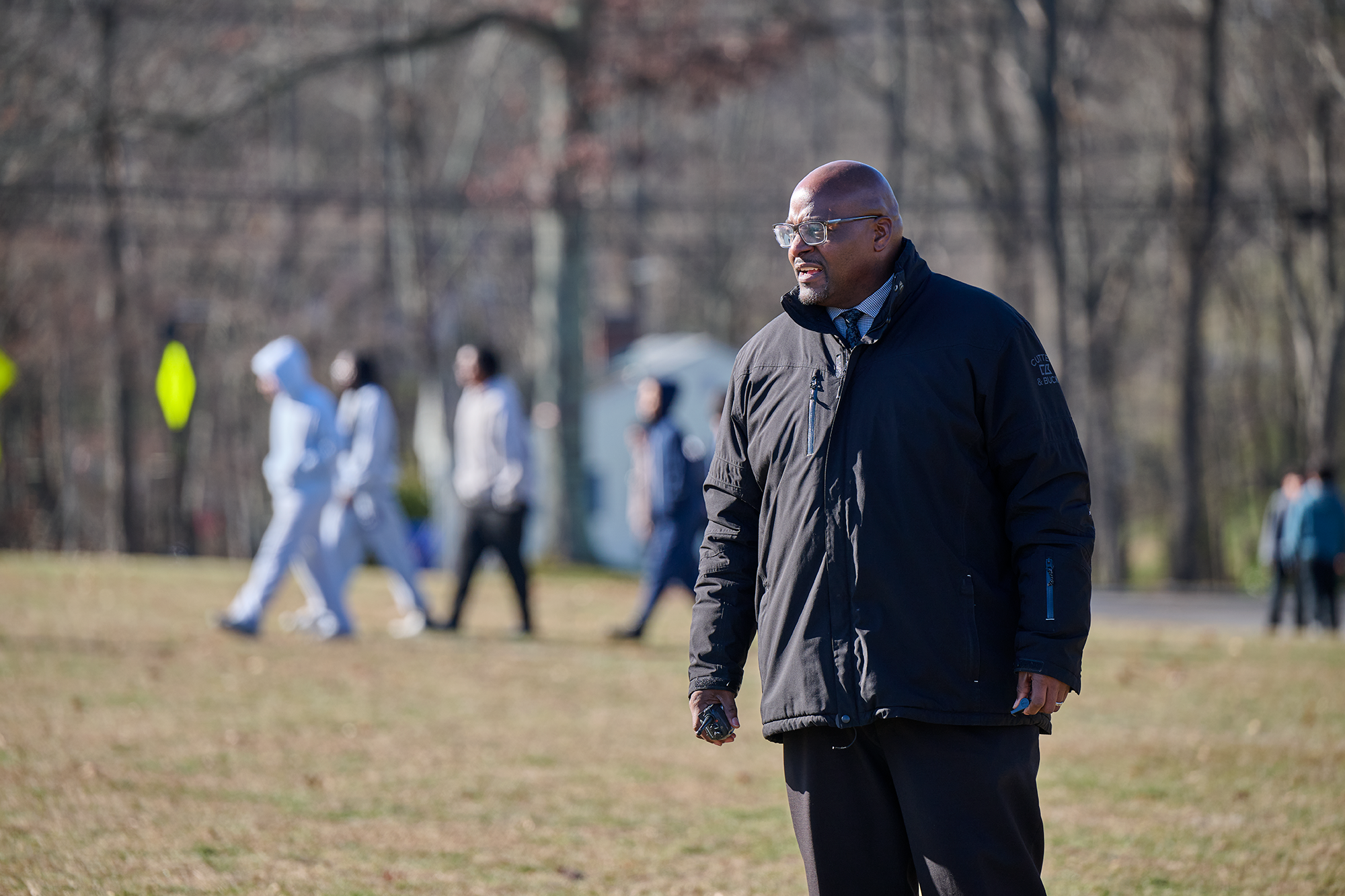
A day spent with Lewis is a day in the halls, classrooms, cafeteria, and recess yard. “You cannot find the pulse of your school behind closed doors,” he says. “This is the best part and how I get to know the kids.”
When we asked some of his students what emoji would represent Lewis, they replied:

“He’s just so happy, like you will never see him sad, and that’s just so amazing. He keeps our mood up.”
—Marley Bramble, 8th grade

“He’s always happy.”
—Olivia Hempstead, 8th grade

“He’s just really like chill and cool and positive and nice.”
—Frankie Christopher, 6th grade
Some Student Clubs:
- Gaming and E-Sports
- Garden
- Lego
- Rock Band
- Crochet
- Table Tennis
- Debate
- Podcasting
- Creative Writing
In the Verizon Learning Lab, students tackle real-world problems with the help of virtual reality, AI, and 3D printers.
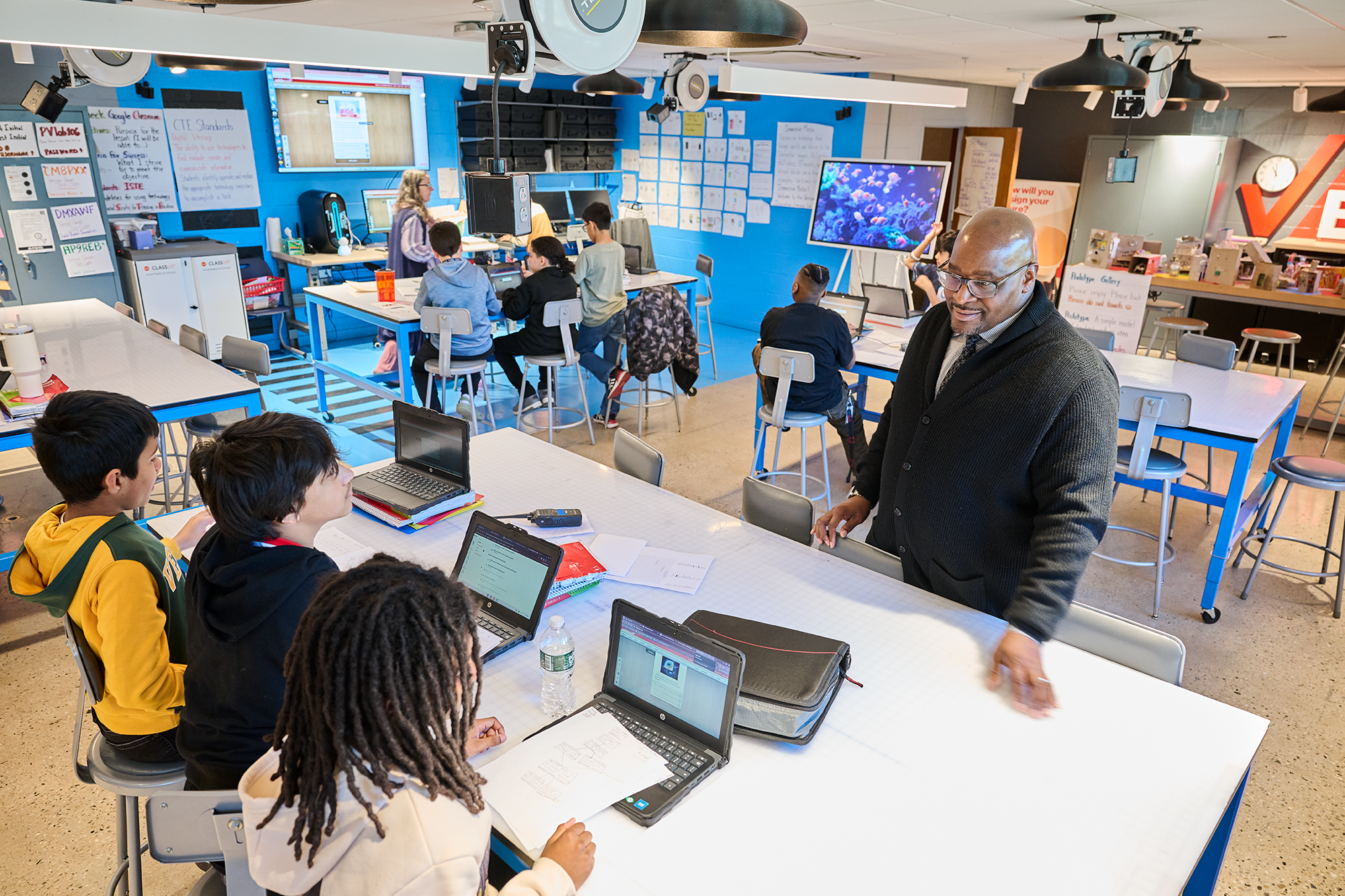
In the Verizon Learning Lab, students tackle real-world problems with the help of virtual reality, AI, and 3D printers.
Walking through some of these classrooms feels less like passing through a school and more like moving through a series of curated galleries. Self-powered fans, automatic trash cans, alarms, and popsicle-stick bridges line the edges of the computer science classroom, where students sit in a large circle enthusiastically chattering. The teacher explains that they are creating mock business websites using the required coding skills they’ve learned since 6th grade. “We’re preparing students for jobs that haven’t even been created yet,” Lewis says.
Past the classrooms is a teachers’ lounge that, at first look, appears ordinary. But a closet in the back is bursting with boxes of apple juice, cans of green beans, bags of rice, and more. This is Ponus’ food pantry for students and families, open daily from 2 to 5:30 p.m. and visited by nearly 200 families a week. It was created during the pandemic thanks to a partnership with Filling in the Blanks food bank after Lewis saw a disparity: While some students ate all three meals at home, others were going hungry. “Kids need to be fed, they need to be loved, they need to be supported. … So if I can offer free breakfast to kids and give kids something to take home over the weekend, I’m doing it because they need it and because it’s the right thing to do,” Lewis says.
“I do think that for schools to be successful, they need to engage families in the work. Dr. Lewis has been tremendously successful at bringing families into the fold and empowering them, educating them, giving them a voice, and allowing them to be true participants in their children’s education.”
Karen Packtor, deputy executive director, Connecticut Association of Schools–Connecticut Interscholastic Athletic Conference

During the COVID-19 pandemic, Lewis saw real food disparity among students. The food pantry he created then has since expanded.
Community partnerships have been key to realizing Lewis’ vision for Ponus. A partnership with telecommunications company Verizon provides students and teachers with Chromebooks, unlimited access to the internet, and a physical lab with VR headsets and 3D printing. Other collaborations have flourished into a school-based health center, a donation closet, and counseling services for multilingual learners new to the country.
All this unfolds with the doors wide open to anyone curious about Ponus. In an attempt to change the narrative about the school and boost transparency, Lewis created monthly Walkthrough Wednesdays, where Ponus welcomes families and community members during school hours. When asked what motivates him to provide so much for his community, he says it’s all rooted in “faith and service,” the two words that guide him as a person.
“Those are his core values,” says Byron. “Service to kids and service to people. And faith in the ability that you can operationalize dreams for kids if you put the right practices and purpose in place.”
Although he is the face of the school, Lewis is quick to acknowledge he wouldn’t be able to do it alone and says he has complete trust in his team.
“I think one of his greatest attributes that has changed Ponus is that he empowers all of us,” says Joseph Giandurco, a science and social studies teacher with the school for over 20 years. With Lewis’ support, he created a school garden during the pandemic, which now helps interested students not only learn how to grow their own food but also how to cook with it. Students have even created a business plan to sell compost.
“Dr. Lewis does a great job of finding our staff’s passions and telling us to go do it,” says Giandurco. “I think that sense of empowerment really makes the ownership of a project that much more rich and valid for people.”
Do What’s Right, Not What’s Popular
Limiting barriers, says Lewis, helps his students find stability, even when everything outside the school’s doors can seem out of control. He knows what that feels like — school was once the place where he, too, found stability and belonging.
In 8th grade, Lewis’ parents got divorced. His father, a beloved teacher, coach, and athletic director at Harding High School and Lewis’ football coach there, moved out but remained a constant presence in his life. Then, at the beginning of Lewis’ senior year, his father was murdered. The case was never solved.
In a rare quiet moment in his office at the end of the day, Lewis shares that today would have been his father’s 88th birthday. He reflects on the business and life lessons his father passed down to him that he holds dear: Never be afraid to hire and work with someone who’s smarter than you, trust the people you hire, consistency is the key to greatness, and always seek to be better.
“I bring a lot of baggage, I will say honestly and transparently, with me to work,” he says, not attempting to hold back tears. “But the fire that burned in me was a lot stronger than the fires that burned outside of me, and I’ve learned that being a good principal begins with being a good person.”
See Lewis in Action:
“Dr. Lewis is all about community. ... He’s all about building trust with parents, teachers, and staff and knowing it takes a village.”
Carly Campbell, senior manager of member engagement, National Association of Secondary School Principals