
Do What Matters Most
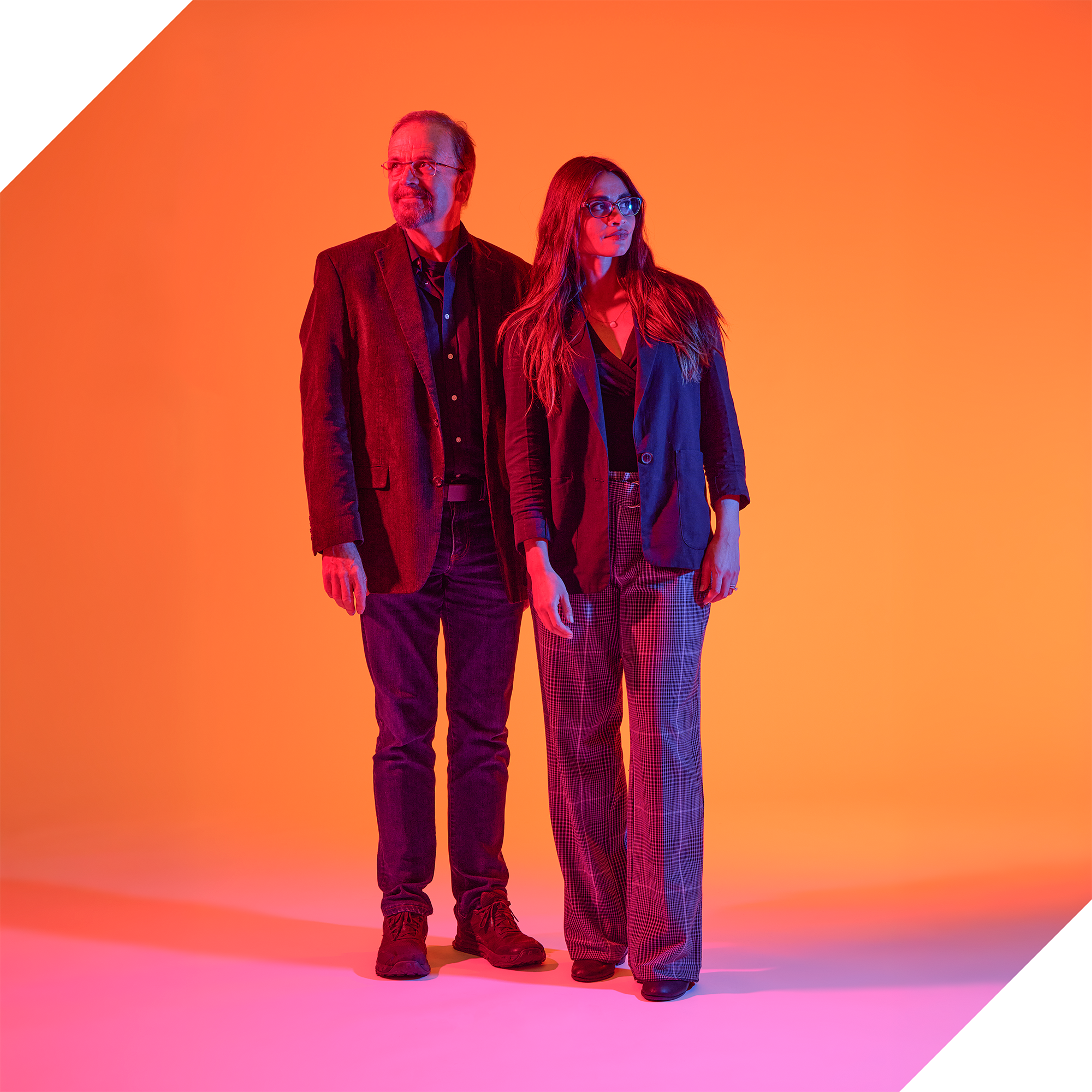
Bradley Wright
Professor of Sociology
Jordan Ochs
FYE Program Director
In a Life Purpose Lab workshop, a group of student mentors joins the ranks of Huskies who have challenged themselves to embrace a more meaningful future.
By Alexandra Kennedy
Photos by Peter Morenus
On a sunny Friday afternoon in Storrs, just two weeks into the fall semester, a few dozen mentors in the First Year Experience (FYE) program pack into a classroom in the Philip E. Austin Building for a required Life Purpose Lab workshop. They look a little harried, juggling backpacks, checking emails, and scarfing down protein bars as they wait for everyone to arrive. Bradley Wright, a sociology professor at UConn since 1998 and founder of the lab, stands at the front of the room, welcoming each participant and handing them a blank journal. Lean and light on his feet, with a neat salt-and-pepper goatee, Wright is warm but decidedly low-key.
The mentors, mostly sophomores and juniors, are wrapping up a busy week assisting instructors in FYE seminars and meeting one-on-one with their assigned first-years. They work hard to give these incoming students, all arriving with their own unique ambitions and worries, a leg up on college life so that they can adapt and thrive.
This September afternoon, however, will be all about their own futures: What are they going to do with their lives? Are they on autopilot, or have they really considered all the possibilities that lie ahead? The workshop is no small commitment. It’s made up of two intensive sessions, a week apart, each four hours long. Judging by the surrounding chatter, the students are feeling curious and a bit anxious. A few are dreading it. (Eight hours!)
Some 350 students apply for the 170 mentor spots in Storrs each year. Those selected are trained in peer mentoring through a credit-bearing educational psychology course. “We employ a theory-to-practice model where mentors are learning theory and skill sets in the educational psychology classroom and then applying them in their first-year seminars with their mentees,” says Jordan Ochs ’17 MA, Cert., ’20 Ph.D., the FYE program director and a member of Life Purpose Lab’s leadership team (along with Emily Pagano and Eran Peterson).
Ochs partnered with Wright to tailor this particular workshop for mentors. “We want them to explore their own purpose,” says Ochs. “In addition, we want them to focus on how to make the student leadership experience the most purposeful it can be, giving them some of the perspective and tools to engage their mentees in conversations around their own purpose journeys.”
Wright gets the mentors’ attention from the get-go. “The goal of this workshop,” he tells them in his introduction, “is to move from your projected life to your purposeful life. How would you use the time, so you have no regrets?” After warm-up activities, he assigns a writing exercise that requires them to envision their lives if they stay on their current trajectory, letting inertia be their guide. That is their baseline, Wright tells them. Now, what would happen if instead they applied purpose to all the decisions ahead?
The mentors dive into each prompt, hardly fidgeting despite the close quarters and the long afternoon ahead. Wright had a feeling this would be a very engaged group. “These are student leaders. They like to help people.”
Finding Purpose Case Study 1
Quan Huynh was a gang member from Los Angeles serving 16 years for murder. In prison, he turned to philosophy and spirituality to find meaning. Once released, he founded Defy Ventures, a California nonprofit that helps people with criminal histories get a second chance — a chance to lead a purposeful life, just like he did.
So does Wright. For years, students have flocked to his Social Well-Being course, hoping to unlock the secret to a better life. Many say it was the best class they ever took. So why is Wright, at age 63, accelerating, pushing himself harder than ever before, while many of his peers are downshifting as they head toward retirement? Late in his career, he has discovered his life purpose: to help as many people as possible pursue more meaningful lives.
“Finding purpose is a self-transformation project,” Wright says over a seltzer at Dog Lane Café. His own journey began with a crisis of faith in his profession. Like many sociologists, he had hoped as a young Ph.D. student that he could bring about societal change by researching and publishing peer-reviewed articles that gave critical insights into the human condition, with the surety that journalists, lawmakers, and others would then take up the charge and improve the world. But he didn’t see those changes happening fast enough, or at all.
Over his years studying both criminology and well-being, Wright grew increasingly interested in a deceptively simple question: How do people find purpose, and how do people become more purposeful? In 2019, he started the Life Purpose Lab, inviting faculty, staff, and students to join him in his efforts to use applied research to find the answers. The lab, whose motto is “Do what matters most,” upends the sociology norm. “We work on promoting good things rather than trying to solve bad things,” Wright says.
For the last six years, the lab’s staff has used quantitative data, smartphone-based surveys, and feedback from their own pilot workshops to develop and refine their Possibility Management Model. Its goal is to help people determine their own life purpose — what the possibilities are, how to test them, and how to turn them into action. The lab offers more than a dozen workshops a year, taking participants through a meticulous step-by-step process. Nearly 800 students and staff at UConn have now completed it, and the results are impressive. Six months after the workshop, 85% of attendees say they experienced a significant increase in their understanding of their life purpose. Participants also felt happier and more satisfied with their lives.

Kiley Girard ’26 (BUS)
Hometown: Storrs, Connecticut
Career Goal: Health Care Management
Something I want to follow through with:
I want to get back into adventuring or traveling, just finding new places, even if it’s just a day trip. I love spending time with my family, so I would like to do that with them as well.
An important lesson I took away:
It helped me start thinking about how I might be more purposeful in my everyday actions and just cherish the small things in life, too. Everyone has one big goal, but I think we get so caught up in okay, I got to keep going, I got to keep going. Some of the smaller moments really mean a lot.
Wright’s style is more patient guide than charismatic purpose guru. Leaning on the desk at the front of the Austin classroom, he comes across as introspective and serious. Fittingly, he shares with the students that his personal “big dream” would be to become a monk.
He mixes up his presentation to keep things moving briskly, switching from research to case studies to personal stories, punctuating each with a well-timed joke, often aimed at himself. He gives frequent prompts for journaling, then asks the students to break into small groups to share their responses. Inclusive by nature, they look around as they split off to make sure no one got stranded.
So what, Wright asks, is purpose anyway? It’s “future-facing,” like goals, aspirations, and dreams, he says, citing research. It feels significant. And it goes “beyond the self.” That is, it often involves making others’ lives better. When young people, like these students, consider purpose, they tend to feel very hopeful, he explains. The world is at their feet. For older people, it can feel more complex contemplating what’s meaningful. Regrets tend to ride along with hope. Wright clicks to a slide with a word cloud that shows the benefits of leading a meaningful life, all played out in research. Purpose-driven people experience more joy and creativity, greater motivation and ability to make decisions. They’re less anxious. Studies even show that, on average, people with purpose live longer.
“[Your calling] is the place where your deep gladness and the world’s deep hunger meet.” —Frederick Buechner
According to William Damon, a psychologist at Stanford University, people fall into one of four “purposeful” stages. The disengaged (25%) might not care about purpose or prefer to seek fame or money instead. Dreamers (25%) have some idea of what is meaningful to them, but they don’t do much about it. Dabblers (30%) know what would be meaningful but don’t consistently take action. Purposeful (20%) people know what matters and are committed to doing it. That, of course, is the lab’s holy grail. Wright asks the students to take out their journals and “score their purpose.” He is certain, he says, as they put down their pens, that no one in the room was “disengaged.” They wouldn’t be mentors if they were.
 Wright’s style is more patient guide than charismatic purpose guru.
As the workshop unfolds, students start to share their dreams with one another, tentatively at first but then eagerly, cheered on by each other’s laughter and validations. The exercises are designed to encourage them to explore possibilities from every angle. “Do you want to be wealthy?” asks Wright. “Manage your money. Do you want to be productive? Manage your time. Do you want to have purpose in your life? Manage your possibilities. Manage them intentionally and strategically.”
“Don’t ask what the world needs. Ask what makes you come alive, and go do it. Because what the world needs is people who have come alive.” —Howard Thurman
It’s a tough job market for college graduates right now and, for many students, a hard time to dream. Some of the FYE mentors have their hopes already pinned on a specific vocation. Their plan might be practical, allowing them to pay off their student loans or enter a field where jobs are easier to come by. That kind of focus is fine, Wright assures them, but he wants them to use this process to confirm those paths and consider other aspects of their lives as well.
Purpose is not just one thing, he explains, in that old-fashioned sense of “you must find your purpose in life.” They will have multiple paths to choose from, and purposes can be small, big, or somewhere in between. A rich life, he contends, will be made up of many meaningful actions running across the years — work, yes, but also relationships, how they care for themselves, their finances, their spiritual pursuits, and what they do with their free time or to help others.
Finding Purpose Case Study 2
The late Don Ritchie, a Royal Australian Navy vet and life insurance salesman, moved to a house near Sydney, Australia, overlooking The Gap. These beautiful cliffs, it turned out, were a place where desperate people would come to commit suicide. Over the course of 45 years, Ritchie intervened more than 180 times, convincing strangers to come back to his house to talk. In 2006, he was awarded the Medal of the Order of Australia for his rescues. He didn’t choose his purpose. It chose him, and he accepted it.
One basic strategy for bringing more meaning into your life, says Wright, is to look closely at what you do every day and try to do “more of those things that matter, and less of the things that don’t.” Wright asks the students to write down 20 activities they regularly do — studying, working out at the gym, playing video games, that kind of thing — then rank them on two axes: pleasure and meaning. Where, he asks the group, are they finding both high meaning and high pleasure? Can they make more time for that? One student notes to her group that she gets a lot of pleasure, but not meaning, from scrolling social media. Maybe she can bring more meaning to it? Another reported that she is a doom scroller, bringing her neither meaning nor pleasure. Can she stop, and use that time for something she cares about?
It’s a tough job market for college graduates right now and, for many students, a hard time to dream.
“How we spend our days, of course, is how we spend our lives.” —Annie Dillard
Incremental gains count. Wright asks the students if they think they could make their lives 1% more purposeful next week. Hands go up. “If you can do that every week for a year, your life will be two-thirds more purposeful. If you do it every week for two years, it’s almost three times more purposeful.”
Wright tells a story about Tristyn Warren, a nurse at UConn’s health services, who took it further after she attended a Life Purpose Lab workshop in 2023 with the Student Health and Wellness team. At the time, she was working full time and a new mom, coming off multiple years of pandemic chaos. She longed for something to ground her. Inspired by what she learned in the workshop, she and her husband decided to start Warren’s Farm at their home in Hampton, Connecticut, growing cut flowers and offering friends and neighbors a seasonal subscription for bouquets. It’s a small and manageable sideline for them, and it gets her out in the garden, where her children like to join her. It’s creative and joyful for all of them.

Brendan Toon ’28 (CLAS)
Hometown: Woodbury, Connecticut
Career Goal: Government Work
Something that stands out from the workshop:
I really enjoyed the no-phones policy, or at least that you had to take your phone outside of the classroom to use it. I took it as a challenge to go all eight hours just because people would say I can’t.
What I found most helpful:
I’m an econ and poli-sci double major, and I always saw myself going into the private sector. Working on those prompts, I think I want to do something more government-related and help other people. I also want to express myself more creatively, doing more writing and playing music. So, they were opposite ends of the spectrum, but two different discoveries.
For another writing exercise, Wright asks the students to dream big, like his monk example, while keeping their inner skeptics at bay. It doesn’t matter if the dream is feasible, he insists. They surprise one another with their answers. One wants to be a private chef; another an international photographer; another a pop star who makes a difference, like Taylor Swift. He goes on to prompt them with ways to envision other future selves, using different tactics to open their imaginations. By the time the first four-hour session winds down, every student has written up 12 possible future selves.
The journey to purpose is usually nonlinear, full of ambiguity and starts and stops. It almost always takes longer than anyone predicted. That’s in part because it introduces a lot of uncertainty. Evolution has taught us the hard way to minimize risk. We’re hardwired to avoid it. “Living cautiously is not a recipe for a purposeful life,” says Wright.
He tells the students not to make any big changes in their lives for at least four weeks. They need to feel safe, be thoughtful, and let the possibilities sink in. “If I find out next week that you quit your job and are busking with your guitar because you just know that you’re supposed to be a musician, I’ll come yell at you. If it’s a month from now, that’s fine.” The students laugh.
“Plans are nothing; planning is everything.” —Dwight D. Eisenhower
Back in the classroom for the second session, the students are now familiar with the rhythms of the workshop and, just as important, at ease with one another. While the first session was all about widening possibilities, this one will be about narrowing down 12 possible selves to three desired lives so they can start to make plans. Through another series of exercises, they map out how they might successfully approach each of their three favorite journeys over the next 20 years. It’s an empowering, if daunting, exercise when you’re only 20 to begin with.
“Don’t guess about the possibilities,” Wright told them. “Learn about them. Research them, interview people who are doing what you want to do, prototype the experience.”
The students anticipate obstacles that might be ahead, like obligations to care for family members, struggles to manage their own health or finances, or family or societal pressures to live a certain kind of life. Together they strategize ways to get around problems or adapt their plans — just like they are asking of their own first-year mentees as they adjust to being on campus. “Life is unpredictable,” begins one student wistfully, talking about what is ahead. Others echo the phrase.
“Why have we spent so much time talking about the barriers facing you as you live a purposeful life?” asks Wright. “Knowing what they are will help you. It makes you more resilient and less prone to discouragement. It helps you make better plans.”
Wrapping up, Wright asks them to share feedback about the workshop — it is, after all, a virtuous loop, a component itself of the lab’s research. He also invites them to do more work with the lab. There is a study abroad opportunity this year. There are internships, podcasts, videos, a book. The students have a lot to think about. The weekend is coming, and their mentees are waiting. Do what matters most.

LJ Aragon ’28 (CLAS)
Hometown: Trabuco Canyon, California
Career Goal: Lawyer
How it felt being without my phone:
It was awesome. It felt like we were little kids again, and we were able to just talk.
The one lesson I hope stays with me from the workshop in 10 years:
If you do stuff with love, if you do stuff with intention, even if it doesn’t feel like you’re making that big of a difference, it will lead to something that will.
Ochs was buoyed by the anecdotal feedback she got after the workshop. “In their reflections, many mentors wrote about how excited they were to expand their personal horizons and to discuss purpose with their mentees.” She’s relieved, too. It was, after all, an experiment. “We’ll have to do some further assessment, but based on initial reports, it was impactful.”
She hopes for a ripple effect. “In many ways our student leaders are the culture creators. Over 90% of first-year students are in FYE classes, and the mentors are who they look to for what it means to be a Husky. How powerful is it if their guidance encourages an intentional approach to pursuing a purposeful college path? And it’s not just one path. There are multiple fulfilling options.”
... interview people who are doing what you want to do, prototype the experience.
Meanwhile, Wright has more workshops to prepare for. Next, he’ll be running his first designed specifically for staff who are approaching retirement. The lab is also hosting a growing number of workshops outside UConn. A new partnership with an alum looks especially promising. Eileen Crossin ’04 (CLAS) was a marketing executive, working in media and tech companies like TikTok, when she decided to strike out. She’s now the founder of Quantum Potential, specializing in professional development and performance management for the workplace. Crossin and the Life Purpose Lab staff are developing Quantum Purpose to train corporate leaders to bring more purpose to their companies. If successful, it could go a long way toward amplifying the number of people transformed by the research done by the Life Purpose Lab.
The clock is ticking. “Finding purpose is simple,” Wright says, thinking about all that’s ahead for the lab. “But it’s not easy.”
Finding Purpose Case Study 3
When they grew weary of their suburban life in Washington state, Behan and Jamie Gifford decided to pursue their dream of sailing around the world with their kids. They spent five years painstakingly planning how they’d do it. They’ve now been at sea for 17 years, most recently coming ashore on the southern end of Okinawa Island.