
C. Michael White Is on a Mission
For starters, we should understand that the kratom known as gas station heroin is much different than natural kratom leaf.
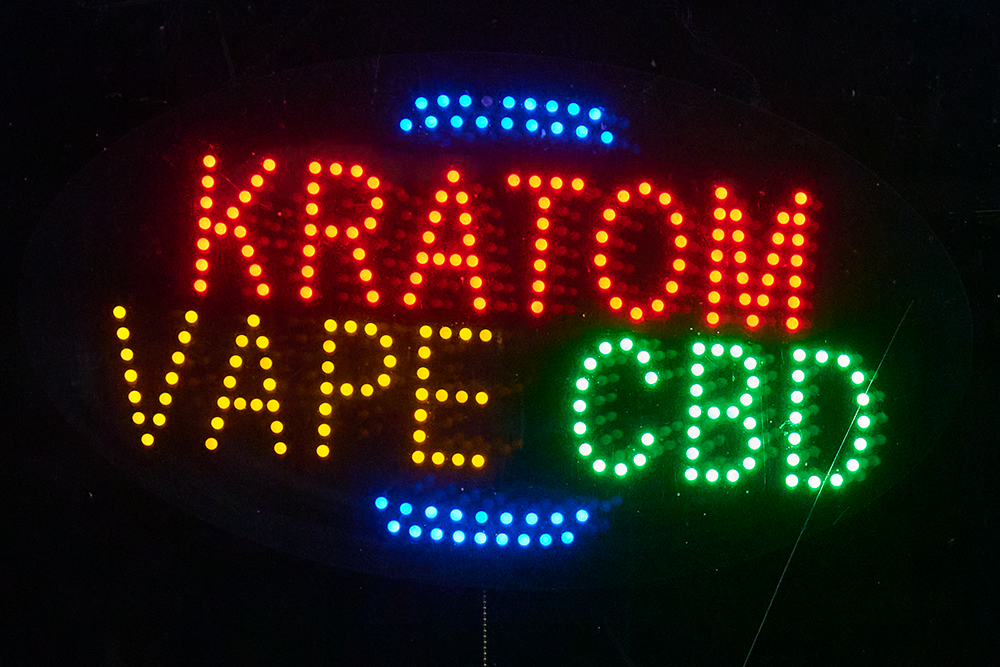
Like many gas station stores, this one near the main UConn campus in Storrs advertises kratom in neon.
The U.S. opioid epidemic is ebbing, thanks in part to the dried leaves of a Southeast Asian tree. A UConn professor is trying to stop unscrupulous companies from sabotaging it.
One of the hardest parts of getting off opiates is the persistent craving for the drug. Many former users find that those dried leaves from Southeast Asia, commonly called kratom, tamp down their cravings without producing unwanted side effects or shackling them to a daily appointment at a methadone clinic.
But recently, more potent and addictive products labeled as kratom have appeared on the market. Sometimes called gas station heroin, designer drugs inspired by alkaloids in the kratom leaf have spread through smoke shops and gas stations around the U.S. These “kratom” gummies or candies are often given out as free samples to kratom leaf buyers. The results have been as predictable as they are sad. Some former opioid users who have tried the free samples have seen their addictions reignited; many other people without previous opioid experience begin using the chemically altered kratom recreationally, and addictions, overdoses, and deaths follow.
“This summer I decided to go to war against the seven-hydroxy companies,” says C. Michael White, a UConn professor of pharmacy. “Seven-hydroxy” is how chemists pronounce 7-OH, the modification that turns mitragynine — kratom’s natural opioid-like alkaloid — into an addictive nightmare. White has studied kratom since 2017 as part of his broader research into substances of abuse.
“A lot of people use kratom instead of opioids because it allows them to function better in society,” White says. The companies marketing the manipulated 7-OH products as similar to natural-leaf kratom are engaging in deception for profit, White maintains. These 7-OH products are synthetic and concentrated and, taken orally, produce the classic euphoria and sleepiness of opioids. The U.S. market for 7-OH is now larger than the domestic heroin market.
White’s research into natural-leaf kratom had convinced him that it was a useful tool for some people with chronic pain or former opioid addiction. But the wave of addictions and deaths attributed to products called “kratom” following the introduction of 7-OH in 2023 was making regulators uneasy. State legislatures began looking at bills to ban kratom, without making a distinction between synthetic chemicals and the natural leaf.
It was around this time that the kratom industry reached out to White. They wanted to make a clear distinction between their botanical product, made from dried, crumbled leaves, and the synthetic 7-OH candies peddled by the recreational drug industry.
“We need to recognize this gentrified drug trafficking for what it is,” says Matthew Lowe, executive director of the Global Kratom Coalition. The coalition asked White to join the Kratom Consumer Advisory Council, an independent board that sets standards for safe natural-leaf kratom products and advocates for sensible regulation.
White agreed, with one stipulation: The Global Kratom Coalition had to post the guidelines developed by the advisory council even if the trade association’s members didn’t agree with them. There would be no influence by kratom producers over the safety guidelines, and no compromise.
“Dr. White has a brilliant mind,” Lowe says. “Not just for chemistry. He has innate empathy for people. He sees the people on both sides of the issue.” There are many people in the U.S. who are staunch advocates for the leaf because it has improved their lives. Other people have lost loved ones to substances labeled as kratom. Those are both real, lived experiences that need to be addressed. White “holds no internal bias; he sees things as they are and puts forth proposals that address the bigger picture: What are the best practices we can follow?” Lowe says that clear-sightedness is why the Global Kratom Coalition sought out White’s counsel.
Their advocacy seems to be working. This past summer, the Florida attorney general made an emergency declaration to get 7-OH put on Schedule 1, the list of dangerous drugs with no legal medical use. The rule made a clear distinction between the synthetic drug and the trace amounts naturally found in kratom leaf. And the Kratom Consumer Advisory Council’s position statements have made it into legislation in Nebraska, Colorado, and Utah. Nationally, the FDA has taken notice of 7-OH and recommended scheduling it.
The kratom community’s goal is to avoid throwing the baby out with the bathwater: Get 7-OH listed as a Schedule 1 drug, but keep natural leaf kratom legal. The Kratom Consumer Advisory Council recommends that natural-leaf kratom products be registered before sale, with an analysis done by an independent laboratory certifying that the product is natural-leaf kratom and has not been adulterated.
“While not risk-free, natural leaf kratom offers an accessible option, and many users report that it helps them regain control of their lives,” White says. “We need a balanced, thoughtful regulatory environment to support people with opioid use disorder and chronic pain.”
By Kim Krieger
Photo by Peter Morenus
 Kratom Is Not the Solution to the Opioid Crisis
Dear Editor,
As a physician who has treated opioid addiction for more than 20 years and worked extensively on opioid policy and research during that time, I am concerned that the recent UConn Magazine article on kratom sends the wrong message at a critical moment in the opioid crisis. The notion that the U.S. opioid epidemic is ebbing “thanks in part to the dried leaves of a Southeast Asian tree” is not supported by evidence.
Regular use of kratom powders, capsules and extracts often leads to opioid tolerance, opioid dependence, and opioid withdrawal. Clinicians across the country are seeing patients with opioid use disorder caused by use of natural kratom products as well as the more potent semi-synthetic 7-OH products.
Allowing opioids, like kratom, to be sold over the counter in gas stations and convenience stores is not a public health solution to an epidemic of opioid addiction. The easy availability of kratom products is likely increasing the number of Americans suffering from opioid use disorder.
Encouraging people who may be struggling with opioid addiction to view kratom as an answer is dangerous. It promotes an untested, unproven product in place of evidence-based care. Use of kratom products — including leaf, powders, and extracts — have been associated with serious safety concerns beyond tolerance, dependence and addiction, including seizures, liver disease, kidney disease, psychosis, neonatal abstinence, respiratory depression and sudden cardiac death. Over the past few years hundreds of Americans have died from kratom toxicity and calls to poison control centers continue to mount.
People struggling with opioid use disorder deserve treatments that are safe, effective, and supported by rigorous science — not hope placed in an untested product sold next to energy drinks and candy.
Sincerely,
Andrew Kolodny, MD
Medical Director, Opioid Policy Research Collaborative
Institute for Behavioral Health
Schneider Institutes for Health Policy & Research
Heller School for Social Policy & Management
Brandeis University
Andrew Kolodny, MD
Brandeis University
Response from Professor C. Michael White:
One issue with a brief overview piece covering a highly complex topic is that it is impossible to do as deep a dive as some readers would like. I thank Dr. Kolodny for his perspective and agree with his many meritorious points. No one should use kratom-derived products for pain or opioid use disorder if there is an effective FDA approved option available to them. Some people are currently being harmed by kratom-derived products, and some seriously. However, what do people do when they cannot access care for issues that are incapacitating them and could easily kill them or when they have tried the available options without any success or intolerable adverse effects? These people are currently using illicit products with all the risks of stopping breathing (death, brain damage), contracting HIV or Hepatitis, losing the ability to care for themselves and family, and committing crimes in the process.
What the current literature base suggests is that natural leaf kratom offers them an alternative to illicit drug use for their substance use disorder or another option to treat intractable incapacitating pain with a risk profile that is much safer. When asked why they use natural leaf kratom, ~66% of people felt it was safer than the options they were using previously. Natural leaf kratom is not risk free and, like Dr. Kolodny states, it does cause tolerance, dependence, and withdrawal in ~25% of people who use it chronically. The risk of natural leaf kratom causing physical or psychological issues or making consumers spend excessive time using was <5%, while social problems, impairment of obligations or activities, and use despite hazardous activities were <2.5%. This is not inconsequential and many people harmed by natural leaf kratom are coming for support from people like Dr. Kolodny. However, let’s compare the addiction risk for the substances of abuse people were using before turning to natural leaf kratom. Eighty percent of people using heroin, 68% of people using methamphetamines, and 22% of people using alcohol chronically will develop a use disorder to it. In those with a use disorder, ~40-50% cannot fulfill work or family obligations and cause social problems, ~28-35% of people report unsafe use practices, and ~50-65% of people use them despite hazardous activities. Approximately 70-80% of people using natural leaf kratom feel that it helps them complete their activities of daily living while 5% feel it hurts their ability to do so. Overall ~63% of people feel that natural leaf kratom is a “lifesaver”. Studies have also shown dramatic reductions in use behaviors that could lead to the spread of HIV or hepatitis.
Natural leaf kratom is a multiple active alkaloid product that stimulates multiple receptors throughout the body, including opioid receptors, but also block opioid receptors. The main alkaloid, called mitragynine, is a partial agonist for the mu-opioid receptor, and also stimulates serotonin and alpha-adrenergic receptors. It stimulates the mu-opioid receptor over 100 times less potently than prescription or illicit opioids. Another alkaloid called 7-hydroxymitragnyine (7-OH) has similar mu-opioid receptor stimulation potency as prescription opioids, but it makes up less than 2% of the total alkaloids in the leaf. We need to understand that the kratom derived products marketplace has evolved since the 1970s in the United States in ways that increase consumer risk beyond that of the natural leaf. People have extracted the mitragynine from the natural leaf, taking away the bitter taste and all the fibrous material that causes upset stomach when taken in excess. These extracts could deliver a lot of mitragynine in a small volume in packages that do not have serving sizes clearly labeled. They could flavor the mitragynine with fruit or mint, add them to chocolate, taffy, or honey sticks. They could add a mascot, like a cartoon hippo, to their packaging to appeal to children. The next iteration was people adding additional 7-OH to the products (spiking them) to enhance the opioid effects.
In the most recent iteration, manufacturers took the extracted mitragynine and chemically converted it into 7-OH or other novel alkaloids like mitragynine pseudoindoxyl or MGM-15. These chemically created alkaloids are being placed into candy formulations with mascots, bright colors, and names that appeal to children as well. With each iteration, the ability to consume larger dosages or stronger opioids has taken place. The FDA and Department of Health and Human Services (HHS) have been very clear that 7-OH products are unsafe and should be made Schedule I, banning them from use. They were also clear that they were not calling for the scheduling of natural leaf kratom. Why have they made this decision and why has the DEA and the WHO previously reviewed the available evidence and decided not to schedule or ban natural leaf kratom? The rationale was made clear by the former Assistant Secretary of Health for HHS in 2018 who asked the DEA not to schedule natural leaf. He stated the decision was based on a potentially substantial risk to public health if it was scheduled and that people switching from kratom back to highly lethal opioids would risk thousands of deaths. The FDA and HHS are not saying natural leaf kratom is risk free, they specifically warn people about the risks of natural leaf kratom even as they state it should still be available because it seems to be a safer option than illicit substance use.
Our UConn team has identified all kratom-derived products that would appeal to children so states can act and ban their sale. We identified all the vaping products and sublingual or buccal products which carry a greater risk to consumers and identified products with excessive levels of heavy metals so they can be banned. We have created a continuing education program so health professionals can identify the risks of kratom-derived products and better support their patients. While not part of my UConn role, I am chairing the Kratom Consumer Advisory Council (KCAC) to bring together consumers hurt and helped by kratom-derived products to devise position statements about how to reduce the risk in the marketplace. We advocate for a minimum purchase age of 21 years, no candy or brightly colored formulations, no names that suggest recreational drug use or that would appeal to children, child resistant packaging, clear labels with serving sizes and risks, no synthetic alkaloid products like 7-OH, mitragynine pseudoindoxyl, or MGM-15, and extensive product testing to ensure products are not being spiked and do not have excessive heavy metals or microbial contamination. These are the best practices we have currently identified to allow access to vulnerable people with intractable pain or substance use disorder, while substantially reducing the risks to other potential consumers.
While this is a long response, it is still far too short to fully appreciate the trade-offs. To see my full 8-factor analysis (18 pages with full references), our position statements, and the stories of our consumer members, please visit the KCAC website at https://globalkratomcoalition.org/about-kcac.
My son began using Kratom as early as 2015, before the manipulated 7-OH products were available on the market. He used the natural-leaf kratom, which he obtained by mail from Canada. He also lived in Thailand for several years. In 2019 my son died by suicide and Kratom was found in his toxicology report. While I can’t prove that it was natural-leaf kratom that led to his suicide, I can say with certainty that it aided in his psychosis. Professor C. Michael White and Matthew Lowe admit that natural-leaf kratom is not “risk-free.” I would caution both men and anyone reading this article about concluding that natural-leaf kratom is an “accessible option for people with opioid use disorder and chronic pain” to seriously think about natural-leaf kratom’s availability and ramifications of use by those who experience neither opioid use disorder nor chronic pain. My son didn’t experience either yet relied on its recreational use and took his life at the age of 25.
Carin Buckman
Bloomfield, Connecticut
Response from Professor C. Michael White:
Carin’s story is a tragedy. I am so sorry that she must deal with the loss of a child. While I can’t confirm the cause of her son’s death, the available data suggests that while many vulnerable people function better with a reduced risk of harm from illicit substances while using natural leaf kratom, a percentage of people’s lives are significantly harmed. In one large assessment, 63% of people felt that natural leaf kratom was lifesaving, but 3% found it not only addictive but a burden on their lives. Another study found that 80% of people using natural leaf kratom were able to meet their family and work obligations because of the leaf but up to 5% of people felt it made harder for them to function. Favorable odds don’t dampen the tragedy if the harm is borne by you or a loved one.
At the Addiction Policy Forum, I spoke along with David Breggar, a father who lost a son to a kratom extract product. He is now a member of our Kratom Consumer Advisory Council where consumers both helped and hurt by kratom derived products try to work together on a way to maintain access for vulnerable people and reduce the chances for harm for consumers. I think we have several potential regulations that can really help and I would be interested in hearing from Carin and everyone who read the article about our approach and what other proactive steps we can consider https://globalkratomcoalition.org/kcac-position-statements. I also want to be clear that if a patient has access to an FDA approved option for opioid use disorder or for pain, they should try that first. However, there are so many people who don’t have access to those options for financial reasons, those options didn’t work for them, or the adverse effects were intolerable, and they are turning to illicit opioids instead. Illicit opioids are killing tens of thousands of people annually in the United States, causing many times more brain injuries after overdose, causing many infectious diseases from HIV, hepatitis, and bacteria, and leading people to have their children taken away or being incarcerated from them because they cannot care for themselves or others. Natural leaf kratom is an accessible option as a substitute for illicit products that looks to have a much better risk profile. That is why the FDA, WHO, and HHS are not recommending a natural leaf ban, because while it is not risk free, it is functioning as a band-aid on a broken healthcare system.
This is a complex area, and I don’t have all the answers but the more perspectives I have, the better job I can do advocating for proactive ways to better public health in this area. I really appreciate Carin’s perspective, and I believe it is valid.
A hearty congratulations to Professor White and his team for their recent publication in Public Health Reports of their Brief Report: 'Nonswallowed Kratom-Derived Products: Unlawful Dietary Supplements That Endanger Public Health" that is now available online at:
Sincerely,
Zygmunt Dembek, PhD, MS, MPH, FACE
Editor in Chief
Public Health Reports
Zygmunt Dembek '95 Ph.D., '05 MPH
Suffield, Connecticut